
 US
Benefits of AMD Ryzen Embedded Motherboards, SBCs, and Industrial PCs
AMD Ryzen Embedded brings Zen CPU cores and Radeon graphics to industrial SBCs, motherboards and fanless PCs, with long availability and ECC support. Here is every generation compared, from R1000 to the 8000 series with an NPU, and how to choose a board or system.
Ryzen Embedded is AMD’s family of x86 processors for industrial and embedded systems, built on the same Zen CPU cores as its desktop and laptop chips but supplied with long-term availability, ECC memory support and package and temperature options suited to boards and fanless computers. It runs from 6 W dual-core parts for small controllers to 16-core processors for heavy edge computing, and the newest generations add an NPU for AI.
AMD has invested in the embedded sector for many years, using its Zen architecture as the foundation for both high-performance and low-power processors with applications in factory automation, industrial IoT, medical equipment, gaming machines and transport. The move to the 7 nm Zen 2 cores in the V2000 series, made by TSMC, doubled the core count at a similar power, and each generation since has followed the same pattern of more performance within the same power bands.
You will find AMD Ryzen Embedded processors in industrial embedded computers, panel PCs, SBCs and motherboards. This guide compares every Ryzen Embedded generation, explains how the embedded parts differ from standard Ryzen, which ones have an NPU, and how to choose a board or system.
Key takeaways
- 01One family, many power levels
- From the 6 W R1000 to 16-core desktop-socket parts, all on AMD’s Zen cores.
- 02Built for long service
- AMD plans up to ten years of availability for Ryzen Embedded processors, far longer than consumer parts.
- 03ECC on most parts
- Most Ryzen Embedded processors support ECC memory, which matters for control and logging systems.
- 04Strong graphics
- Radeon graphics drive up to four independent displays on many V-series and 8000-series boards.
- 05AI on the 8000 series
- Ryzen Embedded 8000 adds an XDNA NPU rated at 16 TOPS for on-device inference.
Ryzen Embedded generations compared
AMD sells Ryzen Embedded in several series at once, because each one is supplied for years after the next arrives. The table sets out the main series; power ranges and core counts are approximate and individual models vary, so check AMD’s product pages for the exact part.
| Series | Cores (Zen) | Cores / threads | Power | Graphics | NPU | Package and typical use |
|---|---|---|---|---|---|---|
| R1000 | Zen | 2 / 2–4 | About 6–25 W | Radeon Vega 3 | No | BGA; thin clients, femto-ITX SBCs, compact gateways |
| R2000 | Zen+ | 2–4 / 4–8 | About 12–35 W | Radeon Vega | No | BGA; box PCs, 3.5-inch SBCs, in-vehicle computers |
| V1000 | Zen | 2–4 / 4–8 | About 12–54 W | Radeon Vega, up to 11 CUs | No | BGA; multi-display SBCs, signage, medical |
| V2000 | Zen 2 (7 nm) | 6–8 / 12–16 | About 10–54 W | Radeon Vega, up to 7 CUs | No | BGA; Mini-ITX boards, vision and gateways |
| V3000 | Zen 3 (6 nm) | 4–8 / 8–16 | About 10–54 W | None | No | BGA; networking, storage and headless edge servers |
| 5000 | Zen 3 | 6–16 / 12–32 | About 65–105 W | None | No | AM4 socket; high-core-count industrial PCs |
| 7000 | Zen 4 | 6–12 / 12–24 | About 65–105 W | Radeon, 2 CUs | No | AM5 socket; ATX and Micro-ATX industrial boards |
| 8000 | Zen 4 (4 nm) | Up to 8 / 16 | About 15–54 W | Radeon RDNA 3, up to 780M | XDNA, 16 TOPS | BGA; edge AI box PCs, Mini-ITX and 4-inch SBCs |
| 9000 | Zen 5 | Up to 16 / 32 | About 65–170 W | Radeon, 2 CUs | No | AM5 socket; high-performance industrial PCs |
AMD has also announced newer lines for the same market, including Ryzen Embedded P100 and Ryzen AI Embedded processors with larger NPUs; these appear in boards and systems as manufacturers adopt them. Our AMD range brings every series we supply together, and our guide to CPU generations and embedded processors places them alongside Intel and Arm.
V-series and R-series models
The V-series and R-series are the BGA processors soldered onto most Ryzen Embedded SBCs and fanless computers. V-series parts carry more cores and graphics; R-series parts offer lower cost and power. The models below are the ones most often found on industrial boards.
| Model | Series | Clock (base–boost) | Cores / threads | Power |
|---|---|---|---|---|
| V2748 | V2000 | 2.9–4.25 GHz | 8 / 16 | 35–54 W |
| V2718 | V2000 | 1.7–4.15 GHz | 8 / 16 | 10–25 W |
| V2546 | V2000 | 3.0–3.95 GHz | 6 / 12 | 35–54 W |
| V2516 | V2000 | 2.1–3.95 GHz | 6 / 12 | 10–25 W |
| R2514 | R2000 | 2.1–3.7 GHz | 4 / 8 | 12–35 W |
| R2314 | R2000 | 2.1–3.5 GHz | 4 / 4 | 12–35 W |
| R2312 | R2000 | 2.7–3.5 GHz | 2 / 4 | 12–25 W |
| V1807B | V1000 | 3.35–3.8 GHz | 4 / 8 | 35–54 W |
| V1756B | V1000 | 3.25–3.6 GHz | 4 / 8 | 35–54 W |
| V1605B | V1000 | 2.0–3.6 GHz | 4 / 8 | 12–25 W |
| V1404I | V1000 | 2.0–3.6 GHz | 4 / 8 | 12–25 W |
| V1202B | V1000 | 2.3–3.2 GHz | 2 / 4 | 12–25 W |
| R1606G | R1000 | 2.6–3.5 GHz | 2 / 4 | 12–25 W |
| R1505G | R1000 | 2.4–3.3 GHz | 2 / 4 | 12–25 W |
| R1305G | R1000 | 1.5–2.8 GHz | 2 / 4 | 8–10 W |
| R1102G | R1000 | 1.2–2.6 GHz | 2 / 2 | 6 W |
The V2000 series replaced V1000 with Zen 2 cores on a 7 nm process, doubling the core count; AMD quotes about twice the performance per watt and around 15% higher instructions per clock. The R2000 series refreshed R1000 with Zen+ cores on 12 nm. All of these remain in production for embedded customers. Our Ryzen Embedded V1000, R1000 and R2000 ranges list the boards and systems for each.
What is the difference between Ryzen and Ryzen Embedded?
Ryzen Embedded processors share their cores and much of their silicon with AMD’s consumer and PRO Ryzen chips. The differences are in how they are supplied and supported.
| Consumer Ryzen | Ryzen Embedded | |
|---|---|---|
| Availability | A few years, replaced by each new generation | Up to ten years of planned availability |
| ECC memory | Varies by model and board | Supported on most models |
| Package | Mainly socketed desktop and laptop parts | BGA for soldering to boards, plus AM4 and AM5 socket parts |
| Temperature | Commercial range | Industrial-temperature options on selected models |
| Software support | Consumer Windows and Linux drivers | Windows IoT, embedded Linux and long-term driver support |
| Documentation | Consumer datasheets | Design guides and support for board makers |
For an industrial computer that must be built the same way for years, the availability commitment is the main reason to choose the embedded part. Some industrial systems also use AMD’s Ryzen PRO and Ryzen AI processors, which share the same cores; they suit projects with shorter lifecycles or that need the newest AI performance.
Why use Ryzen Embedded in industrial systems?
Ryzen Embedded processors combine Zen CPU cores and Radeon graphics in one system on chip, which gives system designers flexibility: a single SoC can handle data processing and drive high-quality displays without a separate graphics card. That keeps the board small, the power low and the thermal design simple, which suits harsh industrial deployment where operating temperature is vital to reliability.
Multi-display graphics with 4K support
Ryzen Embedded SBCs and motherboards can drive multiple 4K displays at once. Many V1000, V2000, R2000 and 8000 boards support four independent screens, which suits digital signage, control desks, medical imaging and casino and gaming machines where several high-resolution displays must run reliably for long hours. Our AMD Ryzen SBCs include quad-display boards in 3.5-inch and Mini-ITX formats.
Wide temperature and fanless designs
Low power ratings let industrial PC manufacturers cool Ryzen Embedded with a heat spreader and a finned case rather than a fan. Systems in our range are rated from −40 to 75 °C and −30 to 80 °C on selected boards, and the absence of a fan removes the most common moving part to fail. Board-level protections such as over-voltage and over-current protection are common on industrial designs.
Long availability
AMD plans up to ten years of availability for Ryzen Embedded processors, which helps machine builders and OEMs keep the same design in production and avoid repeated requalification. The ECC memory support on most models adds data integrity for control, logging and transaction systems.
What is the Ryzen Embedded V3000?
The V3000 series brings Zen 3 cores on a 6 nm process to the V-series, with up to eight cores and 16 threads in a 10 to 54 W range. It drops integrated graphics in favor of I/O: DDR5-4800 memory with ECC, PCIe 4.0 lanes and support for dual 10 GbE networking, which makes it a good fit for networking appliances, storage, industrial servers and headless edge computing.
In our range, the SolidRun BEDROCK V3000 BASIC uses the V3C48 at 45 W or the V3C18I at 15 W, with two 10GbE SFP+ ports and four 2.5GbE ports in a fanless case. Our Ryzen Embedded V3000 range covers it.
Which Ryzen Embedded has an NPU?
The biggest recent change to Ryzen Embedded is AI. The Ryzen Embedded 8000 series, and the related Ryzen PRO 8000 parts, add a dedicated XDNA NPU alongside Zen 4 cores and Radeon RDNA 3 graphics. AMD rates the NPU at up to 16 TOPS and the whole processor at up to 39 TOPS, so machine vision, analytics and inference can run on a compact, fanless system without a discrete GPU. Our guide to NPUs explains what the accelerator does, and our explainer on AMD Ryzen AI covers the wider family.
| Processor | NPU | Whole-chip AI figure | Example system in our range |
|---|---|---|---|
| Ryzen Embedded 8845HS / 8840U | XDNA, 16 TOPS | Up to about 39 TOPS | SolidRun BEDROCK R8000 DIN rail PC, with Hailo-8 or Hailo-10 modules as options |
| Ryzen PRO 8640U | XDNA, 16 TOPS | 31 TOPS | Neousys POC-915 DIN rail PC with four PoE+ ports |
| Ryzen AI 300 (not Embedded-branded) | XDNA 2, 50 TOPS | Higher | NUC PCs and 4×4 boards for heavier AI |
| V3000, V2000, R-series | None | CPU and GPU only | Add an M.2 AI accelerator where needed |
For more AI throughput on older Ryzen Embedded parts, an M.2 accelerator is the usual route; our guide to Hailo-8 AI accelerators explains the pairing.
Ryzen Embedded SBCs, motherboards and box PCs
Ryzen Embedded processors appear in every common embedded form factor. The choice depends on whether you are building your own enclosure or buying a finished computer.
| Form factor | Typical Ryzen Embedded | Best for |
|---|---|---|
| Femto-ITX SBC | R1000, R2000 | The most space-constrained designs; two 4K displays and an mPCIe slot on many boards |
| 3.5-inch SBC | R1000, R2000, V1000 | Compact devices needing quad displays and several LAN ports |
| 4-inch and EPIC SBC | 8000 | Edge AI devices with wide DC input |
| Mini-ITX motherboard | V1000, V2000, R2000, 8000 | OEM machines and signage players; the most common industrial format |
| ATX and Micro-ATX | 7000, 9000 | Expansion-heavy industrial PCs with several PCIe slots |
| Box PC and DIN rail PC | R2000, V3000, 8000 | Finished, fanless systems for cabinets and vehicles |
Single board computers have existed for years, but the Zen SoC has pushed far more performance into small formats. The 3.5-inch SBC is popular because it fits almost anywhere with room for mission-critical I/O, while femto-ITX SBCs suit the smallest designs. Industrial Mini-ITX motherboards are the most common format for system integrators and OEMs, and our AMD motherboards and AMD industrial PCs cover the boards and finished systems. For help with the board choice, our guide to choosing an embedded motherboard or SBC sets out the trade-offs.
Ryzen Embedded, Intel and EPYC compared
Ryzen Embedded is one of several x86 options for industrial systems, and the right one depends on the workload rather than the brand.
| Ryzen Embedded 8000 | Intel Core Ultra (Series 1 and 2) | AMD EPYC Embedded 8004 | |
|---|---|---|---|
| Cores | Up to 8 Zen 4 | Up to 16 hybrid cores | Up to 64 Zen 4c |
| NPU | 16 TOPS | About 11–13 TOPS on H and U parts | None |
| Graphics | Radeon RDNA 3 | Intel Arc or Xe graphics | None; GPUs added in slots |
| Power | About 15–54 W | About 15–45 W | About 70–225 W |
| Typical system | Fanless edge AI box PC or Mini-ITX board | Fanless edge AI box PC or Mini-ITX board | Edge AI server with GPUs |
Ryzen Embedded and Intel Core Ultra overlap closely for compact edge AI computers, and the choice often comes down to the board, I/O and software the project already uses. For heavier consolidation and multi-GPU work, see our guide to AMD EPYC 8004 for edge servers. Our comparison of x86 vs Arm covers the non-x86 alternatives.
AMD ranges for embedded systems
Boards and systems grouped by AMD processor series and use.
Digital signage players
Multi-display players and OPS computers, many on Ryzen Embedded.
View range
AMD Ryzen 8000
Zen 4 boards and systems with Radeon 780M graphics and an NPU.
View range
Ryzen 7000
Zen 4 processors in AM5 boards and compact edge AI computers.
View range
Ryzen AI 300
Zen 5 processors with a 50 TOPS NPU for heavier on-device AI.
View range
Ryzen PRO 5000
Zen 3 processors in high-core-count industrial PCs.
View range
DIN rail PCs
Cabinet computers including Ryzen Embedded 8000 and Ryzen PRO 8640U builds.
View rangeRyzen Embedded boards and systems
A DIN rail edge AI PC on Ryzen Embedded 8000, a V3000 networking computer, a V2000 Mini-ITX board, an R2000 3.5-inch SBC and an ECC Mini-ITX board on the Ryzen 5 8640U.
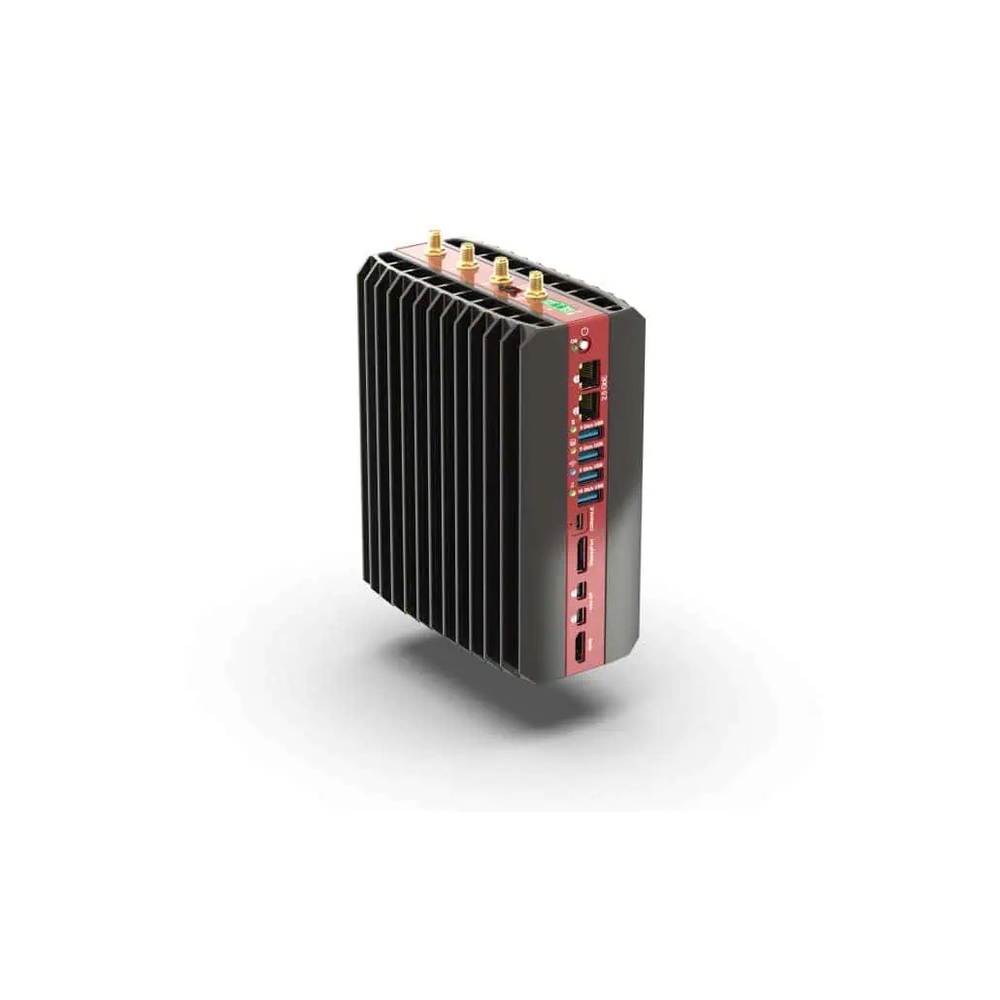
AMD Ryzen Embedded 8845HS DIN Rail Industrial PC with Hailo AI Options and 4x 2.5GbE
- AI
- 16–40 TOPS
- CPU
- AMD Ryzen Embedded 8000
- Ethernet
- 4× 2.5GbE
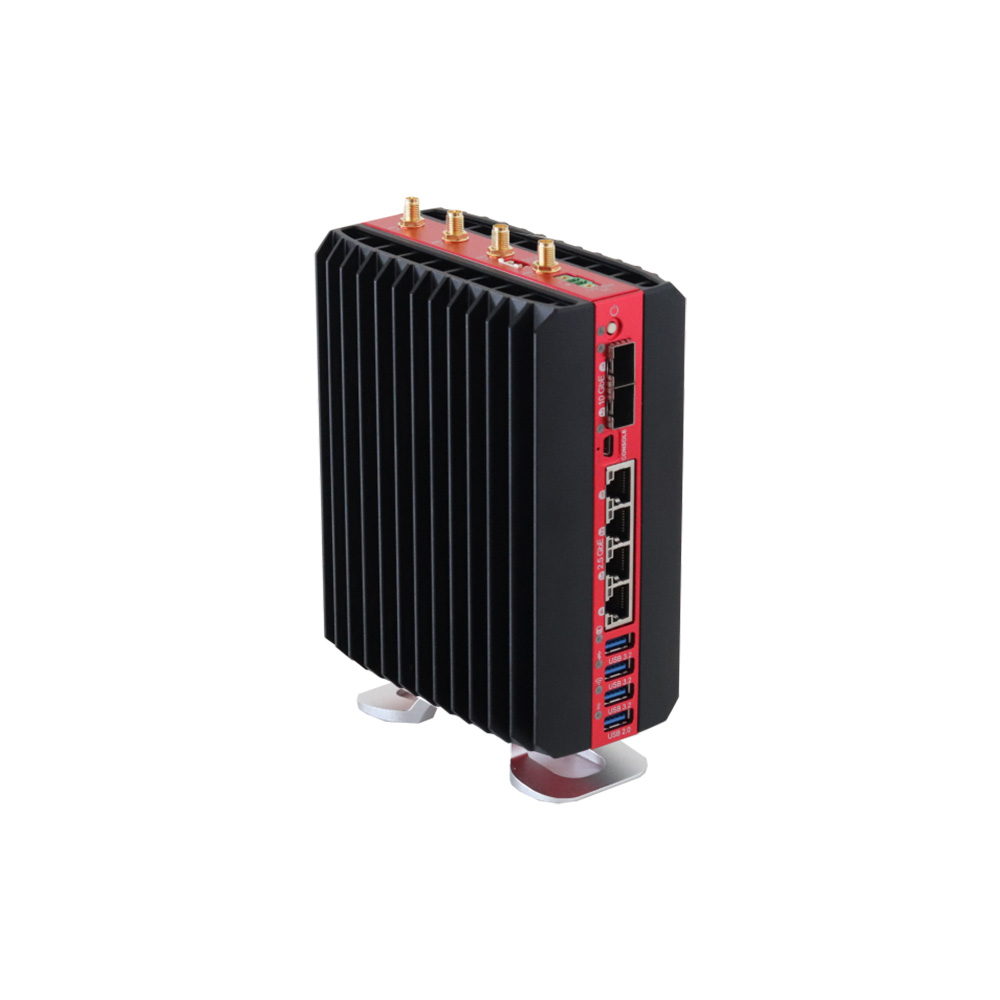
AMD Ryzen Embedded V3C48 Fanless Industrial Edge Computer with Dual 10GbE SFP+ and 4x 2.5GbE
- CPU
- AMD Ryzen V-Series
- Ethernet
- 2× 10GbE, 4× 2.5GbE
- Temp
- −40 to +85 °C
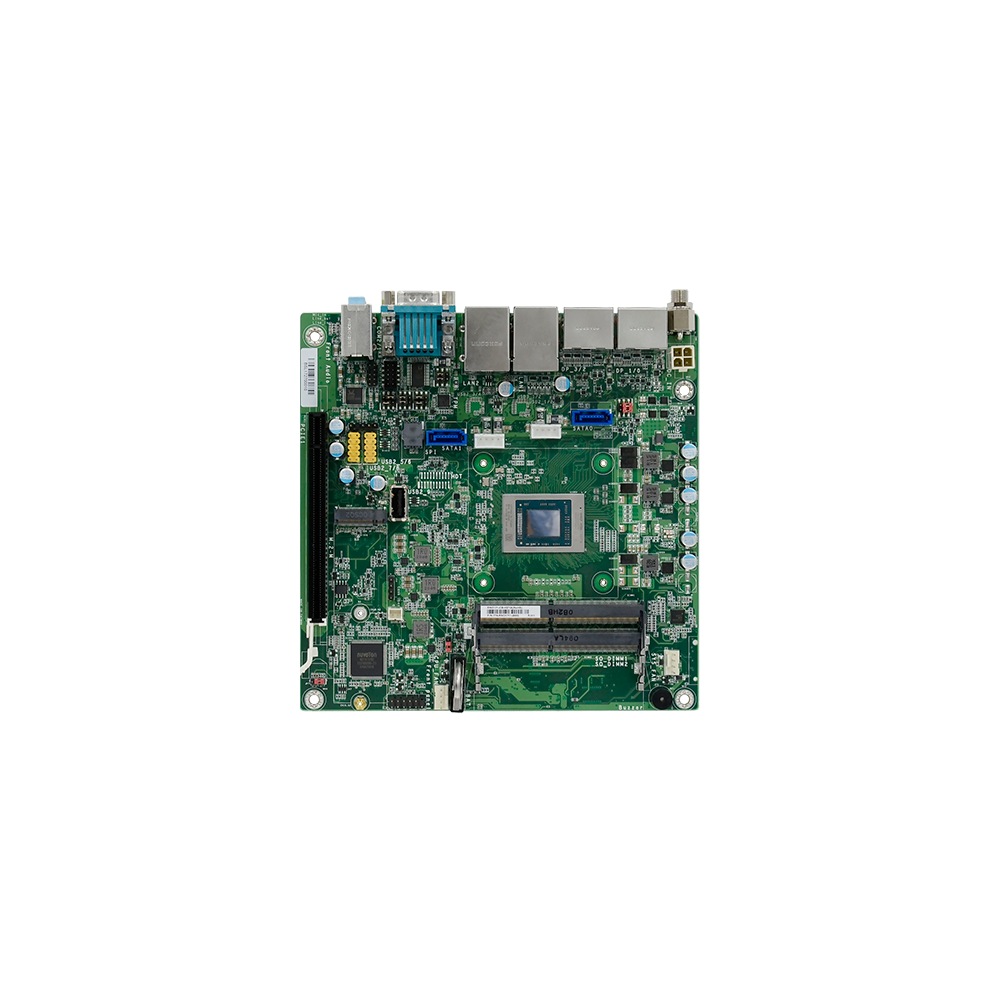
AMD Ryzen Embedded V2718 (V2000 Series) Industrial Mini-ITX Motherboard with Dual GbE and Quad Display
- CPU
- AMD Ryzen V2000
- Ethernet
- 2× GbE
- Temp
- −5 to +65 °C

3.5″ SBC with AMD Ryzen Embedded R2514, Quad Display and Triple GbE
- CPU
- AMD Ryzen R-Series
- Ethernet
- 3× GbE
- Temp
- −5 to +65 °C
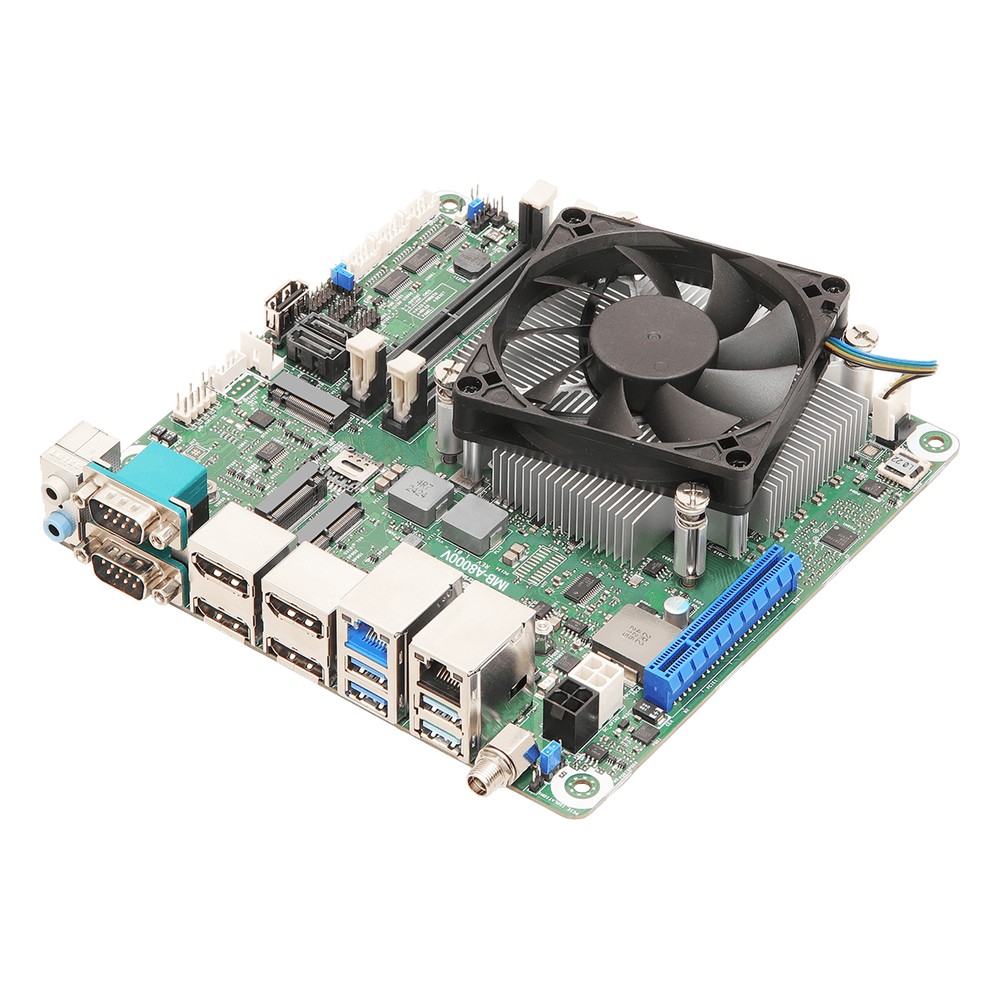
AMD Ryzen 5 8640U Mini-ITX Embedded Board with ECC, Quad Display and 12-28V DC
- AI
- 16 TOPS
- CPU
- AMD Ryzen Embedded 8000
- Ethernet
- 1× 2.5GbE, 1× GbE
Where Ryzen Embedded fits in our range
Ryzen Embedded turns up across our partners’ rugged and edge AI ranges. SolidRun’s BEDROCK R8000 pairs Ryzen Embedded 8000 with optional Hailo accelerators in a fanless DIN rail case; Neousys builds the Ryzen PRO 8640U and its NPU into the POC-900 DIN rail computers; and Sintrones uses the Ryzen Embedded R2312 in IP66 and in-vehicle computers. We configure every system to the job: memory and storage rated for the temperature range, BIOS and power settings for the enclosure, and Windows 11 IoT Enterprise or Linux imaged with your software and tested before it ships.
Choosing a Ryzen Embedded system
Seven questions that point to the right series.
-
01
Workload
Is it light control and gateway work (R-series), multi-display or vision (V-series, 8000) or many cores (5000, 7000, 9000)?
-
02
AI
Does the system need an NPU, so the 8000 series, or an M.2 accelerator on an older part?
-
03
Displays
How many screens, and at what resolution?
-
04
Networking
Is 10GbE needed, which points to V3000?
-
05
Memory
Is ECC required, and how much memory will the application use?
-
06
Form factor
Your own enclosure (SBC or Mini-ITX) or a finished box PC?
-
07
Lifecycle
How long must the build stay the same, and which series has the longest remaining availability?
Ryzen Embedded: common questions
Quick answers
What is AMD Ryzen Embedded?
AMD’s family of x86 processors for industrial and embedded systems. It uses the same Zen cores as consumer Ryzen, with long-term availability, ECC support and embedded packages.
What is the difference between Ryzen and Ryzen Embedded?
Supply and support rather than the cores. Ryzen Embedded has up to ten years of planned availability, ECC on most models and BGA packages for soldering to boards.
Does Ryzen Embedded support ECC?
Yes, on most models. The V1000, V2000, V3000, R-series and 8000 series support ECC memory, subject to the board design.
What is the Ryzen Embedded V3000?
An eight-core Zen 3 series for networking and headless edge systems. It has no integrated graphics but supports DDR5 ECC memory, PCIe 4.0 and dual 10GbE at 10 to 54 W.
How long is Ryzen Embedded available?
Up to ten years from launch. AMD plans long availability for each embedded series; check the remaining time for a specific model before starting a design.
Which Ryzen Embedded has an NPU?
The Ryzen Embedded 8000 series. Its XDNA NPU is rated at 16 TOPS, with up to about 39 TOPS across the whole chip.
Ryzen Embedded FAQs
-
What Is AMD Ryzen AI?
AMD Ryzen AI is AMD’s name for the AI hardware and software in its Ryzen processors. At its centre is an NPU based on AMD’s XDNA architecture, built onto the processor beside the CPU cores and Radeon graphics. In our range, Ryzen 8000-series processors carry a 16 TOPS NPU and Ryzen AI 300-series processors a 50 TOPS NPU.
-
How Many TOPS Does an NPU Need?
There is no single figure: the TOPS an NPU needs depends on the model, image resolution, frame rate and number of camera streams. Check whether a rating is for the NPU alone or the whole platform, since vendors often add CPU and GPU TOPS together. The reliable test is to benchmark your own model on the target processor.
-
iGPU vs dGPU: What Is the Difference?
An iGPU (integrated GPU) is built into the processor and shares the system memory, so it adds little power, heat or cost. A dGPU (discrete GPU) is a separate graphics processor with its own memory, offering far more performance but needing more power, cooling and space. For edge AI, iGPUs suit lighter inference and dGPUs suit heavy workloads.
-
What Is a Motherboard?
A motherboard is the main circuit board in a computer. It carries the processor socket, memory slots, chipset, firmware and power circuitry, and it links storage, expansion cards and every external port so the parts work together as one system.
-
What Is a Motherboard Form Factor?
A motherboard form factor is the standard that fixes a board’s size, mounting holes, rear I/O area and slot positions, so it fits matching cases and power supplies. The main motherboard sizes are ATX, Micro-ATX and Mini-ITX, with smaller embedded sizes such as 3.5-inch, Pico-ITX and PC/104.
-
What Is an Embedded System?
An embedded system is a combination of a processor, memory, input/output and software built into a larger device to do one dedicated job, such as controlling a washing machine, a car’s brakes or a factory machine. Unlike a general-purpose PC, it runs fixed software, often in real time, and is designed around the device it serves.
-
What Is TPM 2.0, and Why Do Industrial PCs Need It?
A TPM, or Trusted Platform Module, is a security chip or processor function that stores encryption keys and records whether a computer started with untampered firmware. TPM 2.0 is the current version. Windows 11 requires it, and it underpins disk encryption, measured boot and device identity on industrial PCs.
Choosing a Ryzen Embedded system?
Tell us the workload, the screens and the environment it will run in. We will recommend the right Ryzen Embedded series and board or system, then configure, image and test it before it ships.