
 US
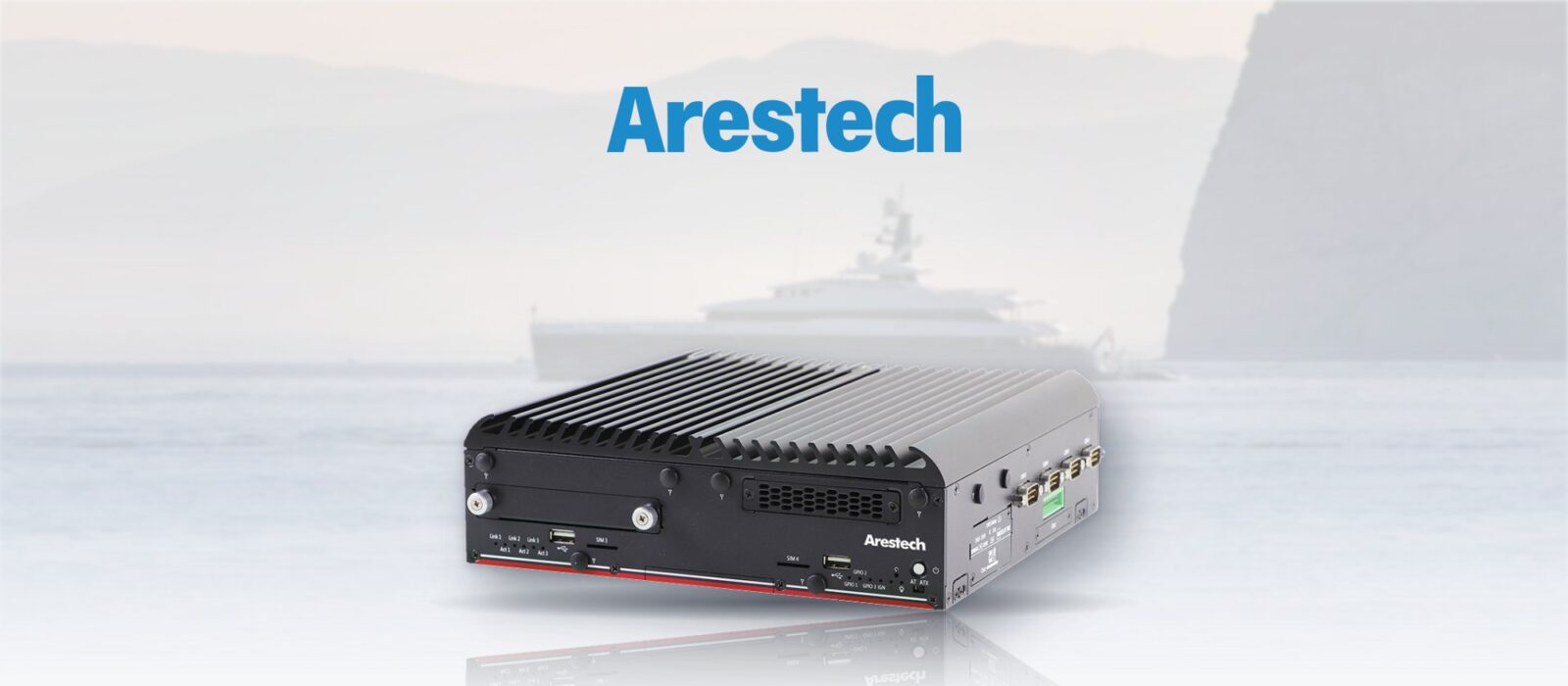
Embedded PC Acts as Intelligent Router with 4 SIM Slots for Fast, Stable and Secure Bonded Cellular Internet
A leading developer of proprietary 4G technology asked us to help it deliver fast, reliable and secure internet on superyachts, cruise ships, research vessels and river cruises. Its product is a bonded cellular router: four 4G connections, from four SIM cards, merged into one fast and stable stream.
The software needed a host: an embedded PC that could take four modems, run 24/7 on board ship and cope with the conditions of a marine equipment cabinet. It is the kind of system we supply for marine computing.
Why bond four connections
- 01More bandwidth
- Four connections carry far more traffic than one, which matters on a yacht with many guests online at once.
- 02Stable in busy ports
- Signal on each SIM fluctuates constantly; merging four keeps the connection reliable, even where local networks are overloaded.
- 03A dedicated IP address
- Traffic leaves from the bonding server with a static, dedicated IP, needed for country-specific streaming services.
- 04Longer reach offshore
- The customer’s product extends cellular coverage up to 60 miles offshore, covering 95% of typical cruising ranges.
Bonding is not load balancing
Many commercial 4G routers with several SIM slots use load balancing, which shares sessions out between the connections. The limitation is that a film stream or a video call still runs over a single SIM, at the mercy of its fluctuating signal. Bonding splits every session across all four connections, so each stream gets the combined bandwidth and keeps going when one link weakens. Our bonding vs load balancing FAQ sets out the difference, and our superyacht internet FAQ shows where cellular fits alongside satellite.
What the embedded PC had to do
The customer's research found few industrial PCs that could meet all of these at once.
-
01
Four modems
Enough expansion slots for four cellular modems running at the same time.
-
02
Four external SIM slots
Most industrial PCs support one or two modems, with SIM slots the limiting factor.
-
03
Fanless and solid-state
No fan or spinning drive to fail in a marine environment with constant movement.
-
04
Heat in a closed cabinet
Reliable operation at higher ambient temperatures with minimal air exchange.
-
05
24/7 operation
Continuous running for guests and crew throughout each voyage.
-
06
Available now
Supply in weeks, not months, while component shortages delayed the existing controller.
The Arestech MERA‑3100
The fanless embedded PC chosen as the host, with four expansion slots and four external SIM card slots.

MERA‑3100‑3L
8th/9th Gen Intel Core Extended Temperature Fanless Industrial PC with 3x GbE
- Processor
- Intel Core 9th Gen (Coffee Lake)
- Networking
- 3× GbE
- Operating temp
- −40 to +70 °C
- Power Input
- 9–48 V DC Input [Terminal Block]
- Memory
- 2× DDR4-2666 SO-DIMM, up to 64 GB
Why the MERA-3100 was selected
- 014 modems, 4 external SIMs
- One of the few fanless embedded PCs with four expansion slots and four externally accessible SIM slots; see our multi-SIM router FAQ.
- 029th Gen Intel Core i3
- A 35 W processor with the headroom to run the bonding software across four connections.
- 03−40 to 70 °C, passive cooling
- Heat sink cooling handles the higher temperatures inside a cabinet with little airflow.
- 04No moving parts
- Without a fan or hard drive, the PC resists the shock and vibration of life at sea.
- 05Stock on hand
- Arestech’s commitment to holding stock supported the project from the outset.
Hosting four modems in one fanless PC comes down to expansion slots and SIM access; our industrial cellular computer guide explains how 4G, LTE and 5G modems are built into a system, and our maritime computing guide covers the standards for equipment on board ship.
Hit by component shortages during the COVID-19 pandemic, supply of our existing embedded controller was pushed out beyond 30 weeks. Finding an embedded PC with enough expansion to host multiple SIM cards was proving difficult, but Things Embedded delivered not just the right solution: we had a test system at our door in under one week.
What the project delivered
The right host PC kept the customer's product shipping through a global shortage.
-
Outcome 01
Test system in under a week
Against a 30-week wait for the existing controller.
-
Outcome 02
Four bonded connections
Four modems and four SIMs in one fanless PC, running the customer's bonding technology.
-
Outcome 03
Built for the cabinet
Passive cooling and solid-state storage for 24/7 use in warm, enclosed spaces at sea.
-
Outcome 04
A path to 5G
The project opened talks on a custom-branded 5G router.
Looking ahead to 5G
With the hardware sourced at short notice, the conversation turned to what comes next, and the answer was 5G. We discussed a custom-branded version for the customer’s future product, with its own livery and logo, I/O labeling, serial numbers and part codes. Our guide to 5G at the edge covers what the move brings.
5G brings real advantages for users of our hardware. Its higher bandwidth suits our customer’s requirement to serve data-hungry users in parallel without affecting internet speed or connection quality.
Bonded cellular FAQs
-
What Is Cellular Bonding?
Cellular bonding combines several mobile connections, usually from different SIM cards and networks, into one faster and more reliable link. Traffic is split across all the connections and put back together by a bonding server, so even a single video call or upload uses the combined bandwidth and keeps going if one connection weakens or drops.
-
Cellular Bonding vs Load Balancing: What Is the Difference?
A load balancing router spreads separate sessions across several connections, but each session, such as a video call, still runs over just one of them. Bonding splits every session across all the connections and reassembles it at a server, so a single stream gets the combined bandwidth and survives one link dropping. Load balancing needs no server; bonding does.
-
What Is a Multi-SIM Router?
A multi-SIM router is a cellular router with two or more SIM card slots. In its simplest form, one modem switches to a backup SIM when the first fails. Routers with a modem per SIM can use every connection at once, for load balancing or bonding, which is what high-bandwidth, always-on applications need.
-
How Do Superyachts Get Internet at Sea?
Superyachts combine cellular and satellite connections. Near the coast and in port, 4G and 5G through high-gain marine antennas give fast internet, and bonding several SIMs keeps it reliable. Further offshore, satellite services take over, increasingly low Earth orbit (LEO) systems, with the onboard system switching between links to keep guests and crew connected.
Need an embedded PC with multiple modems?
Tell us about your application and a member of our team will get right back to you.