
 US
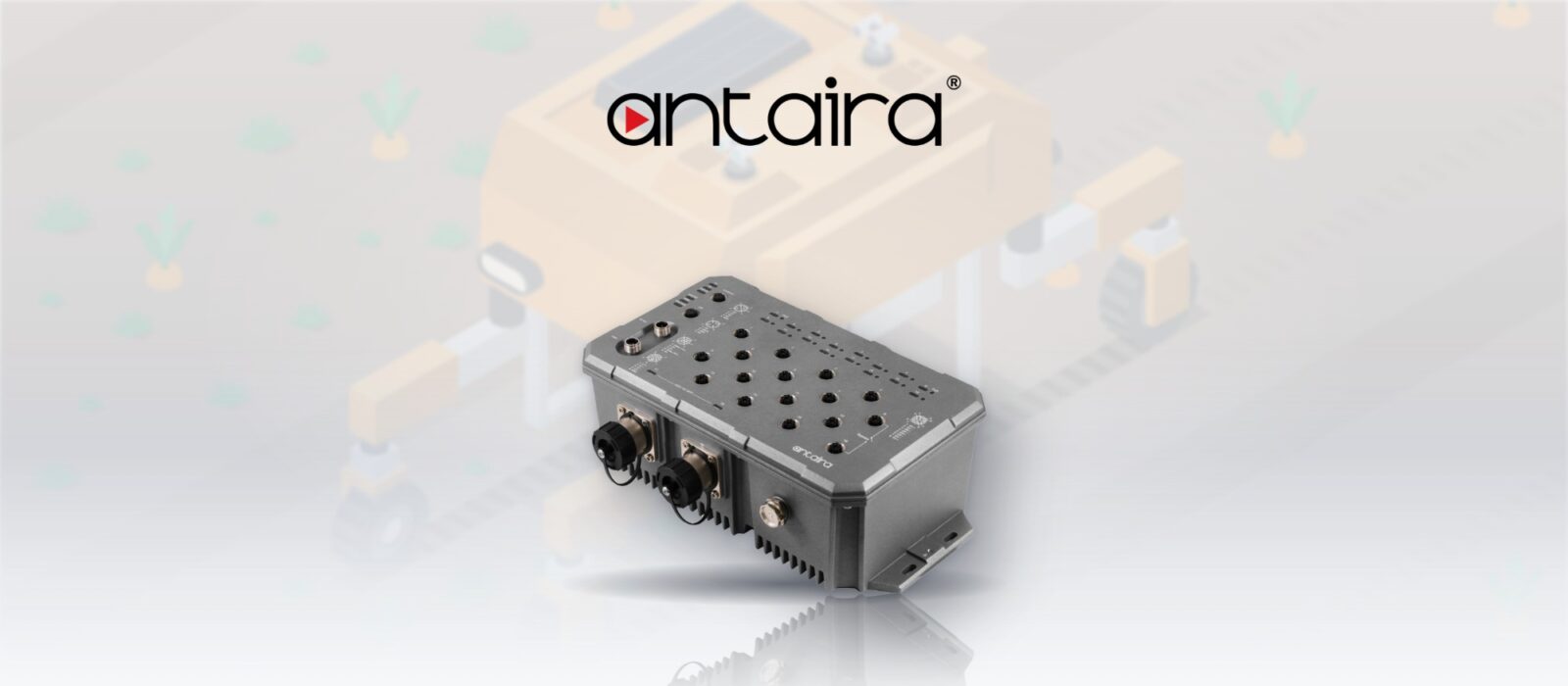
Spot Spraying For Sustainable Agriculture Powered by AGX Orin & GigE Cameras
A USA manufacturer builds autonomous platforms that use rugged AGX Orin computers and GigE cameras to spot and eliminate weeds in real time.
A USA company that designs and manufactures autonomous platforms for farming came to us with a working concept and a problem: its code ran well in development but kept failing once the hardware went out into the field. The platforms automate field maintenance for precision agriculture, finding weeds and treating them individually, so a farmer uses far less chemical than spraying the whole field.
The system pairs high-speed GigE vision cameras with AI running on NVIDIA Jetson AGX Orin, deciding plant by plant whether it is looking at a weed and triggering the sprayer in the moment it passes. We supplied the rugged edge computer and the sealed network that connects it to the cameras. It is the kind of system we build for agriculture.
Why the hardware kept failing in the field
A spot sprayer works in some of the harshest conditions any computer sees. It runs all day over ploughed ground, taking constant shock and vibration, in dust, spray drift and rain, and it is washed down at the end of each shift.
The first build used commercial network switches, mounted inside cabinets to protect them from the weather. The cabinets were not enough: dust and water still found their way in, and the switches could not take the 24/7 vibration of bumpy terrain. Every failure meant a stopped machine and a lost day of work in a short spraying window.
What the platform needed
Every part of the vision chain, from camera to computer, had to survive life on the machine.
-
01
AI fast enough for 15 mph
Each weed has to be detected and classified in the time it takes to pass under the boom.
-
02
Bandwidth for many cameras
Several high-speed GigE cameras streaming at once need a 10G link back to the computer.
-
03
Power over the camera cable
PoE+ keeps wiring down to one cable per camera along the boom.
-
04
Sealed against dust and water
Hardware mounted on the machine itself, with no cabinet, and able to be washed down.
-
05
Locking connectors
Screw-locking M12 connectors that hold their connection through constant vibration.
-
06
Vehicle power
A wide DC input with ignition control, so the system starts and shuts down with the platform.
From camera to nozzle in real time
Every plant the platform passes goes through the same four steps in a fraction of a second.
-
Capture
GigE camerasGigE Vision cameras along the boom capture the ground continuously as the platform moves, powered by PoE+ over the same cable that carries their images.
-
Aggregate
IP67 M12 switchA sealed Antaira M12 switch collects every camera stream on PoE+ ports and passes them to the computer over a 10G uplink.
-
Detect
Jetson AGX OrinThe Sintrones IBOX-650P-IP66 runs the AI model on the Jetson AGX Orin, telling weeds from crop or soil for each frame.
-
Spray
Targeted nozzlesWhen a weed is found, the system fires the nozzle above it, so herbicide lands only on the target. This is precision spraying.
Green-on-brown and green-on-green
The platform records images as it works, so the models keep improving and can be adapted to new crops and conditions. That supports both green-on-brown spraying, finding weeds on bare soil, and the harder green-on-green task of picking out weeds growing among the crop, one of the clearest examples of AI in agriculture.
At 15 mph, shutter type and timing both affect where each weed appears in the frame. Our global vs rolling shutter guide explains how each handles moving scenes, and our IEEE 1588 PTP explainer shows how camera clocks are kept in step to sub-microsecond accuracy.
The IBOX‑650P-IP66 edge computer
The LE builds of Sintrones' sealed Jetson AGX Orin computer take camera streams over Ethernet, in 64 GB and 32 GB versions.
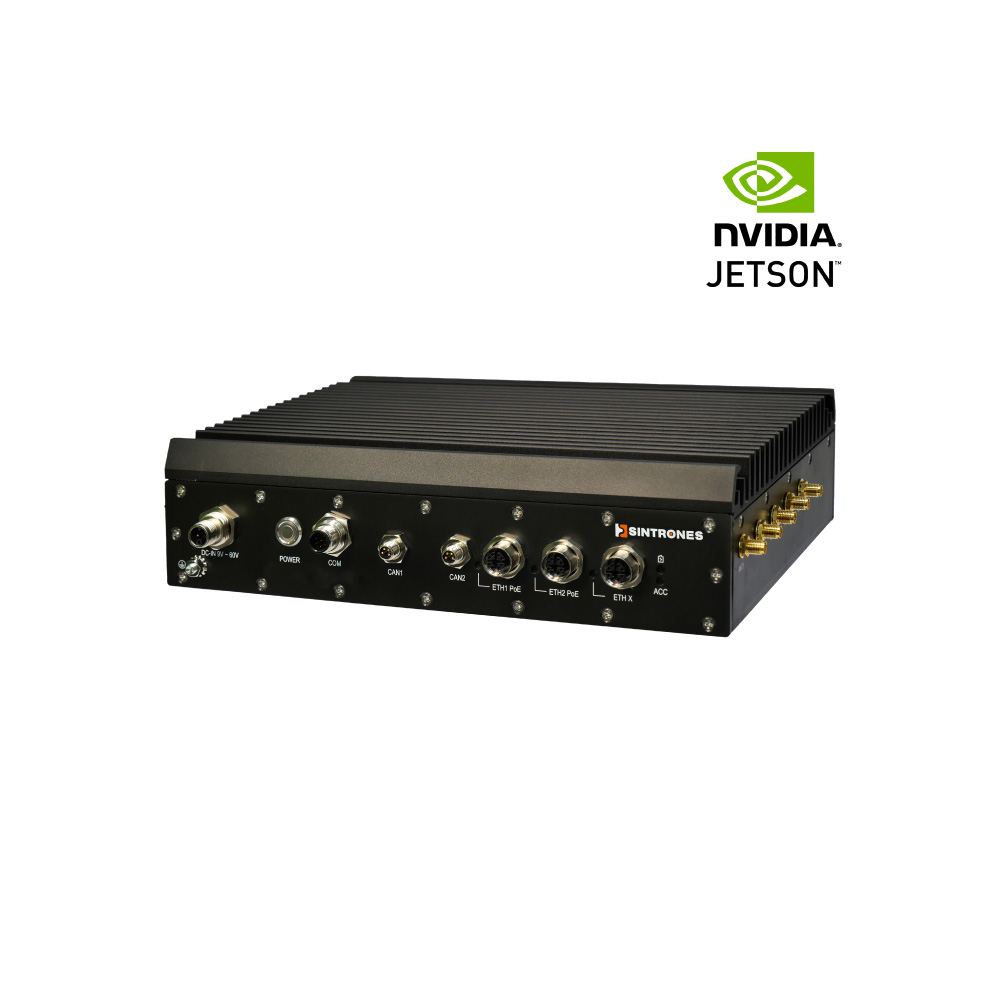
NVIDIA Jetson AGX Orin 64GB IP66 Outdoor PC with 10GbE and PoE
- AI
- 275 TOPS
- SOM
- NVIDIA Jetson AGX Orin 64 GB
- Ethernet
- 1× 10GbE, 2× 2.5GbE (2× PoE)
NVIDIA Jetson AGX Orin 32GB IP66 Outdoor PC with 10GbE and PoE
- AI
- 200 TOPS
- SOM
- NVIDIA Jetson AGX Orin 32 GB
- Ethernet
- 1× 10GbE, 2× 2.5GbE (2× PoE)
Why the IBOX-650P-IP66 fitted the machine
- 01Up to 275 TOPS
- The Jetson AGX Orin 64 GB module runs detection models on every frame at working speed, with the 32 GB build for lighter models.
- 0210GbE and 2× PoE+ on M12
- A 10GbE port takes the uplink from the camera switch, and two 2.5GbE PoE+ ports power extra cameras or sensors, all on screw-locking X-coded M12 connectors.
- 03IP66, fanless
- A sealed fanless enclosure keeps out dust and water jets, so the computer mounts on the platform without a cabinet.
- 04−25 to 70 °C, MIL-STD-810H
- Rated for heat and cold and tested for the vibration and shock of working over rough ground.
- 059–60 V DC with ignition detection
- Runs from the platform’s own supply, with surge and reverse-polarity protection, and powers up and down with the vehicle.
Taking the switch out of the cabinet
The answer to the switch failures was Antaira’s LMP-1802G-M12-10G family, built to live outside. Its IP67 metal housing is waterproof and dustproof, and every port uses an M12 connector that stays locked through vibration. The switch no longer needed a cabinet at all: it now mounts on the outside of the platform and is washed down with the rest of the machine at the end of the day.
| Factor | Commercial switch in a cabinet | Antaira LMP-1802G-M12-10G |
|---|---|---|
| Dust and water | Relied on the cabinet; ingress still caused failures | IP67 sealed housing, mounted outside |
| Connectors | RJ45, prone to working loose | Screw-locking X-coded M12 |
| Camera power | Separate supplies | 16× PoE+ from a 240 W budget |
| Uplink | Limited | 2× 10G SFP+ |
| Wash-down | Not possible | Washed down with the machine |
PoE scheduling and per-port output limits let the team set how long each port supplies power and how much, saving energy and prioritizing critical cameras. Planning the power across many cameras matters; our PoE power budgeting guide shows how to size it.
The Antaira M12 switch
The 24–55 V DC build, with a −40 to 70 °C version for the coldest and hottest conditions.
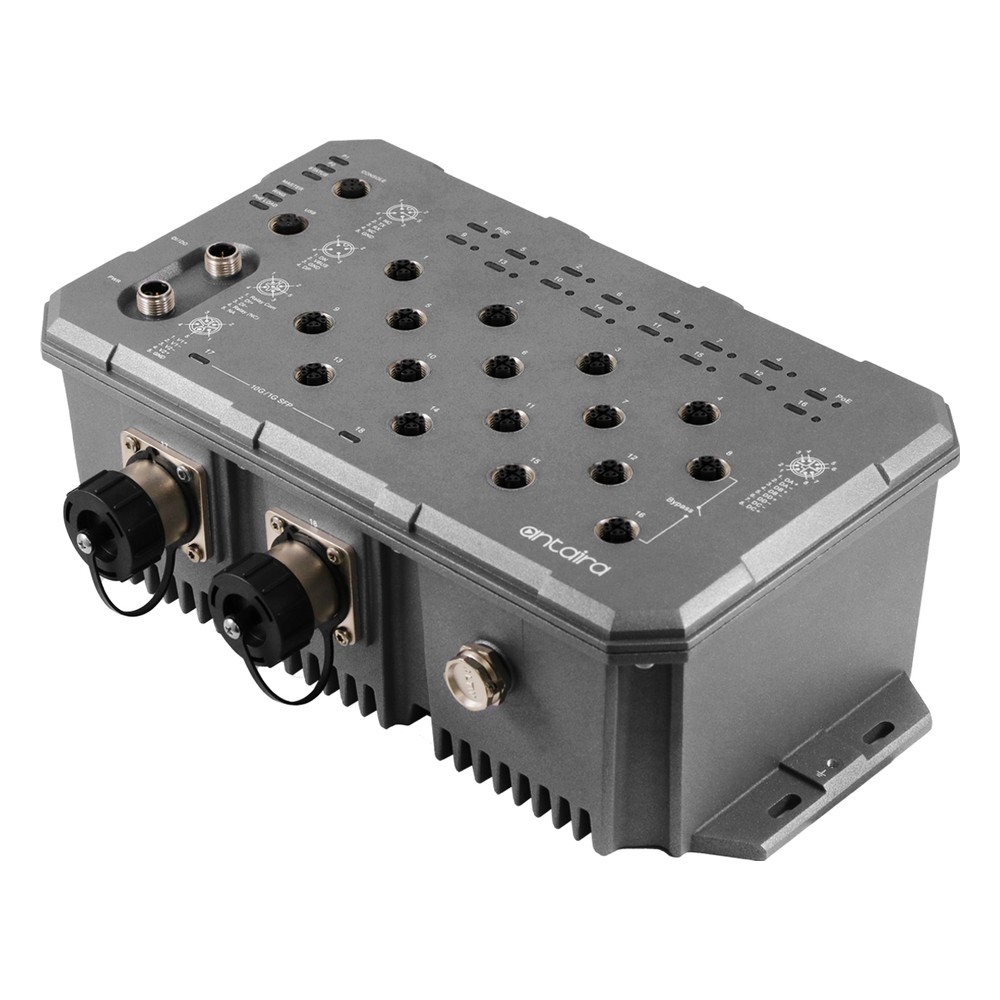
18-Port 10G Managed M12 Ethernet Switch with 16x PoE+ (240W), 2x 10G SFP+, IP67 and 24-55V DC Input
- IP Rating
- IP67
- Temp
- −10 to +65 °C
- Power
- 24–55 V DC [M12]
18-Port 10G Managed M12 Ethernet Switch with 16x PoE+, 2x 10G SFP+, 24-55V DC Input and -40 to 70 °C
- IP Rating
- IP67
- Temp
- −40 to +70 °C
- Power
- 24–55 V DC [M12]
What changed in the field
With a sealed vision chain from camera to computer, the platform's code finally ran in the field the way it did on the bench.
-
Outcome 01
Field failures eliminated
Sealed, vibration-tested hardware replaced the commercial kit that had been failing on the machine.
-
Outcome 02
Real-time detection at 15 mph
AI on Jetson AGX Orin identifies weeds fast enough to spray each one while the platform keeps moving.
-
Outcome 03
No more cabinets
The IP67 switch mounts outside the platform and is washed down with the machine at the end of the day.
-
Outcome 04
Models that keep improving
Recorded images retrain the AI for new crops and both green-on-brown and green-on-green spraying.
Precision spraying FAQs
-
What Is Precision Spraying?
Precision spraying applies herbicide or pesticide only where it is needed, instead of covering the whole field. Cameras on the sprayer boom capture the ground as the machine moves, a computer identifies weeds in real time, and individual nozzles fire on each target. It is also called spot spraying or targeted spraying.
-
What Is a GigE Vision Camera?
A GigE Vision camera is an industrial camera that sends images and takes commands over standard Ethernet, following the GigE Vision interface standard. It runs over long, low-cost network cables, can be powered by PoE, and lets many cameras share one network through a switch, which makes it a common choice for machine vision on lines and vehicles.
-
How Is AI Used in Agriculture?
AI in agriculture uses machine learning on images and sensor data to make farming decisions faster and more precisely. Common uses include detecting and spraying weeds, steering autonomous tractors, monitoring crop and livestock health, forecasting yields, and sorting and grading produce, often running on rugged edge computers mounted on the machines themselves.
-
What Is Precision Agriculture?
Precision agriculture is a way of farming that uses GPS, sensors, cameras and data to manage each part of a field according to what it needs, rather than treating the whole field the same. Water, fertiliser, seed and chemicals go where they will do the most good, which raises yields and cuts waste.
-
What Is an M12 X-Coded Connector?
An M12 X-coded connector is the 8-pin M12 coding for Gigabit and 10 Gigabit Ethernet. Its four twisted pairs are separated by a cross-shaped shield that controls crosstalk at high speed, and it can carry Power over Ethernet with a suitable cable. It is defined in IEC 61076-2-109.
-
What does IP66 mean?
IP66 is the rating above IP65 — dust-tight, and protected against powerful water jets. It is the standard specification for outdoor industrial computing in storm-exposed locations, marine deck equipment and light wash-down food handling, equivalent to NEMA 4 / 4X in North American markets.
-
What does IP67 mean?
IP67 means an enclosure is dust-tight and protected against temporary submersion in water up to 1 meter deep for 30 minutes. It is the standard rating for field-deployed equipment that might be briefly immersed — agricultural sensors, military field hardware, marine bilge installations — equivalent to NEMA 6 in North American markets.
-
What is 10GbE networking?
10GbE (10 Gigabit Ethernet) is a networking standard that carries data at 10 gigabits per second, four times faster than 2.5GbE. Defined in the IEEE 802.3 family, it runs over SFP+ fiber or copper and over Cat6A twisted pair, and is increasingly the baseline for edge AI systems handling high-resolution video and multi-sensor data.
Building an autonomous agriculture platform?
Tell us about your machine vision pipeline and field environment, and we will spec a rugged AGX Orin platform with the camera interfaces and networking to match.