
 UK
Monitoring Station Activity with AI Enabled Smart Surveillance NVRs
A compact AI NVR built on the Jetson AGX Orin brings facial recognition and virtual fencing to a busy metro station surveillance.
Rail services around the world carry more passengers than their stations were designed for. Security teams have to manage the crowds safely, stop people travelling without a ticket and spot suspicious or restricted individuals, and they need to know about unusual activity as it happens.
A metro station in Florida was relying on an outdated security platform, with operators watching banks of screens in a control room. Monitoring live activity was hard work, and finding and handing over evidence to the local police took hours. The station turned to an AI NVR to change that. It is the kind of system we supply for surveillance and rail.
Footage that would previously have taken me hours to find, record and share now takes me a few minutes. The AI NVR provided by Things Embedded is very convenient and provides meaningful insights from our security camera footage for passing on to the relevant authorities.
What the AI NVR watches for
- 01Virtual fencing
- Monitors everyone passing through a defined area or virtual barrier, alerting if someone goes through a ticket barrier the wrong way.
- 02Facial recognition
- Checks a fast-moving crowd against a managed watchlist of people of interest.
- 03Object detection
- Flags recognised objects, such as a skateboard in a busy area, so operators can verify and respond.
- 04Behavioural analysis
- Trained to spot potentially dangerous behaviour and raise an alert.
- 05Occupancy counting
- Cameras at entrances and exits keep a running total of people in the station.
From camera to guard's phone
Security staff no longer need to sit in front of screens to know what is happening.
-
Capture
8 PoE camerasIP cameras take power and data from the NVR over single cables.
-
Analyse
At the NVRAI on the NVR analyses every stream in real time, even if the network or cloud connection drops.
-
Alert
MobileAlerts go to guards’ mobile devices, so they can be on the floor and respond faster.
-
Share
EvidenceFlagged recordings are backed up to the cloud and found in minutes for the police.
The EverFocus eNVP-JAO-AI-V0008
A fanless Jetson AGX Orin AI NVR with eight PoE camera ports and 10GbE.
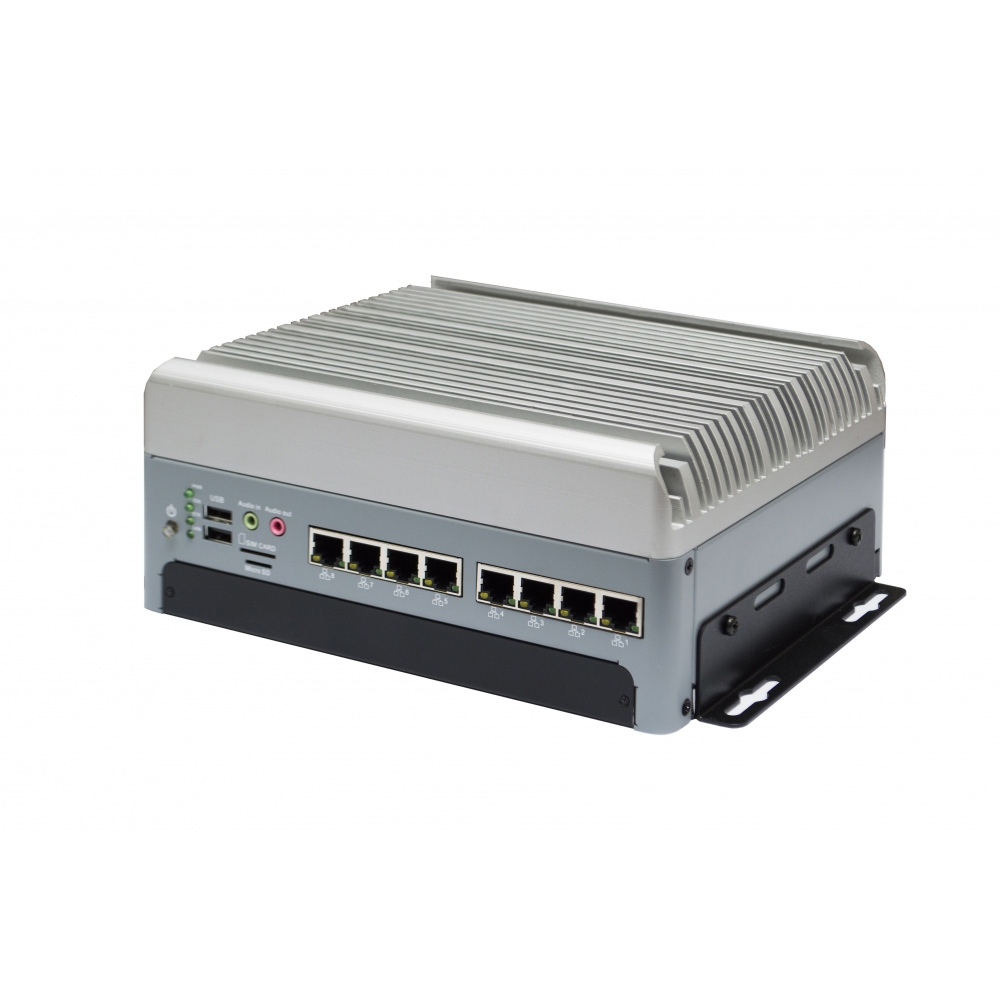
eNVP‑JAO‑AI‑V0008
NVIDIA Jetson AGX Orin 32GB/64GB Industrial AI Computer with 8x PoE and 10GbE
- AI accelerator
- 200–275 TOPS
- NVIDIA Jetson SOM
- NVIDIA Jetson AGX Orin 64 GB
- Networking
- 1× 10GbE, 9× GbE (8× PoE)
- Operating temp
- −20 to +60 °C
- Power Input
- 9–55 V DC Input [Terminal Block]
Why the eNVP-JAO-AI-V0008 was selected
- 01Jetson AGX Orin 64GB
- Up to 275 TOPS runs modern surveillance analytics in a compact, fanless recorder.
- 028 channels at 1080p60
- With the DeepStream SDK it decodes and analyses eight 1080p60 IP camera feeds at once.
- 03Eight PoE ports
- Power and data for each camera over one cable, with each port able to reboot its camera remotely if it fails.
- 04Storage for recording
- Two SATA bays and an NVMe slot keep recording locally if the cloud link goes down.
- 0510GbE uplink
- Fast connection to the station network and video management system.
Each camera takes power and data from the recorder over one cable; our PoE surveillance guide walks through how cameras, ports and the NVR are wired, and our NVR vs DVR FAQ explains why IP recording suits a system like this. Where recorders ride on the trains rather than in the station, our EN 50155 summary sets out the rolling stock requirements.
With testing and approval complete, future NVRs are built to a fixed bill of materials, with additional storage and the JetPack SDK and surveillance software pre-installed, ready to roll out.
What changed for station security
AI at the recorder turned hours of footage review into minutes.
-
Outcome 01
Evidence in minutes
Footage that took hours to find, record and share now takes a few minutes.
-
Outcome 02
Guards on the floor
Mobile alerts free staff from the control room to respond faster.
-
Outcome 03
Live awareness
Virtual fencing, watchlists and behaviour alerts flag issues as they happen.
-
Outcome 04
Resilient recording
Analytics and recording carry on at the station if the cloud connection drops.
AI NVR FAQs
-
What Is ONVIF?
ONVIF is an open industry standard that lets IP cameras, network video recorders and video management software from different manufacturers work together. A camera and an NVR that support the same ONVIF profile can find each other on the network, share live video and recordings, and exchange settings without a custom driver for each brand.
-
What Is an NVR?
An NVR (network video recorder) is a recorder that receives video streams from IP cameras over a network, stores them, and lets users watch live and recorded footage locally or remotely. PoE NVRs also power the cameras. An AI NVR adds a GPU or AI accelerator so it can analyse the video, detecting people, objects and events as it records.
-
NVR vs DVR: What Is the Difference?
A DVR (digital video recorder) records analogue cameras connected by coaxial cable, converting their video to digital inside the recorder. An NVR (network video recorder) records IP cameras over a network, with each camera encoding its own video. NVRs support higher resolutions and flexible camera placement, and PoE NVRs power cameras over the same cable.
-
What Is People Counting?
People counting uses sensors, most often overhead cameras with AI, to count how many people pass through entrances and exits. Subtracting exits from entrances gives live occupancy, so operators know how busy a space is at any moment. Stations, shops, offices and venues use it for safety limits, staffing and planning.
-
What Is a Virtual Fence in Video Analytics?
In video analytics, a virtual fence is a line or zone drawn on a camera’s view that raises an alert when a person or vehicle crosses or enters it. It is also called line crossing detection or a tripwire. It can watch one direction only, and AI classification means it reacts to people and vehicles, not shadows or rain.
-
What Is Video Analytics?
Video analytics is software that analyses video automatically to detect, classify and track people, vehicles and events, so operators do not have to watch every screen. Modern systems use AI models and often run at the edge, on a computer beside the cameras, to react in real time and avoid sending every stream to the cloud.
Looking to upgrade your network video recorder?
Tell us your camera count and analytics needs and we will spec an AI NVR built on the right Jetson platform.