
 UK
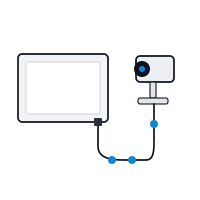
Four PoE+ cameras from one computer
Four Intel I350 GbE ports supply 802.3at PoE+, so the side and rear cameras take power and data over one cable each, with no separate switch or camera power supply to fit.
Your Quote List ()
A refuse collection vehicle stops at every property on its round, and its lifting arm or bin lift has to meet each wheeled bin at the right height and distance while the crew works close by.
Cameras with a light AI model can take some of that judgement off the operator, by finding the bin in the image and estimating where it sits relative to the arm. Here the model runs on the Neousys POC-751VTC, a fanless rugged PC for vehicles that powers four cameras directly and runs inference on its integrated graphics with OpenVINO.
One compact computer in the cab handles the cameras, the AI model and the vehicle interfaces.
Four Intel I350 GbE ports supply 802.3at PoE+, so the side and rear cameras take power and data over one cable each, with no separate switch or camera power supply to fit.

The eight-core Intel Core i3-N305 has 32-EU Intel UHD Graphics, which supports OpenVINO for light AI on board. A compact detection model suits it well, with no discrete GPU to power or cool.

Two isolated CAN 2.0 ports with SocketCAN support in Linux connect to the vehicle bus, and 8-channel isolated DI and DO handle arm sensors, alarms and indicators. Built-in ignition control starts and shuts the computer down with the truck.

The POC-751VTC is E-Mark certified, which our E-Mark guide explains, and is tested to IEC 61373 Category I Class B for vibration and shock. It runs fanless from −40 to 70 °C.

We install the operating system and OpenVINO runtime, fit the SSD and a 4G or 5G module in a mini PCIe socket, set the BIOS for ignition power-on and prepare the cabling to match the vehicle, so the computer goes into the cab ready to load the detection model.
Two Core i3-N305 computers with four PoE+ ports: one for vehicle control, one for recording.
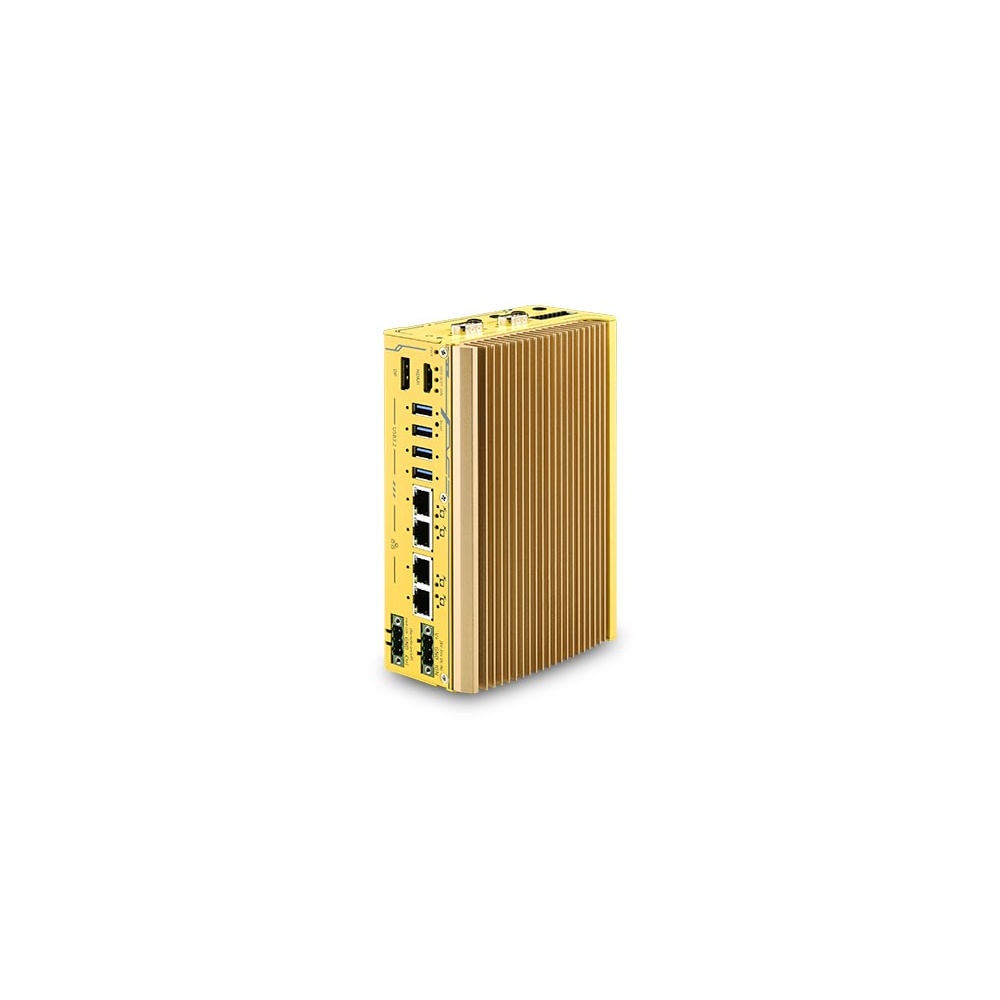
Intel Core i3-N305 Ultra-Compact In-Vehicle Computer with 4x PoE+
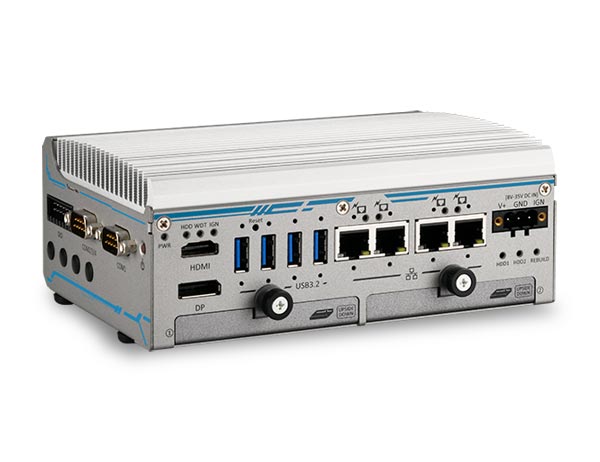
Intel Core i3-N305 Fanless Surveillance PC with 4x PoE+ and RAID 0/1 SSD Bays
The POC-751VTC is the vehicle-control choice, with CAN, more isolated I/O and E-Mark. Where keeping camera footage matters as much as detection, the POC-764VR adds hardware RAID across two 2.5″ SSDs, so a failed drive does not take the recording with it. It has a narrower fanless temperature range and no onboard CAN, so it suits a cab installation with a CAN module fitted if needed.
| Specification | Neousys POC-751VTC | Neousys POC-764VR |
|---|---|---|
| Processor | Intel Core i3-N305, 8 cores, OpenVINO support | Intel Core i3-N305, 8 cores, OpenVINO support |
| Camera ports | 4× GbE PoE+ | 4× GbE PoE+ (locking RJ45), plus 1× 2.5GbE |
| Storage | 1× M.2 2280 SATA | 2× 2.5″ SSD with RAID 0/1, plus 1× M.2 2280 NVMe or SATA |
| Vehicle I/O | 2× isolated CAN 2.0, 8-channel isolated DI and DO | 4-channel isolated DI and DO; CAN via mini PCIe |
| Wireless | 2× mini PCIe for Wi-Fi, 4G or 5G | 2× mini PCIe for Wi-Fi, LTE or 5G |
| Power | 8–35 V DC, ignition control | 8–35 V DC, ignition control |
| Operating temperature | −40 to 70 °C, fanless | −10 to 55 °C fanless; to 70 °C with the optional fan kit |
| Approvals | E-Mark, EN 50121, IEC 61373 | MIL-STD-810H vibration and shock |
Both are part of our in-vehicle computers range, alongside larger GPU systems for heavier models.
A bin lift is the hydraulic mechanism at the back of a refuse collection vehicle that lifts a wheeled bin, tips it into the hopper and lowers it back to the ground. The crew positions each bin and works the controls, and cameras and sensors can help the lift meet the bin at the right height and distance.
SocketCAN is the CAN bus support built into the Linux kernel. It treats each CAN interface as a network device, so software can send and receive CAN messages through standard sockets, and common tools such as candump and cansend work with any supported CAN adapter or onboard CAN port.
OpenVINO is Intel’s open-source toolkit for optimising and running AI inference. It takes models trained in frameworks such as PyTorch, TensorFlow or ONNX, optimises them, and runs them efficiently on Intel hardware, including CPUs, integrated GPUs such as Iris Xe and Arc, discrete Arc GPUs and the NPUs in Core Ultra processors.
PoE, PoE+ and PoE++ are the three generations of IEEE Power over Ethernet. PoE (802.3af) supplies about 15 W per port, PoE+ (802.3at) about 30 W, and PoE++ (802.3bt) 60 W (Type 3) or 90 W (Type 4). PoE and PoE+ use two of the four cable pairs; PoE++ can use all four.
An iGPU (integrated GPU) is built into the processor and shares the system memory, so it adds little power, heat or cost. A dGPU (discrete GPU) is a separate graphics processor with its own memory, offering far more performance but needing more power, cooling and space. For edge AI, iGPUs suit lighter inference and dGPUs suit heavy workloads.
CAN bus (Controller Area Network) is a two-wire network that lets controllers, sensors and actuators share short messages without a central computer. Developed by Bosch for vehicles, it uses a noise-resistant differential signal and gives every message a priority, so critical data gets through first. It is now standard in vehicles, machinery and remote equipment.
An NVR (network video recorder) is a recorder that receives video streams from IP cameras over a network, stores them, and lets users watch live and recorded footage locally or remotely. PoE NVRs also power the cameras. An AI NVR adds a GPU or AI accelerator so it can analyse the video, detecting people, objects and events as it records.
Tell us the cameras, the vehicle signals and the software you plan to run. We configure the computer, storage and modem to suit the vehicle.