Case Study
Sealed M12 Switch Takes Over From Cabinet Switches
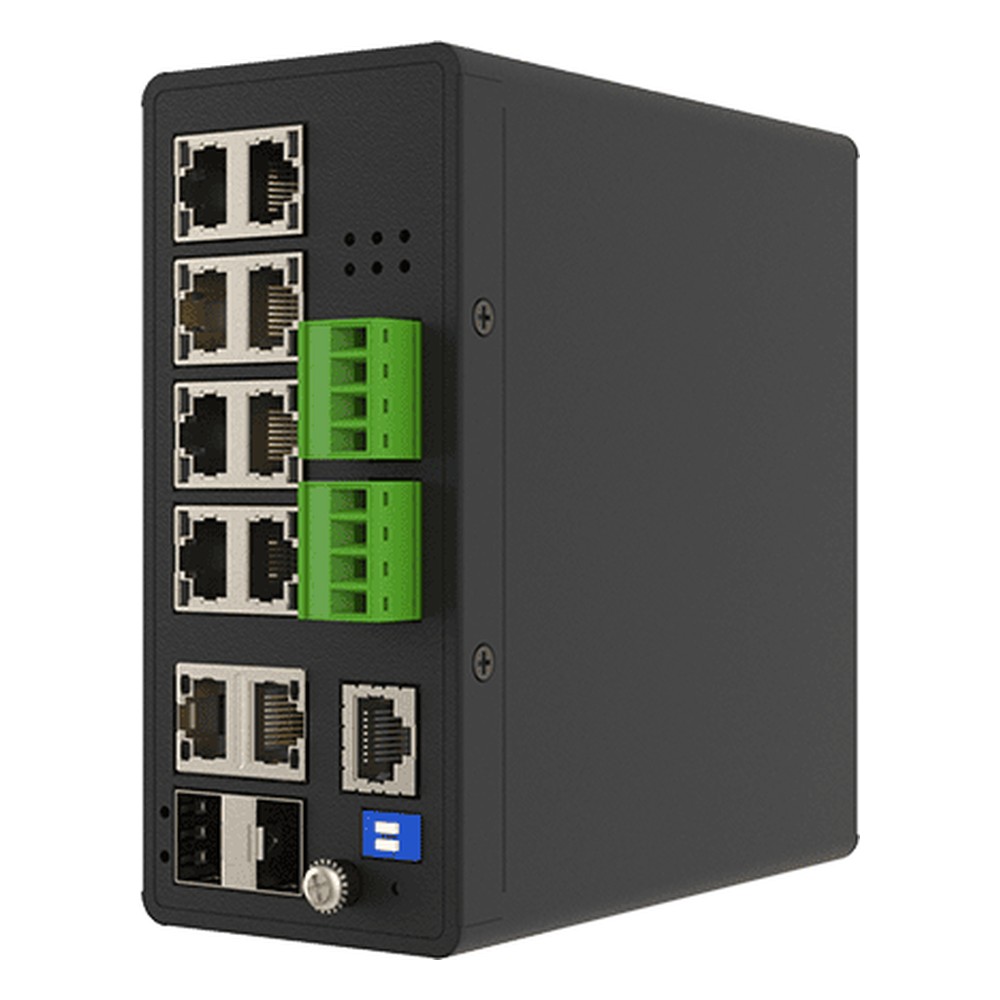
A UK farm robot maker replaced failing commercial switches in cabinets with an IP67 Antaira M12 switch that powers GigE cameras over PoE+ and is washed down with the machine.
White Paper
Managed vs Unmanaged Industrial Ethernet Switch Guide
When a plug-and-play industrial switch is enough for the cabinet, and when VLANs, QoS, ring redundancy and remote monitoring justify management.
White Paper
Layer 3 Routing on Industrial Network Switches
Why segmented plant networks route between VLANs on a Layer 3 industrial switch at the edge instead of hairpinning traffic to a central router.
White Paper
TSN for Industrial Ethernet: Deterministic Control Traffic
How time-sensitive networking lets motion, vision and plant data share one industrial network with bounded latency, when every switch supports it.
White Paper
Rugged Industrial Switches: Speeds, Connectors and Types
Fast, Gigabit and 10 Gigabit industrial Ethernet switches compared, with RJ45, M12 and latching connectors for dust, water and vibration.
White Paper
10GbE for Industrial Edge AI: What Changes From 2.5GbE
Why camera-heavy edge AI is saturating 2.5GbE, and why 10GbE with RDMA needs NICs and switches that support it across the industrial network.
FAQ
What Is a Managed Industrial Switch?
The configuration layer explained: how a managed industrial Ethernet switch adds VLANs, QoS, redundancy and SNMP monitoring to plug-and-play.
FAQ
Why Do Industrial Networks Use VLANs?
VLANs keep control, video and telemetry traffic apart on one set of cabling, using IEEE 802.1Q tags set up on a managed industrial switch.
FAQ
When Does a Plant Need a Router as Well as a Layer 3 Switch?
Inside the site a Layer 3 industrial switch routes between VLANs at close to wire speed; a router connects the site to outside networks.
FAQ
SFP+ or RJ45 for 10G Industrial Uplinks?
Why SFP+ is the more practical 10GbE choice on an industrial network switch, with EMI tolerance and reach, and where RJ45 suits short indoor runs.
FAQ
Will RoCEv2 Run Over Industrial Ethernet Switches?
It can, when the switches support PFC and ECN. Learn how RDMA over Converged Ethernet v2 routes over UDP/IP and what to check first.
FAQ
What Is UL 61010-1?
UL 61010-1 is the North American safety standard for electrical equipment used for measurement, control and laboratory work. It is the US and Canadian version of IEC 61010-1 and covers shock, fire, heat, mechanical and other hazards. Part 2 standards such as UL 61010-2-201 add rules for specific equipment, including PLCs, HMIs and industrial PCs used as controllers.
FAQ
What Does UL Listed Mean?
UL Listed means UL Solutions has tested samples of a complete product to a published safety standard, found it meets the requirements for fire, electric shock and related hazards, and inspects the factory to check that later production still matches. It is different from UL Recognized, which covers components, and UL Classified, which covers specific properties or uses.
FAQ
What Is ATEX Certification?
ATEX certification is the conformity assessment showing that equipment meets the EU equipment directive 2014/34/EU for use in explosive atmospheres. Category 1 and 2 electrical equipment needs an EU-type examination by a notified body; category 3 equipment for Zone 2 or 22 is usually self-declared by the manufacturer. Both end in a declaration and the CE and Ex marking.
FAQ
Dry Contact vs Wet Contact: What Is the Difference?
A dry contact is a voltage-free switch, such as a relay contact or door switch, that only opens or closes; the device reading it supplies the voltage. A wet contact already carries a voltage from the device that owns it, so the receiving input just detects that voltage. Dry contacts are also called volt-free or potential-free.
FAQ
What Does NDAA Compliant Mean?
NDAA compliant means a product contains no telecommunications or video surveillance equipment, components or services from the Chinese companies named in Section 889 of the US National Defense Authorization Act for 2019: Huawei, ZTE, Hytera, Hikvision and Dahua, or their subsidiaries. US federal agencies, contractors and grant recipients must not buy or use such equipment.
FAQ
What Is a Layer 2 Switch?
A Layer 2 switch forwards Ethernet frames between devices using their MAC addresses, which belong to the data link layer (Layer 2) of the OSI model. It learns which device is on which port and sends each frame only where it needs to go. It connects devices within one network or VLAN; routing between networks needs Layer 3.
FAQ
What Is a Grandmaster Clock?
A grandmaster clock is the reference clock at the top of a Precision Time Protocol (IEEE 1588) network. Every other clock in the PTP domain synchronises to it, directly or through switches. It is usually a dedicated appliance that takes time from GNSS satellites and keeps it with a stable oscillator if the signal is lost.
FAQ
PTP vs NTP: What Is the Difference?
PTP (Precision Time Protocol, IEEE 1588) and NTP (Network Time Protocol, RFC 5905) both synchronise clocks over a network. NTP runs in software and typically holds a local network to around a millisecond. PTP timestamps packets in hardware and typically reaches sub-microsecond accuracy, but needs PTP-aware network cards and switches. Most sites run both.
FAQ
What Is IEC 62443?
IEC 62443 is the international series of standards for the cybersecurity of industrial automation and control systems. Developed by ISA and the IEC, it sets requirements for asset owners, system integrators and product suppliers, and defines zones and conduits, seven foundational requirements and four security levels.
FAQ
What Is the Cyber Resilience Act?
The Cyber Resilience Act (CRA) is EU Regulation 2024/2847. It sets cybersecurity requirements for hardware and software “products with digital elements” sold in the EU, from design through support. Vulnerability reporting duties apply from 11 September 2026 and most obligations from 11 December 2027.
FAQ
What Is the Purdue Model?
The Purdue model is a reference architecture that divides an industrial network into levels, from sensors and actuators at Level 0 up to business IT and the internet at Levels 4 and 5, with an industrial DMZ between them. It is widely used to plan network segmentation for industrial control systems.
FAQ
What Is DNP3?
DNP3 (Distributed Network Protocol 3) is an open SCADA protocol, standardised as IEEE 1815, that links a control centre master to outstations such as RTUs and protection relays. It runs over serial lines or TCP/IP, reports changes as time-stamped events, lets outstations send unsolicited reports and is widely used by electricity and water utilities.
FAQ
What Is IEC 61850?
IEC 61850 is the international standard for communication in electrical substations and other power utility automation. It gives every protection relay, meter and controller a common data model, a configuration language (SCL) and three Ethernet services: MMS for SCADA, GOOSE for fast peer-to-peer trips and Sampled Values for digitised measurements.
FAQ
What Is Precision Time Protocol (PTP)?
Precision Time Protocol (PTP), defined in IEEE 1588, synchronises the clocks of devices on a network to a single reference clock, called the grandmaster. With hardware timestamping in the network interfaces and switches, PTP typically aligns clocks to within a microsecond or better, far tighter than NTP, which is why it is used in industrial automation, substations, broadcast and telecoms.
FAQ
What Is DHCP Snooping?
DHCP snooping is a managed switch feature that blocks rogue DHCP servers. The switch only accepts DHCP offers on ports you mark as trusted, drops them everywhere else, and records which IP address each device was given on which port. That binding table also feeds IP source guard and dynamic ARP inspection.
FAQ
What Is 802.1X Authentication?
802.1X is the IEEE standard for port-based network access control. A switch or wireless access point keeps a port closed until the connected device proves its identity, usually with a certificate or password checked by a RADIUS server. Only then does the port pass normal traffic, so an unknown device plugged into a wall socket gets no network access.
FAQ
What Is Port Mirroring?
Port mirroring is a managed switch feature that copies the traffic on one or more ports or VLANs to a separate monitoring port. A packet analyser, intrusion detection sensor or recorder on that port sees the traffic without sitting in its path. Cisco calls it SPAN; remote versions such as RSPAN carry the copy across the network.
FAQ
What Is VRRP (Virtual Router Redundancy Protocol)?
VRRP (Virtual Router Redundancy Protocol) is an open IETF standard that lets two or more routers or Layer 3 switches share one virtual default gateway address. One device is active and forwards traffic; if it fails, a backup takes over the same IP and MAC address within seconds, so hosts keep routing without any change to their settings.
FAQ
What Is Network Redundancy?
Network redundancy means building a network with spare paths, devices and power feeds, so traffic keeps flowing when a cable, switch, gateway or supply fails. A protocol such as RSTP, ERPS, PRP or VRRP decides which path is used and how quickly the backup takes over, from tens of seconds down to zero frame loss.
FAQ
What Is Fieldbus?
Fieldbus is the family of industrial digital networks that connect controllers such as PLCs to field devices: sensors, actuators, drives and valves. One shared cable replaces a separate wire pair per signal. PROFIBUS, Foundation Fieldbus, Modbus RTU, CANopen and DeviceNet are fieldbuses, standardised internationally in IEC 61158 and IEC 61784.
FAQ
T568A vs T568B: What Is the Difference?
T568A and T568B are the two colour codes for wiring an RJ45 plug or socket, both defined in the ANSI/TIA-568 cabling standard. The only difference is that the orange and green pairs swap places. Both perform identically; what matters is using the same scheme at both ends of a straight-through cable.
FAQ
What Is a Broadcast Storm?
A broadcast storm is a flood of broadcast or multicast frames that builds up until it uses most of a network’s capacity, so normal traffic stops getting through. The usual cause is a switching loop, where frames circle endlessly and multiply. Loop protection such as RSTP and per-port storm control on managed switches prevent or contain it.
FAQ
What Are Jumbo Frames?
Jumbo frames are Ethernet frames that carry more than the standard 1,500 bytes of payload, usually up to 9,000 bytes. Fewer, larger frames cut header overhead and the number of packets a computer has to process, which helps bulk transfers such as GigE Vision cameras and storage. Every device on the path must support the same size.
FAQ
What Is LLDP (Link Layer Discovery Protocol)?
LLDP (Link Layer Discovery Protocol) is a vendor-neutral Layer 2 protocol, defined in IEEE 802.1AB, that lets a network device advertise its identity and capabilities to the devices directly connected to it. Switches store what they hear in a neighbour table, which management software uses to map the network, find which port a device is on and negotiate PoE power.
FAQ
What Is IGMP Snooping?
IGMP snooping is a switch feature that listens to the IGMP messages hosts send when they join or leave a multicast group. The switch records which ports want each group and forwards multicast traffic only to those ports, instead of flooding every port like a broadcast. It keeps multicast video and control traffic off links that do not need it.
FAQ
What Is RSTP (Rapid Spanning Tree Protocol)?
RSTP (Rapid Spanning Tree Protocol) is the faster version of Spanning Tree Protocol, first published as IEEE 802.1w. It keeps redundant Ethernet links loop-free like STP, but neighbouring switches negotiate directly instead of waiting on timers, so recovery after a link failure typically takes around a second or less instead of 30 to 50 seconds.
FAQ
What Is Spanning Tree Protocol (STP)?
Spanning Tree Protocol (STP) is a Layer 2 network protocol, defined in IEEE 802.1D, that stops loops in Ethernet networks with redundant links. Switches elect a root bridge, work out the lowest-cost path to it and block every other path, then unblock a backup link if the active one fails.
FAQ
What Is EtherNet/IP?
EtherNet/IP (Ethernet Industrial Protocol) is an industrial network protocol that carries the Common Industrial Protocol (CIP) over standard Ethernet and TCP/IP. Managed by ODVA, it links PLCs, remote I/O, drives and HMIs, using TCP for configuration and UDP for real-time I/O. The IP means Industrial Protocol, not Internet Protocol.
FAQ
What Is cULus?
cULus is a UL safety mark showing that a product has been tested and certified by UL Solutions to both Canadian (c) and US (us) safety standards. One certification covers both markets, and UL inspects the factory on an ongoing basis. It is accepted by US OSHA rules and Canadian electrical codes.
FAQ
What Is Remote I/O?
Remote I/O is input and output hardware installed near the sensors and actuators it serves and connected to the controller over a network or fieldbus, rather than wired back to the controller’s own rack. It cuts field wiring on large machines and sites, and it works with PLCs, industrial PCs and gateways.
FAQ
What Is Link Aggregation?
Link aggregation combines two or more parallel Ethernet links between the same two devices into one logical link, called a LAG. It adds bandwidth and keeps traffic flowing if one link fails. LACP, defined in IEEE 802.1AX (originally 802.3ad), negotiates and monitors the bundle; a static LAG skips the negotiation.
FAQ
What Is SNMP?
SNMP (Simple Network Management Protocol) is the standard way to monitor and manage networked devices. A manager polls agents on switches, routers, UPSs and computers for values held in a MIB, such as port status, traffic and temperature, and agents send traps when something changes. It runs over UDP: port 161 for polling, 162 for traps.
FAQ
What Is APIPA?
APIPA (Automatic Private IP Addressing) is how a device set to use DHCP gives itself an address when no DHCP server answers. It picks an address in 169.254.0.0/16, checks that no other device is using it, and can then talk to devices on the same local network, but not through a router or to the internet.
FAQ
What Is a TCP Port?
A TCP port is a 16-bit number, from 0 to 65535, that tells a device which application a TCP connection is for. The IP address finds the device and the port finds the service: Modbus TCP listens on 502, OPC UA on 4840 and HTTPS on 443. UDP has its own separate set of port numbers.
FAQ
TCP vs UDP: What Is the Difference?
TCP is connection-oriented: it sets up a session, numbers every byte, resends anything lost and delivers data in order. UDP is connectionless: it sends independent datagrams with no handshake, retransmission or ordering, so it has less overhead and lower latency. Use TCP when every byte must arrive, and UDP when late data is worthless.
FAQ
What Is 1000BASE-T?
1000BASE-T is Gigabit Ethernet over copper twisted pair: 1,000 Mb/s on all four pairs of Cat 5e or better cable, up to 100 m per link, defined in IEEE 802.3ab. In the IEEE naming scheme the number is the speed in Mb/s, BASE means baseband signalling and the suffix names the medium.
FAQ
IT vs OT: What Is the Difference?
IT (information technology) manages data: servers, PCs, networks and business software. OT (operational technology) monitors and controls physical equipment: PLCs, SCADA, robots and building controls. IT puts data confidentiality first and changes fast; OT puts safety and uptime first, runs for decades and changes only in planned outages.
FAQ
ETL vs UL: What Is the Difference?
ETL and UL are product safety marks from two competing test laboratories, Intertek and UL Solutions. Both are recognised by OSHA as Nationally Recognized Testing Laboratories (NRTLs) and test to the same published safety standards, such as UL 62368-1, so an ETL Listed product meets the same requirements as a UL Listed one.
FAQ
What Is Star Topology?
Star topology is a network layout in which every device connects by its own cable to one central device, today almost always an Ethernet switch. Traffic between any two devices passes through the centre. A broken cable affects only one device, but the central switch is a single point of failure for everything connected to it.
FAQ
What Is Ring Topology?
Ring topology is a network layout in which each device connects to exactly two neighbours, so the links form a closed loop. Data travels around the ring from node to node. Modern industrial Ethernet rings keep one link blocked and open it when another link fails, typically restoring traffic in under 50 ms with ITU-T G.8032 ERPS.
FAQ
What Is QoS?
QoS (quality of service) is a set of network techniques that give some traffic priority over the rest. Switches and routers classify packets, mark them with a priority such as an IEEE 802.1p or DSCP value, and serve the higher-priority queues first. That keeps delay, jitter and packet loss low for voice, video and control traffic when links are busy.
FAQ
What Is Packet Switching?
Packet switching is a way of sending data in which a message is split into small blocks called packets, each carrying its own address header. Switches and routers forward each packet independently towards its destination, sharing links with other traffic, and the receiver puts the packets back in order. Ethernet, IP and the internet all use packet switching.
FAQ
What Is NAS (Network Attached Storage)?
NAS (network attached storage) is a storage device that connects to a network and shares its drives as files with many computers at once. A NAS is a small dedicated computer with its own processor, operating system and drive bays, usually set up as RAID, and it is reached over Ethernet using file protocols such as SMB and NFS.
FAQ
What Is Mesh Topology?
Mesh topology is a network layout in which devices connect to several others, so traffic has more than one path between any two points. In a full mesh every node links to every other node. In a partial mesh only some do. Meshes are used where a single failed link or node must not cut anyone off.
FAQ
Cat5e vs Cat6: What Is the Difference?
Cat5e is tested to 100 MHz and Cat6 to 250 MHz, with thicker conductors and tighter crosstalk limits. Both carry gigabit Ethernet and 2.5 Gb/s to 100 m. Cat6 adds 5 Gb/s to 100 m, 10 Gb/s over shorter runs and less heating with PoE, while Cat5e is thinner, cheaper and easier to pull through existing routes.
FAQ
What Is iSCSI?
iSCSI (Internet Small Computer Systems Interface) is a protocol that carries SCSI storage commands over standard TCP/IP Ethernet. It lets a computer use a disk on a remote storage system as if it were a local drive, at block level. It is the usual low-cost way to build a SAN without Fibre Channel hardware.
FAQ
What Is a Wireless Access Point?
A wireless access point (WAP) is a device that connects Wi-Fi clients to a wired Ethernet network. It bridges IEEE 802.11 radio traffic onto the LAN, usually through one Ethernet cable that also powers it with PoE. Unlike a router, it does not route between networks or hand out addresses; it extends an existing network wirelessly.
FAQ
Network Hub vs Switch: What Is the Difference?
A network hub repeats every incoming frame out of all its other ports, so connected devices share one half-duplex link and its bandwidth. A switch learns which device sits on which port and forwards each frame only to its destination, giving every port full-duplex bandwidth. Hubs are obsolete, and switches have replaced them.
FAQ
Single-Mode vs Multimode Fibre: What Is the Difference?
Single-mode fibre has a narrow core of about 9 microns that carries one path of laser light, so it reaches tens of kilometres. Multimode fibre has a wider 50 or 62.5 micron core that carries many light paths, which limits it to a few hundred metres at high speeds but allows lower-cost optics. The SFP transceiver must match the fibre.
FAQ
What Is ONVIF?
ONVIF is an open industry standard that lets IP cameras, network video recorders and video management software from different manufacturers work together. A camera and an NVR that support the same ONVIF profile can find each other on the network, share live video and recordings, and exchange settings without a custom driver for each brand.
FAQ
What Is a PoE Injector?
A PoE injector is a small device that adds power to an Ethernet cable from a non-PoE switch or router. It sits between the network port and the powered device, taking data in on one port and sending data plus power out on the other, so a single camera or access point can run without a PoE switch.
FAQ
What Is a PoE Switch?
A PoE switch is a network switch whose ports supply DC power as well as data over Ethernet cable. It connects devices such as IP cameras, access points and sensors and powers them at the same time, so each device runs from one cable without its own power supply or injector. It shares a fixed power budget across its ports.
FAQ
What Is PoE?
PoE, or Power over Ethernet, sends electrical power and network data down the same Ethernet cable. A powered port on a switch, injector or computer supplies DC power, at around 48 V, to a device such as an IP camera, access point or sensor, so that device needs no separate power supply or mains socket where it is mounted.
FAQ
What Is SFP?
SFP stands for small form-factor pluggable: a compact, hot-swappable transceiver that plugs into a port on a switch, router or computer. The module sets the connection type, so the same port can take multimode fibre, single-mode fibre or copper RJ45. Standard SFP carries up to 1 Gbit/s, and the same-sized SFP+ carries 10 Gbit/s.

 UK