
 UK
UK IEEE 802.1AS — time synchronisation
A profile of Precision Time Protocol (gPTP) that aligns every device’s clock to sub-microsecond accuracy. It is the foundation everything else builds on — without a shared sense of time, scheduling is impossible.
TSN is a set of IEEE 802.1 standards that give standard Ethernet bounded, guaranteed latency. This guide covers the problem it solves, the core standards, how it delivers determinism, and where it is used.
Time-Sensitive Networking (TSN) is a set of IEEE 802.1 standards that add determinism to standard Ethernet — bounded, guaranteed latency and tightly controlled jitter — without abandoning the ubiquitous, low-cost Ethernet hardware and tooling. It exists because control, motion, sensor and safety traffic increasingly share the same network as ordinary data, and that critical traffic cannot tolerate the variable delay of best-effort Ethernet. TSN lets time-critical and best-effort traffic coexist on one converged network while still guaranteeing the critical streams arrive on time.
Standard Ethernet is best-effort: it forwards frames as quickly as it can, but under load a critical frame can sit behind a long bulk-data frame, and the delay varies from one moment to the next. For email or file transfer that is invisible; for a motion controller, a safety interlock or a sensor-fusion loop it is unacceptable, because those systems need to know that a packet will arrive within a fixed, repeatable window. Historically that meant separate, purpose-built fieldbuses. TSN brings the guarantee onto standard Ethernet, so one network can carry both the deterministic control traffic and everything else.
A profile of Precision Time Protocol (gPTP) that aligns every device’s clock to sub-microsecond accuracy. It is the foundation everything else builds on — without a shared sense of time, scheduling is impossible.
Scheduled transmission gates (a gate control list) open and close on a precise timetable, so time-critical traffic is sent inside its own protected window. This is the core mechanism behind bounded latency.
Lets a high-priority “express” frame interrupt a lower-priority frame mid-transmission and resume it afterwards, removing the delay a long frame would otherwise add and shrinking the guard bands the schedule needs.
Replicates a critical stream across two disjoint paths and eliminates the duplicate at the far end, so a single link or switch failure does not drop the traffic.
Reserves and smooths bandwidth for a traffic class, used alongside the time-aware shaper for less strictly scheduled streams.
The pieces work together. First, 802.1AS gives every switch and end-station a synchronised clock. Then 802.1Qbv uses that shared time to open a transmission gate for the critical traffic class at exactly the right instant at every hop, while frame preemption (802.1Qbu/802.3br) stops a long best-effort frame from spilling into that window. Because each switch forwards the critical stream within its scheduled slot, the delay added at each hop is known — so the end-to-end latency across the whole network is bounded and repeatable, not merely “usually fast.” Where reliability also matters, 802.1CB adds path redundancy on top.
TSN started in audio/video and industrial automation and has spread to any domain converging real-time control onto Ethernet. In industrial automation it carries motion control and machine vision alongside plant data. In automotive it is the backbone of zonal in-vehicle networks feeding ADAS and sensor fusion. In aerospace and defence it underpins deterministic onboard networks on platforms and vehicles, where sensors, mission compute and effectors share one network and timing is mission-critical. The common thread is convergence: replacing several single-purpose networks with one deterministic Ethernet backbone. Many of those in-vehicle links run over single-pair Ethernet, and how automotive-grade single-pair Ethernet is moving into industrial and edge AI computers covers that physical layer.
It is easy to conflate these. IEEE-1588 PTP (and its TSN profile, 802.1AS) provides timing — synchronised clocks — but timing alone does not guarantee delivery. A standard managed switch can prioritise traffic with QoS, but prioritisation is still best-effort under contention. TSN adds the scheduling, preemption and redundancy that turn “high priority” into “guaranteed within a bound.” Crucially, TSN has to be supported end to end: every switch in the critical path must be TSN-capable, which is why the switch hardware matters.
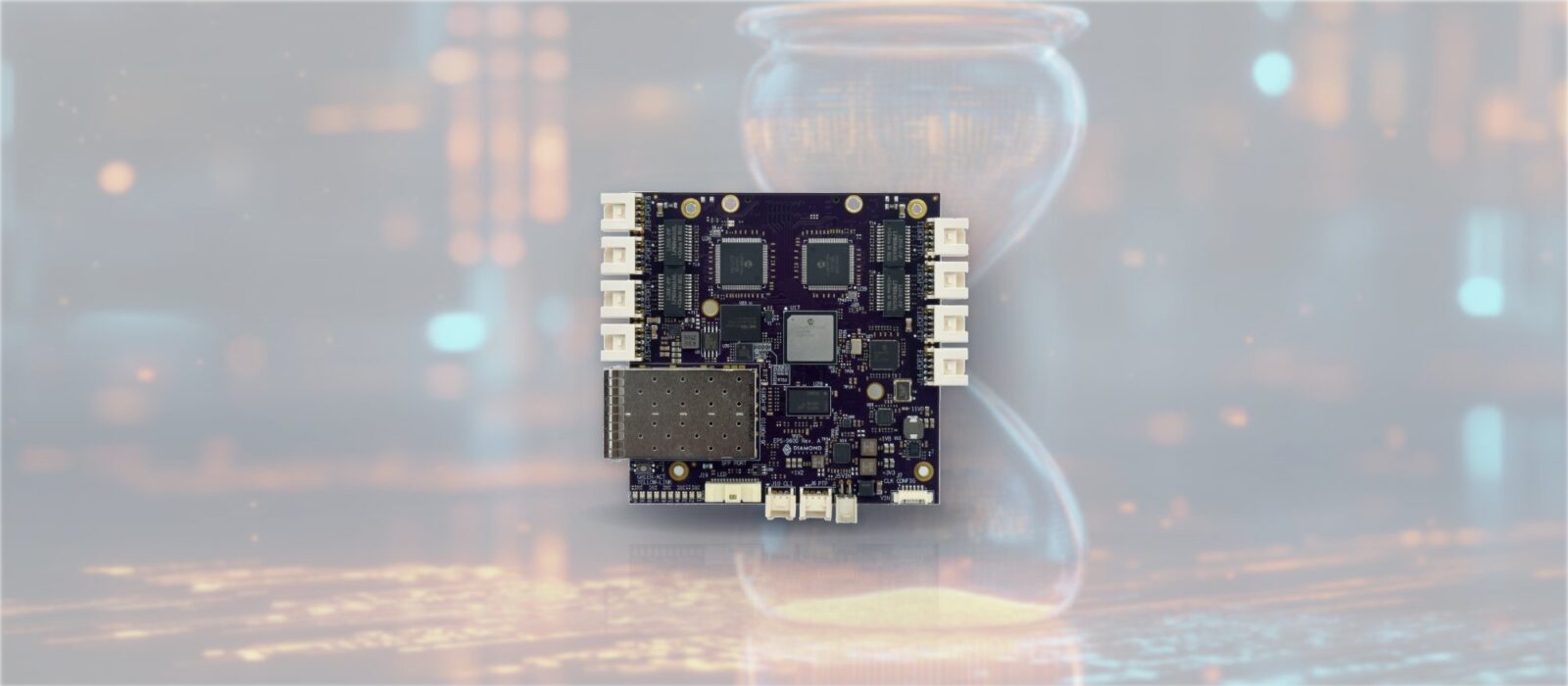
Deterministic networks need TSN-capable switches throughout, and for rugged and defence platforms those switches also have to survive the environment. Our Diamond Systems EPS-9600 brings TSN capability and IEEE-1588 PTP to a board-level, −40 to +85 °C switch with 1G and 10G ports — available as a module for integration and inside a fully-built rugged military switch, so the same deterministic core fits both an OEM design and a deployed platform. Browse our industrial Ethernet switches, or talk to us about a TSN network for your platform.
Tell us the platform and the traffic that has to be guaranteed, and we will help you specify and supply a TSN-capable switch — board-level or rugged — for your network.