
 UK
UK Segmentation (VLANs)
802.1Q VLANs separate traffic types — control, video, telemetry, corporate — across one physical network, so a broadcast storm or a compromised device stays in its own lane.
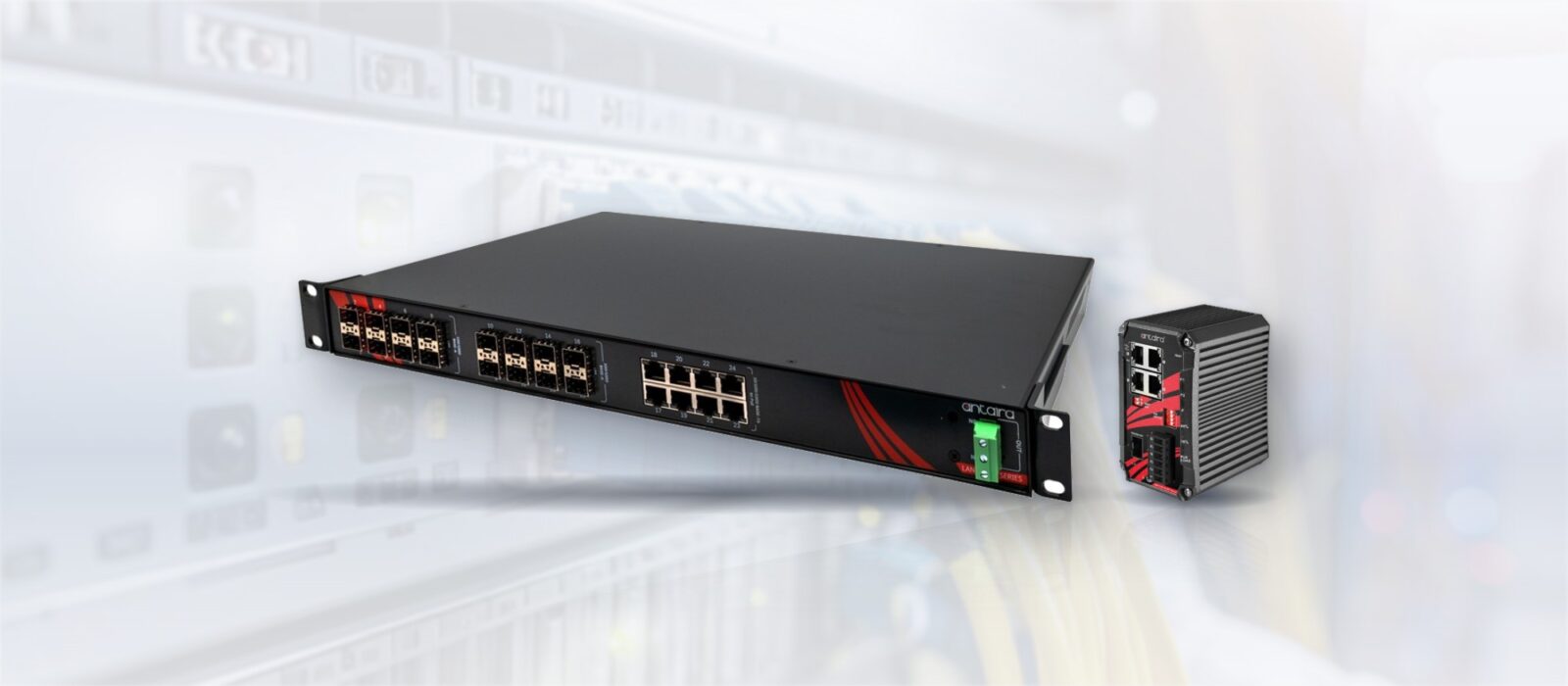
An unmanaged switch is plug-and-play; a managed switch adds control — segmentation, prioritisation, redundancy and visibility. This guide covers what each does, where unmanaged is genuinely the right call, and where managed earns its place.
The choice between a managed and an unmanaged switch is one of the first decisions in any industrial network, and it quietly sets what that network can and cannot do later. Both move Ethernet frames between devices; the difference is control. An unmanaged switch forwards everything, as fast as it can, with no configuration. A managed switch lets you decide how traffic is segmented, prioritised, made resilient and monitored — at the cost of having to set it up. This guide is about matching that choice to the deployment rather than defaulting to one or the other.
An unmanaged switch is fixed-function: you plug devices in and it forwards traffic between them, treating every frame the same way. There is nothing to configure and nothing to monitor beyond the link lights. That simplicity is a genuine strength in the right place.
A managed switch exposes a configuration layer — a web interface, a command line, and usually SNMP — through which you set up VLANs, quality-of-service rules, redundancy protocols and monitoring. It does everything an unmanaged switch does, and then gives you the controls to shape the network around the application.
802.1Q VLANs separate traffic types — control, video, telemetry, corporate — across one physical network, so a broadcast storm or a compromised device stays in its own lane.
Quality-of-service classifies and prioritises time-critical traffic, so control or timing packets are not delayed behind a bulk file transfer when the link is busy.
RSTP/MSTP and ring topologies give controlled, sub-second failover and prevent the accidental loops that bring a flat network down.
IGMP snooping confines multicast (IP cameras, PTP) to the ports that asked for it, instead of flooding every port — a problem that usually appears only once the network scales.
Per-port statistics, error counters, port mirroring and remote monitoring turn a fault from a site visit into a remote diagnosis.
Disabling unused ports, access control and 802.1x authentication control what is allowed to join the network.
Unmanaged switching is not a compromise; for the right network it is the correct tool. If you are connecting a handful of devices that all belong to the same system, with no need to separate traffic, no redundancy requirement and no remote monitoring, a managed switch only adds configuration you will never use and a setting someone can get wrong. A small, static, single-purpose node — a few sensors and a controller in one cabinet — is well served by a rugged, extended-temperature unmanaged switch. Pay for management when the network needs it, not before.
Managed switching earns its place as soon as the network has to do more than connect a fixed set of devices. If different traffic types share the wiring, if uptime depends on failover, if the system will grow, if you need to diagnose faults without a site visit, or if traffic is time-critical, the controls a managed switch provides become risk management rather than convenience. In most industrial, vehicle and defence deployments at least one of these is true — which is why managed switching is the default there, and why determinism features such as QoS and Time-Sensitive Networking only exist on managed hardware.
| Capability | Unmanaged | Managed |
|---|---|---|
| Configuration | None — plug-and-play | Web GUI, CLI, SNMP |
| VLANs / segmentation | No | 802.1Q VLANs |
| Traffic priority (QoS) | Best-effort only | Prioritisation and rate limiting |
| Redundancy | None (loops are a risk) | RSTP / MSTP, ring topologies |
| Multicast control | Floods all ports | IGMP snooping |
| Diagnostics | Link LEDs only | Port stats, mirroring, remote monitoring |
| Security | Open ports | Port control, 802.1x |
If control, video and corporate traffic run over the same wiring, you need VLANs — managed.
If a single link or switch failing is unacceptable, you need RSTP/ring redundancy — managed.
If a fault should be diagnosed without a site visit, you need SNMP and diagnostics — managed.
If timing or control must arrive on schedule under load, you need QoS, and possibly TSN — managed.
If ports, devices or sites will be added, managed gives you the headroom to segment and scale.
A rugged unmanaged switch is the simpler, lower-risk answer.
Things Embedded supplies both. For simple, fixed nodes we offer rugged, extended-temperature unmanaged switches. For everything that needs control, our managed range covers Layer 2+ switching and Layer 3 routing — as compact board-level modules for integration and as fully-built rugged switches — including models with Time-Sensitive Networking and IEEE-1588 PTP for deterministic networks. Browse our industrial Ethernet switches, or tell us the network and we will recommend and supply the right switch.
A managed switch is an Ethernet switch you can configure, through a web interface, command line or SNMP, to set up VLANs, quality of service, redundancy and monitoring. An unmanaged switch, by contrast, is plug-and-play with no configuration.
A VLAN (Virtual LAN) is a logical segment of a network created in a managed switch. Using IEEE 802.1Q tags, it separates traffic into independent broadcast domains over the same physical wiring, so devices behave as if they are on separate networks.
Tell us the traffic types, the redundancy and monitoring you need, and the environment, and we will recommend a managed or unmanaged switch to suit.