
 UK
IEEE 1588 PTP for Machine Vision: Profiles, Clocks and Accuracy
IEEE 1588 defines the Precision Time Protocol, which keeps network clocks within a microsecond of each other. This guide covers PTP versions, clocks, profiles and timestamping, and how shared time lets cameras and sensors work together.
IEEE 1588 is the standard that defines the Precision Time Protocol (PTP), a way to synchronise the clocks of devices on a network to within a microsecond, and often to tens of nanoseconds, by exchanging timestamped messages and measuring the delay between them. In a machine vision system that shared clock is what lets several cameras, lights and sensors act at the same instant and lets every image carry a timestamp you can trust.
Machine vision systems often need precise synchronisation of cameras and other sensors to capture and process visual data accurately. This is where IEEE 1588 comes in. It is supported on many of our edge AI computers and network cards, and can be enabled on our rugged Ethernet switches and managed industrial switches, so the whole path from camera to computer shares one time reference.
This guide explains what IEEE 1588 is and how its versions differ, how the message exchange works with the offset and delay formulas, the clock types and profiles, and the difference between hardware and software timestamping. It then applies all of that to machine vision with a worked timing example, compares PTP with NTP and IEEE 802.1AS, and finishes with an implementation checklist and PTP-capable products from our range.
Key takeaways
- 01IEEE 1588 is PTP
- IEEE 1588 is the standard; Precision Time Protocol is the protocol it defines. The terms are used interchangeably.
- 02Hardware timestamps decide accuracy
- Timestamping in the network controller gives sub-microsecond results; software timestamping is typically tens of microseconds.
- 03Every hop counts
- Switches should act as boundary or transparent clocks, or their queuing delay becomes timing error.
- 04Profiles set the rules
- Default, IEEE 802.1AS, power and telecom profiles pick transports, message rates and accuracy targets.
- 05Vision needs time, not just triggers
- Shared time lets cameras trigger on schedule and lets every frame be matched to encoder, robot and sensor data.
What is IEEE 1588?
IEEE 1588 is the IEEE standard for a precision clock synchronisation protocol for networked measurement and control systems. It describes how clocks on a network elect the best source of time, exchange timestamped messages and correct themselves for both their offset from that source and the delay of the network between them. Our FAQ on how Precision Time Protocol synchronises clocks gives the short version; this article focuses on what that timing does for cameras and sensors and how to put it into an industrial system.
PTP works over standard Ethernet, either directly at Layer 2 or over UDP/IP, and needs no separate timing cable. That is why it has replaced dedicated trigger and timing wiring in many measurement, automation, power and broadcast systems.
IEEE 1588 versions
| Edition | Common name | Key changes | Compatibility |
|---|---|---|---|
| IEEE 1588-2002 | PTP version 1 | First edition, aimed at measurement and control on local networks | Not compatible with version 2 |
| IEEE 1588-2008 | PTP version 2 (PTPv2, often called 1588v2) | Shorter messages, transparent clocks, the peer-to-peer delay mechanism, profiles and transport over IPv6 and Layer 2 | Not backward compatible with version 1 |
| IEEE 1588-2019 | PTP version 2.1 | Optional security mechanisms, a high-accuracy option, better management and profile isolation | Backward compatible with version 2 |
When a datasheet says IEEE 1588 v2 it means the 2008 protocol, and most current devices interoperate on it. The international edition is published as IEC 61588.
How does PTP work?
PTP works in two stages. First, clocks on the network choose a time source using the Best Master Clock Algorithm (BMCA), comparing the quality advertised in Announce messages: priority, clock class, accuracy and stability. The winner becomes the grandmaster. Then every other clock measures its offset from the clock above it with a four-timestamp exchange.
| Step | Message | Timestamp | What happens |
|---|---|---|---|
| 1 | Sync | t1 at the sender, t2 at the receiver | The time transmitter sends Sync; the precise send time t1 travels in the Sync itself or in a Follow_Up message |
| 2 | Follow_Up | Carries t1 | Used by two-step clocks that cannot write t1 into the Sync message as it leaves |
| 3 | Delay_Req | t3 at the receiver, t4 at the transmitter | The time receiver sends a request back and records when it left |
| 4 | Delay_Resp | Carries t4 | The transmitter reports when the request arrived |
With the four timestamps the receiver can solve for both unknowns, assuming the path is the same length in each direction:
The receiver then steers its clock to remove the offset, and repeats the exchange many times a second. Any asymmetry between the two directions, such as a switch queue that delays traffic one way more than the other, appears directly as error, which is why the network hardware matters as much as the end devices. A peer-to-peer variant uses Pdelay_Req and Pdelay_Resp messages to measure each link separately rather than the whole path.
Recent amendments to the standard add timeTransmitter and timeReceiver as alternative terms for the master and slave roles; you will see both on datasheets.
PTP clock types
A PTP network is a tree of clocks. The role a device plays decides how well it preserves time as it passes through.
| Clock type | Role | Where it sits |
|---|---|---|
| Grandmaster clock | The root time source for a PTP domain, usually locked to GNSS | At the top of the network, often with a GPS antenna and a 1PPS output |
| Ordinary clock | A single-port clock that is either a time source or a time receiver | Cameras, computers, PLCs and sensors |
| Boundary clock | A multi-port clock that receives time on one port and serves it on the others | Switches that terminate PTP and regenerate it for each segment |
| Transparent clock (end-to-end) | Measures how long each PTP message spends inside it and writes that residence time into the message | Switches that pass PTP through but correct for queuing delay |
| Transparent clock (peer-to-peer) | Adds the measured link delay as well as residence time | Networks using the peer delay mechanism, such as 802.1AS |
A grandmaster usually takes its time from GNSS; our FAQ on GNSS vs GPS explains the satellite systems behind it. Without boundary or transparent clocks, each switch adds a variable queuing delay that the end devices cannot see, and accuracy falls from nanoseconds to microseconds or worse under load. A managed switch with PTP support is therefore part of the timing system, not just the data path.
PTP profiles and where they are used
IEEE 1588 leaves many choices open: transport, message rates, the delay mechanism, which clock types are allowed. A profile fixes those choices for an industry so devices from different makers interoperate. The profile matters more than the version number when you are matching devices.
| Profile | Defined in | Transport and delay mechanism | Typical target | Used for |
|---|---|---|---|---|
| Default profiles | IEEE 1588 | UDP/IPv4 or Layer 2; end-to-end or peer-to-peer | Sub-microsecond with hardware timestamping | Machine vision, test and measurement, general industrial |
| gPTP | IEEE 802.1AS | Layer 2 only; peer-to-peer; every bridge is time-aware | Sub-microsecond across several hops | Time-Sensitive Networking, audio and video bridging, vehicles |
| Power utility profile | IEC/IEEE 61850-9-3 | Layer 2; peer-to-peer | Within 1 µs at the end device | Substation process bus and sampled values |
| Power profile | IEEE C37.238 | Layer 2; peer-to-peer | About 1 µs | Power system protection and measurement |
| Telecom frequency | ITU-T G.8265.1 | IPv4 unicast | Frequency, not phase | Mobile backhaul |
| Telecom phase, full support | ITU-T G.8275.1 | Layer 2 multicast; every node a boundary clock | Phase and time for 4G and 5G | Mobile networks |
| Telecom phase, partial support | ITU-T G.8275.2 | IPv4 or IPv6 unicast | Phase over networks without full support | Mobile networks over existing IP |
| Broadcast | SMPTE ST 2059-2 | UDP/IP multicast | Sub-microsecond | IP video production |
For Time-Sensitive Networking, 802.1AS is the profile that every other TSN feature depends on; our guide to time sensitive networking explains how scheduling builds on it. In substations, the power utility profile supports IEC 61850 sampled values. Several of the Antaira managed switches we supply list the 1588 default, G.8265.1 and G.8275.1 profiles, which shows how a single switch may need to serve more than one.
Hardware vs software timestamping
Where a timestamp is taken decides how accurate it can be. A timestamp taken by the operating system includes interrupt latency, driver queues and scheduling delay, all of which vary. A timestamp taken by the network controller or PHY as the frame crosses the wire does not.
| Method | Where the timestamp is taken | Typical accuracy | Notes |
|---|---|---|---|
| Software timestamping | In the operating system network stack | Tens of microseconds, worse under CPU load | Works on any network port; adequate for logging |
| Hardware timestamping in the MAC | In the network controller as the frame is sent or received | Sub-microsecond; often tens of nanoseconds on a quiet network | Needs a PTP-capable controller such as the Intel I210, I225 or I226 |
| Hardware timestamping in the PHY | At the physical layer, closest to the wire | Best accuracy | Common in switches and specialist timing hardware |
| Hardware with one-step clocks | Timestamp written into the Sync message on the fly | As above, with fewer messages | Two-step clocks send a Follow_Up instead |
On Linux, the network controller exposes a PTP hardware clock, ptp4l runs the protocol against it and phc2sys copies that time to the system clock; ethtool shows whether a port supports hardware timestamping. A PTP-capable network interface card can add hardware timestamping to a computer whose onboard ports lack it. Figures in the table are typical; real accuracy depends on the network, the number of hops and the clock quality.
How does IEEE 1588 benefit machine vision?
Machine vision systems increasingly use several cameras, lights, encoders and other sensors that must act together. Traditionally that meant hardware trigger lines from a controller to every camera. PTP lets the network carry the timing instead: every device shares a clock to within a microsecond or better, so a trigger can be scheduled for a moment in time rather than wired to an edge on a cable.
| Benefit | What it means in practice |
|---|---|
| Synchronised capture | Cameras looking at a scene from different angles capture at the same instant, which matters for 3D reconstruction, stereo and multi-view inspection |
| Scheduled triggering | GigE Vision 2.0 added IEEE 1588 support and scheduled action commands, so a host can tell several cameras to trigger at a set future time |
| Trustworthy timestamps | Each frame carries the camera’s PTP time, so it can be matched with encoder positions, robot poses or reject signals after the fact |
| Sensor fusion | Camera frames, LiDAR points and radar returns can be aligned in time, which fusion algorithms rely on |
| Less trigger wiring | Fewer dedicated trigger cables, which helps on moving machines and large lines |
| Scalability | Adding a camera means adding a network port, not another trigger output |
GigE Vision cameras are the most common place to meet PTP in vision. Shutter type matters as well: a global shutter sensor exposes every pixel at once, so the PTP timestamp describes the whole frame. In stereo cameras and multi-sensor rigs that combine cameras with LiDAR, shared time is what allows sensor fusion to line data up correctly.
Worked example: timing error on a conveyor
Consider an inspection line moving at 2 m/s, with three cameras inspecting the same part from different sides and a reject gate downstream. Any difference in when each camera fires turns directly into a position error on the part.
| Timing method | Typical clock agreement | Position error at 2 m/s | Effect |
|---|---|---|---|
| Free-running cameras, no synchronisation | Milliseconds and drifting | Several millimetres or more | Views cannot be combined reliably |
| NTP on a local network | About 1 ms | About 2 mm | Too coarse for multi-view measurement |
| PTP with software timestamping | About 50 µs | About 0.1 mm | Often adequate for logging and coarse alignment |
| PTP with hardware timestamping | About 1 µs or better | About 0.002 mm | Views and encoder data align well below a pixel |
The same arithmetic applies to the reject gate: if the gate controller and the cameras share PTP time, the gate can act on the timestamp of the frame plus a known travel time, instead of relying on how quickly a message crosses the network. Figures are typical, not guaranteed; the camera’s own trigger latency and exposure time also count.
Machine vision computers and network cards for IIoT
PTP-capable hardware appears at every point in a vision system, from the cameras’ network cards to the switches and the training servers behind them.
-
01

Machine vision training servers
GPU servers for training and retraining vision models off the line.
View range -
02
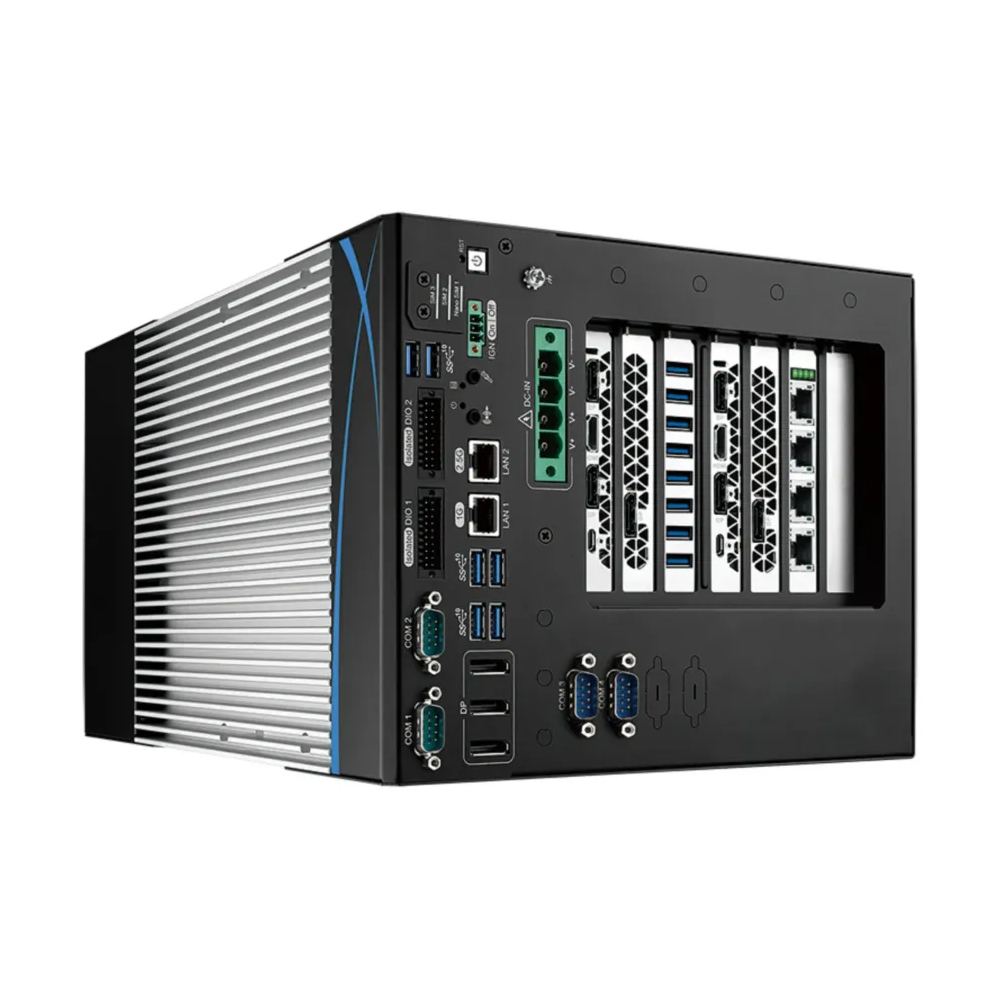
Edge AI inference PCs
Computers that run inference beside the cameras.
-
03
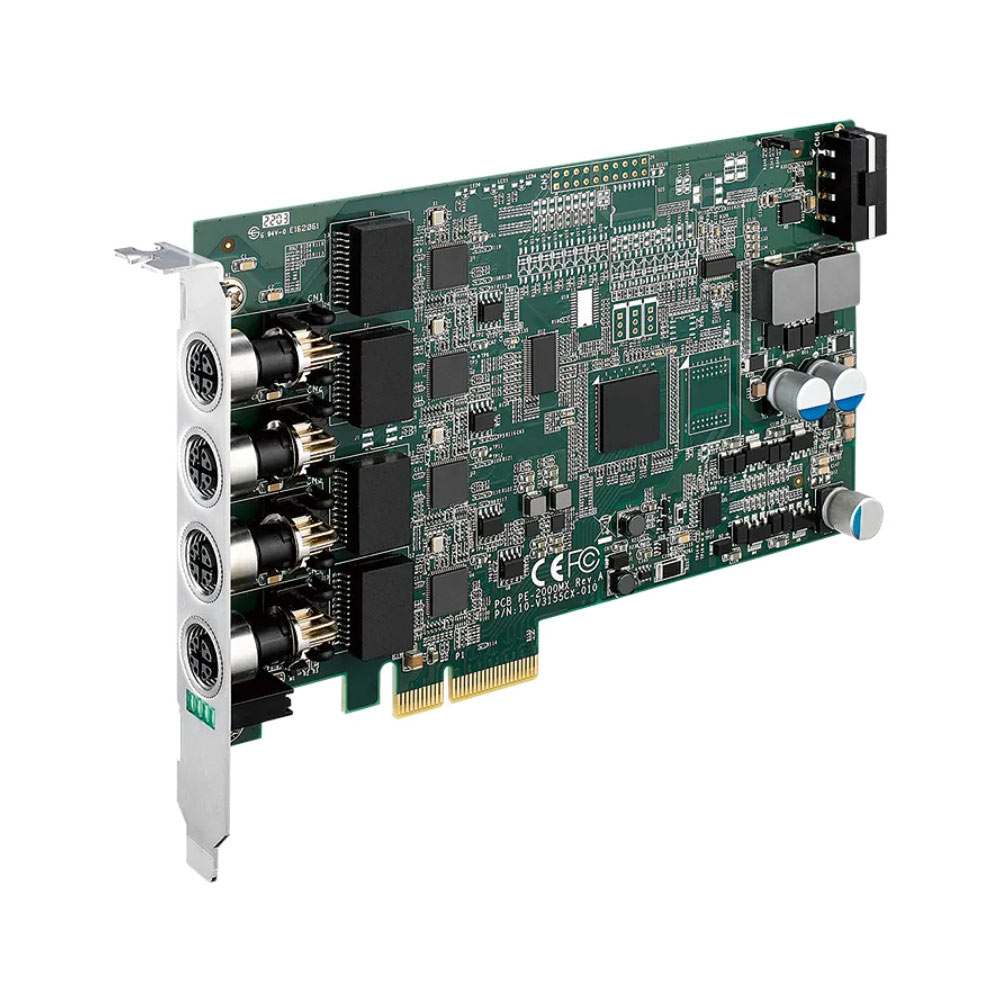
PCIe LAN cards with PTP
Network and PoE cards with hardware timestamping for cameras.
View range -
04
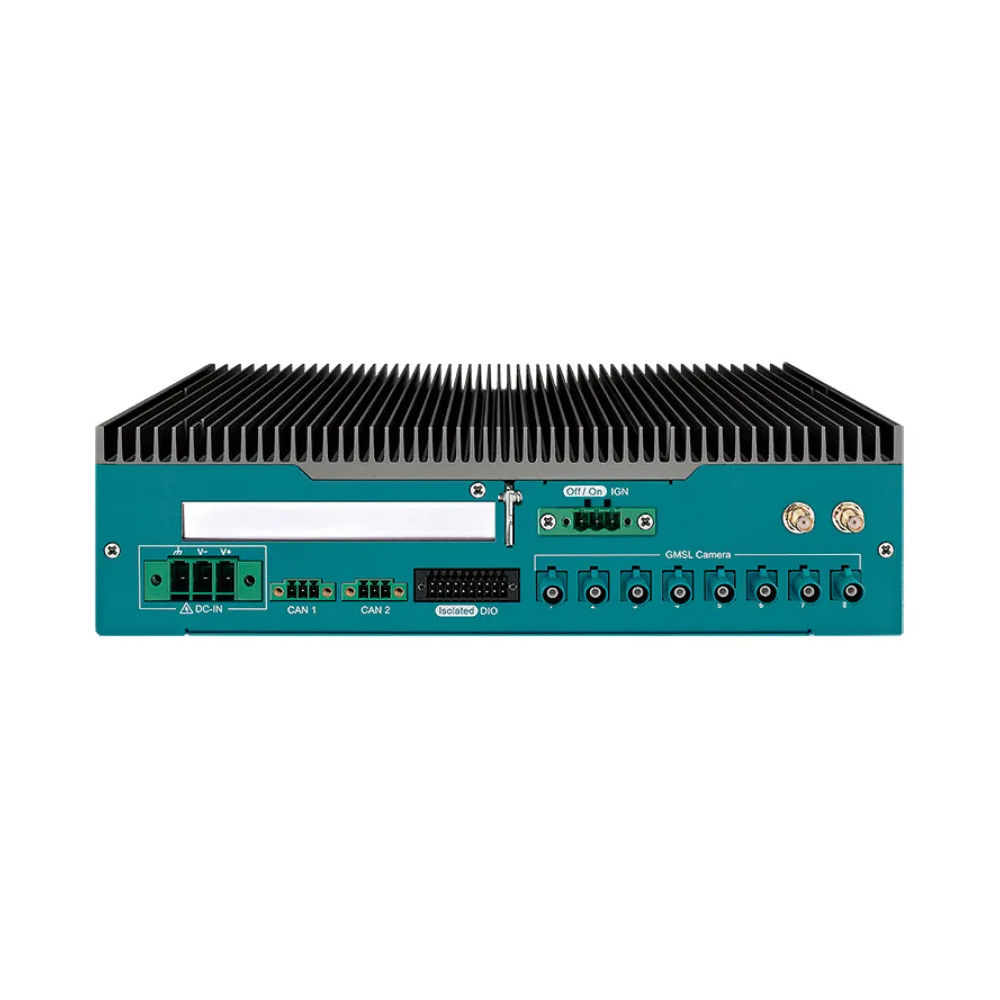
Rugged Ethernet switches
Switches that carry precise time as well as traffic.
Where machine vision uses precise timing
Machine vision is the ability of computers and robots to interpret visual information. These are some of the sectors where it is used and where shared timing helps.
| Sector | Example | Why timing matters |
|---|---|---|
| Quality control | Inspecting components for defects or checking that packaging is sealed | Multi-camera views and reject gates must agree on where the part was |
| Autonomous vehicles and mobile robots | Detecting obstacles and navigating with cameras and other sensors | Camera, LiDAR and radar data must be fused at the same instant |
| Medical imaging | Analysing X-ray, CT and other images to help clinicians | Multi-detector systems need aligned acquisition |
| Security and surveillance | Tracking people or vehicles across several cameras | Events from different cameras must be ordered correctly |
| Agriculture | Detecting plant disease or targeting weeds from moving machines | Camera frames must match the position of the sprayer or tool |
| Robotics | Locating and grasping objects, navigating around obstacles | Images must match the robot pose at the moment of capture |
Our spot spraying case study shows a multi-camera GigE vision system on NVIDIA Jetson AGX Orin in agriculture, the kind of moving-machine application where camera timing and position have to line up.
What is the difference between PTP and NTP?
Both synchronise clocks over a network, but they are built for different accuracies. NTP is designed for computers across the internet and is accurate enough for logs and file times. PTP is designed for measurement and control on a local network and relies on hardware support to reach sub-microsecond accuracy.
| PTP (IEEE 1588) | NTP | |
|---|---|---|
| Typical accuracy on a local network | Sub-microsecond with hardware timestamping | About a millisecond, sometimes better |
| Timestamping | In hardware, at the network controller or PHY | In software |
| Network support | Boundary and transparent clocks in switches remove queuing error | None needed; error from queuing is averaged out |
| Scope | Local and site networks | Local networks and the internet |
| Message rate | Many messages per second | Typically every few seconds to minutes |
| Typical use | Machine vision, motion control, substations, telecom, broadcast | Servers, PCs, logs, general IT |
Many systems use both: PTP for the devices that need tight timing and NTP for everything else. Some switches act as an NTP server and a PTP clock at the same time.
IEEE 1588 vs IEEE 802.1AS
IEEE 802.1AS, generalised PTP, is a profile of IEEE 1588 written for bridged Ethernet. It runs only at Layer 2, uses the peer-to-peer delay mechanism, requires every bridge in the path to be time-aware and fixes many settings that 1588 leaves open. That makes it simpler to deploy and easier to guarantee, which is why Time-Sensitive Networking builds on it. A device that supports 802.1AS supports a specific form of PTP, but not every IEEE 1588 device supports 802.1AS.
How to implement precise timing in an industrial network
PTP support on industrial PCs varies with the hardware and software. Some industrial PCs offer it on their onboard Ethernet ports, others need a PTP-capable card. When selecting a computer for a machine vision or other time-sensitive application, check that the network controller supports hardware timestamping, and that the operating system and the application software can use it.
| Part of the system | What to check | Examples from our range |
|---|---|---|
| Grandmaster | A GNSS-locked grandmaster or a switch that can act as one; holdover if GNSS is lost | Switches with a 1PPS input for a GPS time source |
| Switches | Boundary or transparent clock support for the profile you use, on every switch in the path | Antaira QMX and QMP managed switches; Diamond Systems EPS-24G4X-1588 and SabreNet-12000-120 |
| Computer network ports | Hardware timestamping in the controller, such as Intel I210, I225 or I226 | Industrial PCs with Intel I225 or I226 ports |
| Network cards | PTP-capable controllers where onboard ports lack them | Vecow PE-2004 and FE-1071; Neousys PCIe-AE304bp |
| Software | linuxptp (ptp4l, phc2sys) or the vendor’s PTP stack, configured for the right profile | Set up in the system image |
| Cameras and sensors | IEEE 1588 support and, for vision, GigE Vision action commands | Checked against the camera maker’s documentation |
PTP event messages are multicast by default, so on a managed network check that IGMP snooping and VLAN settings let them reach every clock. Our guides to managed vs unmanaged switches and the types of Ethernet switches explain where a managed switch is needed.
Implementing PTP, step by step
The steps below follow the original implementation guide in this article, with the work we do as standard on the computers we supply.
-
Hardware
PTP-capable partsChoose network controllers, cards and switches that support hardware timestamping and the profile you need.
-
Software
Stack and profileInstall and configure the PTP software, such as linuxptp, for the chosen profile, domain and message rates. We build this into the system image.
-
Connect
Devices and networkConnect cameras and sensors over standard Ethernet cabling, with switches set as boundary or transparent clocks.
-
Configure
Roles and intervalsSet the grandmaster, clock priorities and synchronisation interval on each device.
-
Verify
Measure and monitorMeasure offset and path delay with PTP tools, then monitor them over time and adjust settings as the system grows.
PTP-capable products compared
Products from our catalogue that support IEEE 1588, from network cards to switches. Figures are from each product’s page.
| Product | Type | PTP support | Ports | Rating |
|---|---|---|---|---|
| Vecow PE-2004 | PCIe x4 PoE+ card | IEEE 1588 PTP on Intel I210 controllers | 4× Gigabit PoE+, 25.5 W each | −25 to 70 °C |
| Neousys PCIe-AE304bp | PCIe automotive Ethernet card | Hardware timestamping for IEEE 1588 v1 and v2 and 802.1AS | 4× 100/1000BASE-T1 on H-MTD | −25 to 70 °C |
| Antaira QMX-0804G-2Q2S-T | Layer 2 managed DIN-rail switch | IEEE 1588 v2 with 1588 default, G.8265.1 and G.8275.1 profiles | 4× Gigabit, 4× SFP (two at 2.5G) | −40 to 85 °C, 20–60 V DC |
| Diamond Systems EPS-24G4X-1588 | Layer 3 managed switch board | PTP clock circuit with 1PPS I/O | 24× Gigabit, 4× 10G SFP+ | Designed for vehicle and rugged use |
| Diamond Systems SabreNet-12000-120 | Sealed rugged switch | IEEE 1588 PTP with a 1PPS input for GPS time | 12× Gigabit on MIL-DTL-38999 | MIL-STD-461 filtered supply |
| Vecow FE-1071 | Low-profile PCIe card | IEEE 1588 PTP on Intel X710-BM2 | 2× 10GbE SFP+ | −40 to 55 °C |
Antaira designs and builds its switches and we supply and specify them, pre-configuring IP addressing, VLANs and timing settings where you ask. Diamond Systems builds its switch boards and rugged switches in full, and we supply them; browse our Ethernet switch boards and managed industrial switches for more. The PCIe-AE304bp also appears in our guide to single pair Ethernet, where vehicle sensors use automotive Ethernet.
Where IEEE 1588 fits across our range
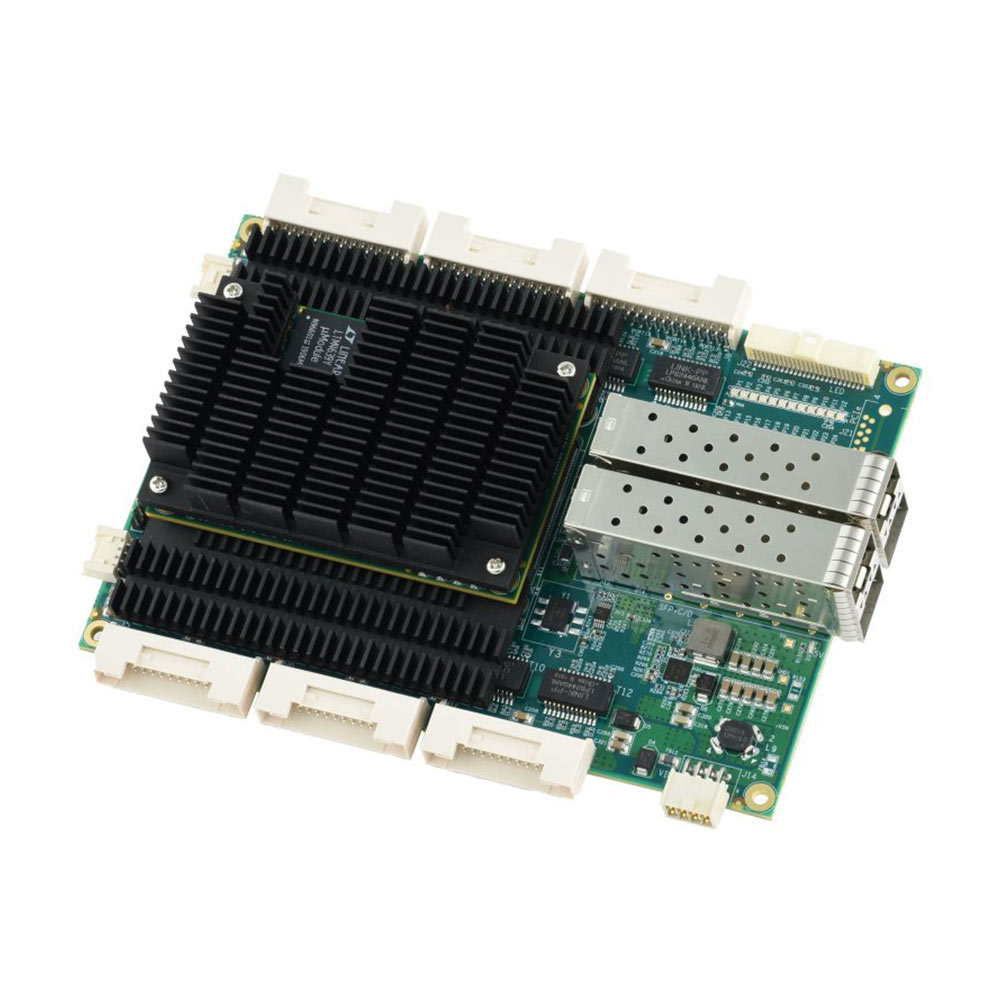
PTP support appears on network cards, switches and the computers that take the timestamps.
Ethernet and PoE frame grabbers
PoE and LAN cards, several with PTP, for multi-camera systems.
View range
Managed industrial switches
DIN-rail switches with IEEE 1588 v2, rings and VLANs.
View range
Ethernet switch boards
Board-level switches with PTP clock circuits for OEM designs.
View range
Rugged Ethernet switches
Sealed switches with PTP for vehicles and masts.
View range
Edge AI computers
Inference computers that timestamp and process camera data.
View range
Industrial PCs
Fanless computers with Intel network controllers for vision cells.
View rangePTP-capable products to start from
A PoE+ card and an automotive Ethernet card with hardware timestamping, a managed DIN-rail switch and a switch board with a PTP clock circuit.

Intel i210 4-Port Gigabit PoE+ PCIe Expansion Card with PTP
- Ethernet
- 4× GbE (4× PoE)
- Temp
- −25 to +70 °C
- Power
- 12 V DC [4-Pin]
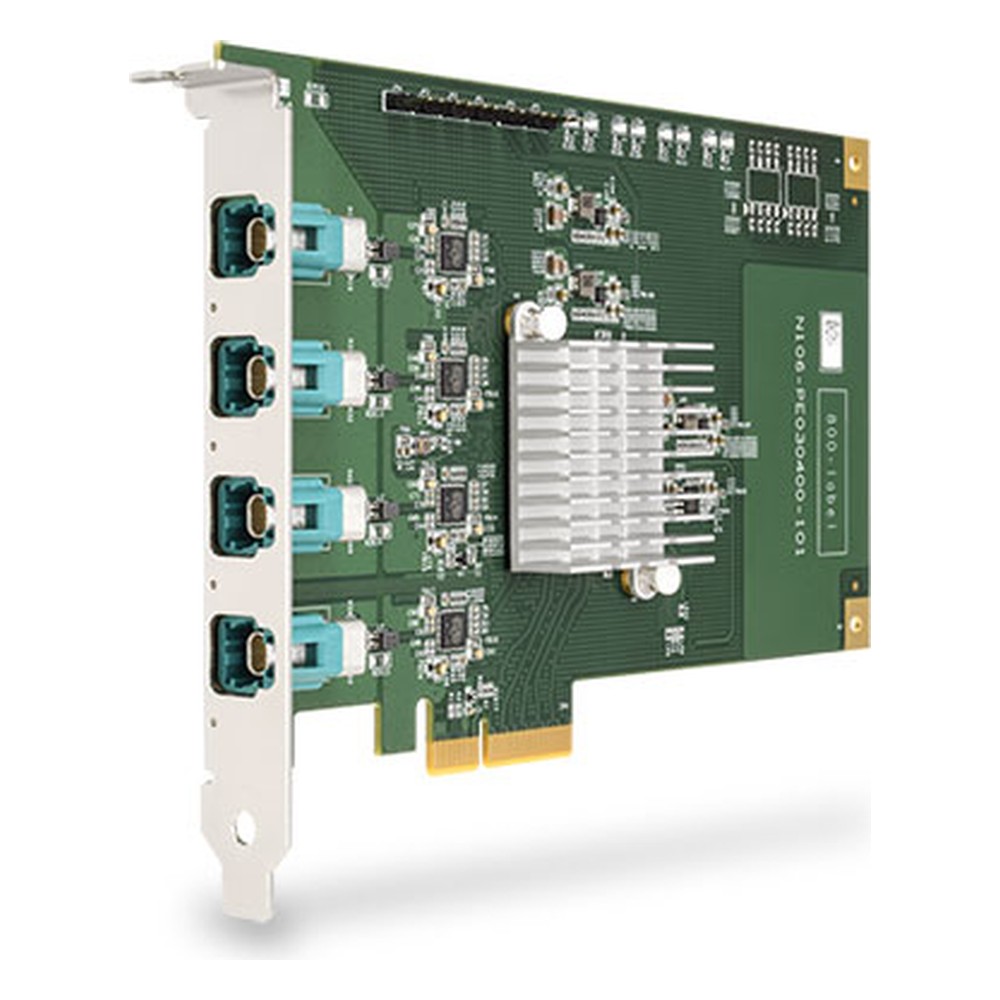
4-Port 100/1000BASE-T1 Automotive Ethernet PCIe Card with H-MTD Connectors and PTP
- Ethernet
- 4× GbE
- Temp
- −25 to +70 °C
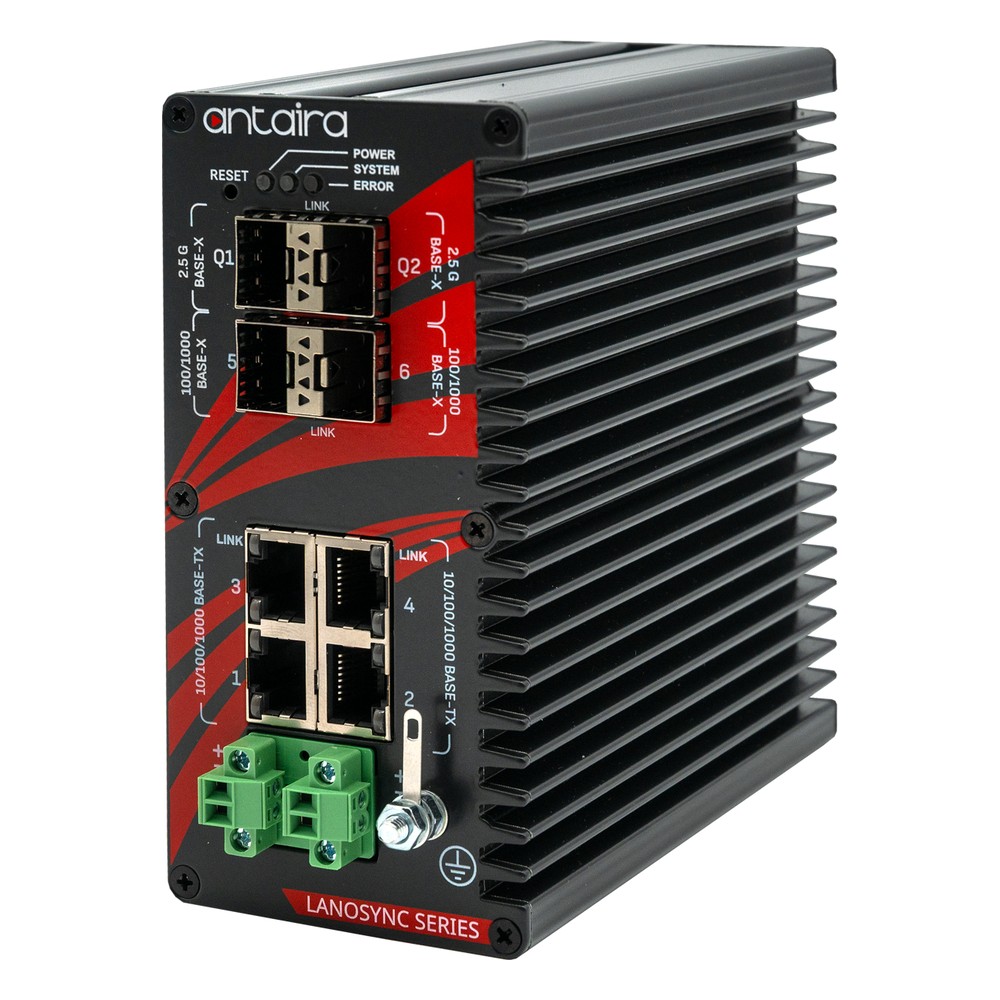
8-Port Gigabit Managed Industrial Switch with 2x SFP, 2x 2.5G SFP and Extended Temperature
- IP Rating
- IP40
- Temp
- −40 to +85 °C
- Power
- 20–60 V DC [Terminal Block]

Compact Managed Layer 3 24 Port Gigabit Ethernet Switch with IEEE-1588 PTP
- Temp
- −40 to +80 °C
- Power
- 7–40 V DC [Latching]
Specifying IEEE 1588 for a vision system
Questions to answer before choosing cameras, switches and computers.
-
01
Accuracy
Work out the timing accuracy the application needs from speed and resolution, as in the conveyor example.
-
02
Profile
Choose the PTP profile and make sure every device supports it: default, 802.1AS, power or telecom.
-
03
Grandmaster
Decide where time comes from, usually GNSS, and what happens if that source is lost.
-
04
Switches
Use boundary or transparent clocks on every switch in the timing path.
-
05
Timestamping
Check for hardware timestamping on each computer port or fit a PTP-capable card.
-
06
Software
Agree which PTP stack runs on each computer and how offsets will be monitored.
-
07
Environment
Match temperature range, power input and connectors to the line, vehicle or outdoor site.
IEEE 1588: common questions
Quick answers
What is IEEE 1588?
The standard that defines the Precision Time Protocol. It synchronises clocks across a network to sub-microsecond accuracy using timestamped messages and delay measurement.
Is IEEE 1588 the same as PTP?
Yes, in practice. IEEE 1588 is the standard and PTP is the protocol it defines; PTPv2 refers to the 2008 edition.
How accurate is IEEE 1588 PTP?
Sub-microsecond with hardware timestamping. Tens of nanoseconds is achievable on a well-designed network; software timestamping is typically tens of microseconds.
What is the difference between PTP and NTP?
Accuracy and hardware. NTP reaches about a millisecond in software; PTP uses hardware timestamps and PTP-aware switches to reach sub-microsecond accuracy.
What is a PTP grandmaster clock?
The root time source for a PTP network. It is usually locked to GNSS and chosen automatically by the Best Master Clock Algorithm.
What is the difference between IEEE 1588 and IEEE 802.1AS?
802.1AS is a profile of 1588. It runs at Layer 2 with peer delay measurement and time-aware bridges, and underpins Time-Sensitive Networking.
Does PTP need special hardware?
For high accuracy, yes. Network controllers with hardware timestamping and switches acting as boundary or transparent clocks; PTP will run in software, but less accurately.
Timing and machine vision FAQs
-
What Is Precision Time Protocol (PTP)?
Precision Time Protocol (PTP), defined in IEEE 1588, synchronises the clocks of devices on a network to a single reference clock, called the grandmaster. With hardware timestamping in the network interfaces and switches, PTP typically aligns clocks to within a microsecond or better, far tighter than NTP, which is why it is used in industrial automation, substations, broadcast and telecoms.
-
What Is a GigE Vision Camera?
A GigE Vision camera is an industrial camera that sends images and takes commands over standard Ethernet, following the GigE Vision interface standard. It runs over long, low-cost network cables, can be powered by PoE, and lets many cameras share one network through a switch, which makes it a common choice for machine vision on lines and vehicles.
-
What Is Machine Vision?
Machine vision is the use of cameras, lighting and a computer to inspect, measure, identify or guide objects automatically. In industry it checks products for defects, reads codes, verifies assembly and guides robots, faster and more consistently than a person can, and today it increasingly runs AI models on edge computers beside the line.
-
What Is a NIC (Network Interface Card)?
A NIC (network interface card, or network interface controller) is the hardware that connects a computer to a network. It converts data from the processor into Ethernet or Wi-Fi signals and back, carries the computer’s MAC address, and is either built onto the motherboard or added as a PCIe, M.2 or USB card.
-
What Is a Managed Switch?
A managed switch is an Ethernet switch you can configure, through a web interface, command line or SNMP, to set up VLANs, quality of service, redundancy and monitoring. An unmanaged switch is plug-and-play with no settings at all. Managed switches suit networks that are segmented, critical or monitored remotely.
-
GNSS vs GPS: What Is the Difference?
GPS is one satellite navigation system, run by the United States. GNSS (global navigation satellite system) is the umbrella term for all of them, including GPS, Galileo, GLONASS and BeiDou. A multi-constellation GNSS receiver sees more satellites at once, which improves accuracy and keeps a fix where the view of the sky is limited.
Looking for an IEEE 1588 computer or network card?
Tell us how many cameras and sensors must share a clock and how accurate it needs to be. We will recommend PTP-capable computers, cards and switches, and configure and test the computers before they ship.