
 UK
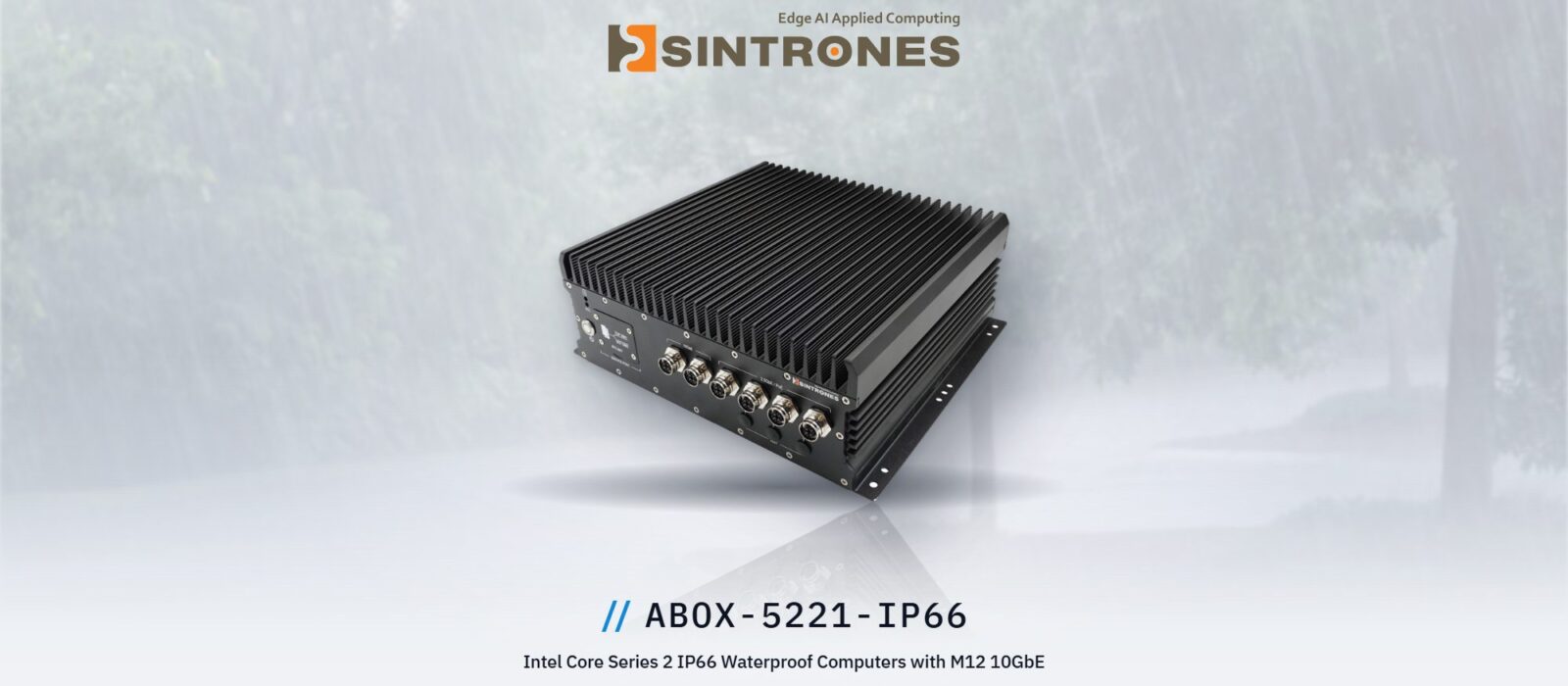
Sintrones ABOX-5221-IP66: a waterproof computer with dual 10GbE
The Sintrones ABOX-5221-IP66 is a waterproof computer sealed to IP66, with two 10GbE and four 2.5GbE ports on M12 X-coded connectors. Built on Intel Core Series 2 processors, codenamed Bartlett Lake, it is a rugged industrial computer for places a cabinet cannot reach: a platform canopy, a quayside crane or the underside of a vehicle.
Dual 10GbE is what sets it apart. Add the four 2.5GbE ports, PoE+ on the P builds and an MXM GPU on the G builds, and one sealed computer can power the cameras, run the models and send the streams upstream. Every port, from the LAN to the power input, uses a sealed M12 connector, and we configure each system to the site’s processor, memory, storage and wireless needs.
Why dual 10GbE on a sealed computer
A computer at an outdoor camera site has two networking jobs: take in the camera streams, and send them on to a server. The ABOX-5221-IP66 splits those jobs across its six ports. Four Intel I226IT 2.5GbE ports face the cameras, and on the P and PG builds each one delivers PoE+ at 25.5 W from a 120 W budget, so a camera takes power and data over a single cable. Two Marvell AQC113 10GbE ports carry the traffic upstream.
The arithmetic is what makes the pairing work. Four 2.5GbE links add up to 10 Gb/s, which one 10GbE uplink can carry in full, leaving the second 10GbE port for a separate network or a second path back to the server. Our look at why edge AI is outgrowing 2.5GbE covers where that headroom starts to matter.
All six ports use M12 X-coded connectors, the 8-pin coding built for Gigabit and 10 Gigabit Ethernet, with a screw-locking body that keeps its seal and its grip under vibration. The 10GbE uplink is copper on the same sealed connector as every other port, so there is no SFP+ cage or separate switch cabinet to weatherproof at the pole.
What the ABOX-5221-IP66 brings
- 01Dual 10GbE on M12
- Two Marvell AQC113 10GbE ports for uplinks, alongside four Intel I226IT 2.5GbE ports, all on sealed M12 X-coded connectors.
- 02PoE+ for four cameras
- The P and PG builds deliver IEEE 802.3at PoE+ at 25.5 W per port from a 120 W budget.
- 03Sealed to every port
- IP66 aluminium enclosure, fanless, with M12 A-coded serial and digital I/O and an M12 K-coded power input.
- 04Intel Core Series 2
- Core 9 273PTE, Core 7 251TE or Core 5 221TE on the R680E chipset, with up to 96 GB of ECC-capable DDR5-5600.
- 05MXM GPU option
- The G and PG builds take an NVIDIA RTX Embedded 5000, 3500 or 2000 Ada, or an Intel Arc A370E, for up to 682 AI TOPS.
- 06Rail and vehicle ready
- 18–60 V DC with ignition detection, MIL-STD-810H shock and vibration, EN 50155, EN 45545-2 (R25) and E-Mark.
ABOX‑5221-IP66 models
Four builds share the dual 10GbE design: the base model, P with PoE+, G with an MXM GPU, and PG with both.
Intel Core Series 2 IP66 Waterproof Computer with M12 10GbE
- CPU
- Intel Core 2 (Bartlett Lake)
- Ethernet
- 2× 10GbE, 4× 2.5GbE
- IP Rating
- IP66
Intel Bartlett Lake IP66 Waterproof Computer with 4x M12 PoE+ and 10GbE
- CPU
- Intel Core 2 (Bartlett Lake)
- Ethernet
- 2× 10GbE, 4× 2.5GbE (4× PoE)
- IP Rating
- IP66
Intel Core 9/7/5 Series 2 IP66 Waterproof Computer with RTX Ada/Arc MXM GPU
- CPU
- Intel Core 2 (Bartlett Lake)
- GPU
- NVIDIA RTX 2000 Ada Embedded (MXM), NVIDIA RTX 3500 Ada Embedded (MXM), NVIDIA RTX 5000 Ada Embedded (MXM), Intel Arc A370E
- AI
- 56–682 TOPS
Intel Bartlett Lake Waterproof Computer with RTX Ada/Arc MXM GPU, 10GbE and PoE+
- CPU
- Intel Core 2 (Bartlett Lake)
- GPU
- NVIDIA RTX 2000 Ada Embedded (MXM), NVIDIA RTX 3500 Ada Embedded (MXM), NVIDIA RTX 5000 Ada Embedded (MXM), Intel Arc A370E
- AI
- 56–682 TOPS
Specification highlights
| Specification | Sintrones ABOX-5221-IP66 |
|---|---|
| Processor | Intel Core 9 273PTE / Core 7 251TE / Core 5 221TE (Core Series 2, Bartlett Lake) |
| Chipset and memory | Intel R680E; 2× DDR5-5600 SO-DIMM, up to 96 GB, ECC support |
| Networking | 2× 10GbE (Marvell AQC113), 4× 2.5GbE (Intel I226IT), all M12 X-coded |
| PoE (P, PG) | 4× PoE+ (IEEE 802.3at), 25.5 W per port, 120 W budget |
| Graphics | Integrated Intel UHD; 2× HDMI 2.0b, up to 3840 × 2160 |
| MXM GPU (G, PG) | NVIDIA RTX Embedded 5000 Ada (682 TOPS), 3500 Ada (369 TOPS), 2000 Ada (232 TOPS) or Intel Arc A370E (56 TOPS) |
| I/O | 2× RS-232/422/485 and 8× DI / 8× DO on M12 A-coded; 2× USB 3.2 Gen 2 |
| Expansion | M.2 Key B (4G/5G, dual nano SIM), M.2 Key E (Wi-Fi, GNSS or CAN), 2× full-size Mini PCIe |
| Storage | 3× M.2 2280 SSD, 2× 2.5-inch SATA |
| Power | 18–60 V DC (24 V / 48 V nominal) on M12 K-coded, ignition detection |
| Sealing and cooling | IP66 aluminium enclosure, fanless |
| Temperature | −40 to 70 °C (base, P); 0 to 60 °C or 70 °C depending on GPU module (G, PG) |
| Standards | MIL-STD-810H shock and vibration; EN 50155, EN 45545-2 (R25), E-Mark |
| Security and software | TPM 2.0, Intel AMT; Windows 11 IoT Enterprise LTSC, Ubuntu 26.04 LTS |
The G and PG builds put the MXM GPU inside the IP66 enclosure, so the models run beside the cameras rather than in a separate cooled cabinet. That places them with our rugged GPU computers, while the base and P builds keep the wider −40 to 70 °C range.
A closer look
-
01

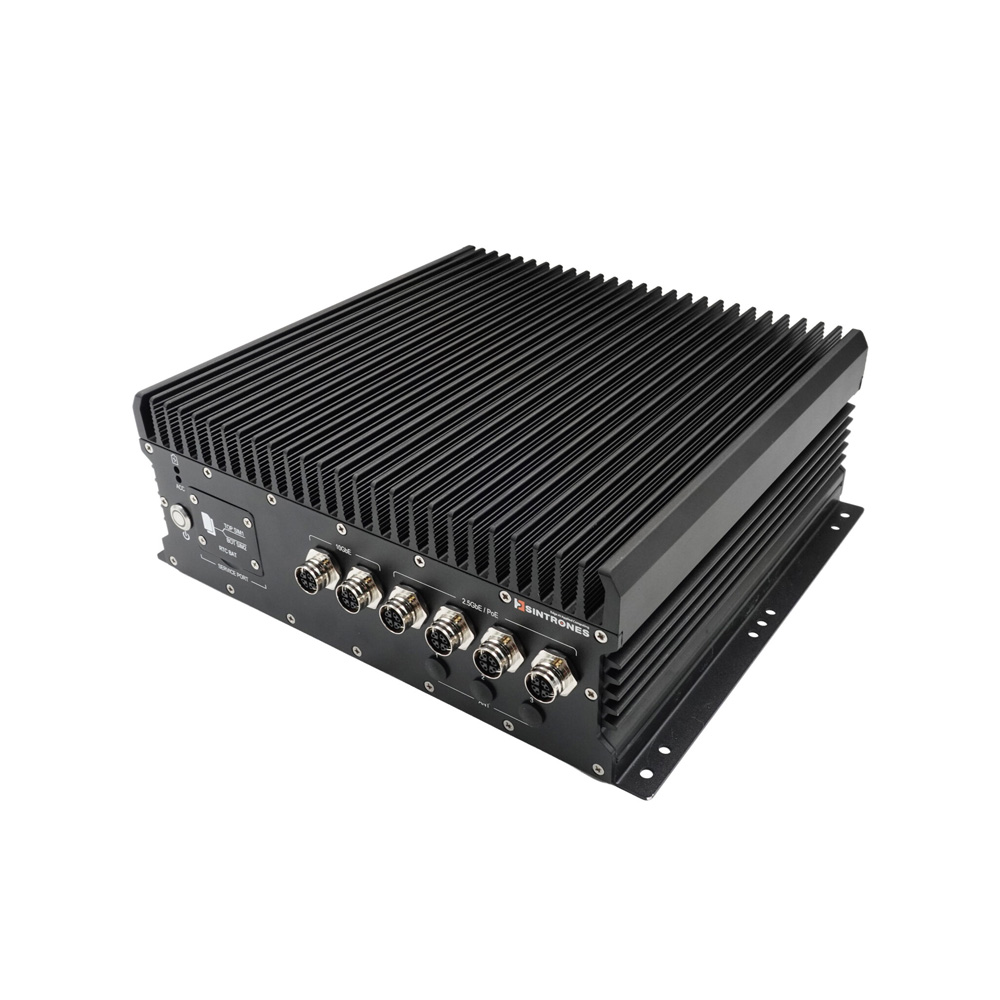
Six M12 LAN ports
The front panel carries the two 10GbE and four 2.5GbE ports, each on a sealed M12 X-coded connector.
-
02
Sealed rear panel
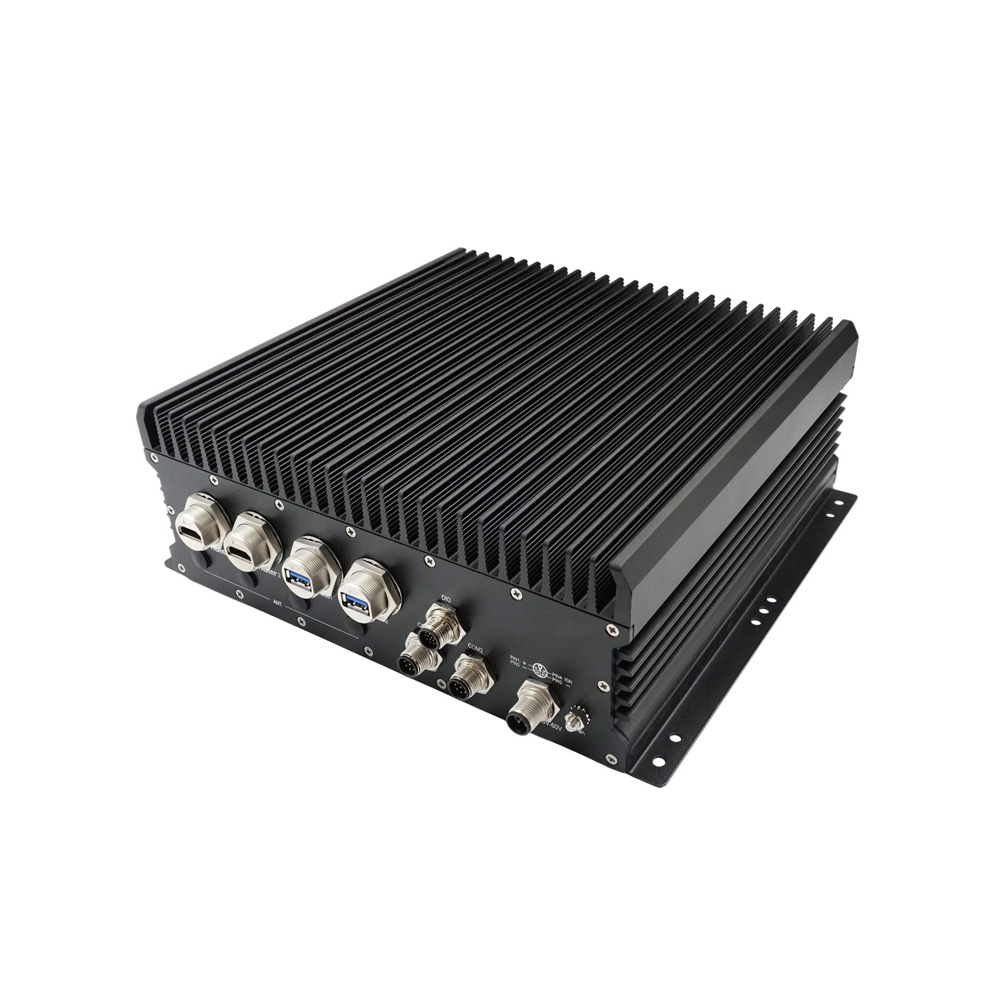
Covered HDMI and USB 3.2 for service, with M12 serial, digital I/O and the 18–60 V DC power input.
ABOX-5221-IP66 vs ABOX-5221
The ABOX-5221-IP66 shares its dual 10GbE layout with the ABOX-5221, which carries the same port count on RJ45 rather than sealed M12. The difference is where each one can live.
| Specification | Sintrones ABOX-5221-IP66 | Sintrones ABOX-5221 |
|---|---|---|
| Processor | Intel Core Series 2: Core 9 273PTE / Core 7 251TE / Core 5 221TE | Intel 14th Gen Core: i9-14900T / i7-14700T / i5-14500T |
| Networking | 2× 10GbE, 4× 2.5GbE (Intel I226IT) | 2× 10GbE, 4× 2.5GbE (Intel I226) |
| LAN connectors | M12 X-coded | RJ45 |
| Serial | 2× RS-232/422/485 on M12 | 2× RS-232/422/485 on DB9 |
| USB | 2× USB 3.2 Gen 2 | 8× USB 3.2 Gen 2 |
| Power input | 18–60 V DC on M12 K-coded | 9–60 V DC on terminal block |
| Ingress protection | IP66 | No IP rating listed |
| Shock and vibration | MIL-STD-810H, IEC 60068-2-64 | MIL-STD-810H, IEC 60068-2-64, IEC 61373 |
| Temperature (base build) | −40 to 70 °C | −40 to 70 °C |
Choose the ABOX-5221-IP66 when the computer has to sit outside a cabinet, where IP66 protection against dust and powerful water jets matters. The ABOX-5221 suits a cabinet or equipment bay, with more USB, RAID 0, 1 and 5 on its SATA trays and a 9 V minimum input.
Where the ABOX-5221-IP66 fits
Exposed sites where one sealed computer has to power the cameras, process the streams and connect back to the network.

Outdoor surveillance
The P builds power four cameras over sealed M12 PoE+ and send their streams on over 10GbE, from the same pole or wall.

Rail
Platform and onboard installs, with EN 50155 and EN 45545-2 (R25) compliance and MIL-STD-810H shock and vibration testing.
View range
Ports and quaysides
Crane and quayside compute sealed to IP66 against spray and dust, running fanless from −40 to 70 °C on the base and P builds.
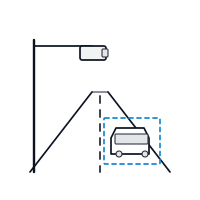
Roadside
Roadside installs on an 18–60 V DC M12 input, with optional 4G or 5G through the M.2 Key B slot and dual nano SIM.

Vehicles
Mounted on or under a vehicle, with E-Mark, ignition detection and a 24 V or 48 V nominal input.
Outdoor AI inference
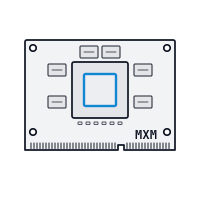
The G and PG builds run models on an MXM GPU, up to 682 AI TOPS with the RTX Embedded 5000 Ada, inside the sealed enclosure.
ABOX-5221-IP66 FAQs
-
What Is Intel Arc? Intel’s GPUs for Edge and Embedded Systems
Intel Arc is Intel’s graphics brand. It covers discrete Intel Arc GPUs, the A-series and newer B-series cards and modules, and the Arc graphics built into Intel Core Ultra processors. Arc GPUs handle displays, video encoding and decoding, and AI inference, and they are supported by Intel’s OpenVINO toolkit for running AI models.
-
What Is an MXM GPU?
An MXM GPU is a graphics processor on a Mobile PCI Express Module, a compact standard board that mounts flat on a carrier instead of standing in a PCIe slot. It lets laptops, embedded systems and rugged computers add discrete NVIDIA, AMD or Intel graphics in a small space, often cooled through the chassis rather than by its own fan.
-
What Is an M12 X-Coded Connector?
An M12 X-coded connector is the 8-pin M12 coding for Gigabit and 10 Gigabit Ethernet. Its four twisted pairs are separated by a cross-shaped shield that controls crosstalk at high speed, and it can carry Power over Ethernet with a suitable cable. It is defined in IEC 61076-2-109.
-
What is 10GbE networking?
10GbE (10 Gigabit Ethernet) is a networking standard that carries data at 10 gigabits per second, four times faster than 2.5GbE. Defined in the IEEE 802.3 family, it runs over SFP+ fibre or copper and over Cat6A twisted pair, and is increasingly the baseline for edge AI systems handling high-resolution video and multi-sensor data.
-
When should you upgrade from 2.5GbE to 10GbE?
Upgrade from 2.5GbE to 10GbE when a workload needs more than about 2 Gb/s of sustained traffic per link, such as several uncompressed camera streams, multi-sensor fusion, multi-node inference or latency-sensitive control. The best time is usually the next platform refresh, specifying RDMA-capable network cards from the start.
-
What does IP66 mean?
IP66 is the rating above IP65 — dust-tight, and protected against powerful water jets. It is the standard specification for outdoor industrial computing in storm-exposed locations, marine deck equipment and light wash-down food handling, equivalent to NEMA 4 / 4X in North American markets.
-
PoE vs PoE+ vs PoE++: The 802.3af, 802.3at and 802.3bt Standards
PoE, PoE+ and PoE++ are the three generations of IEEE Power over Ethernet. PoE (802.3af) supplies about 15 W per port, PoE+ (802.3at) about 30 W, and PoE++ (802.3bt) 60 W (Type 3) or 90 W (Type 4). PoE and PoE+ use two of the four cable pairs; PoE++ can use all four.
Need 10GbE at a sealed outdoor site?
Tell us the cameras, the uplink and where the computer will be mounted. We configure the right ABOX-5221-IP66 build and test it before it ships.