
 UK
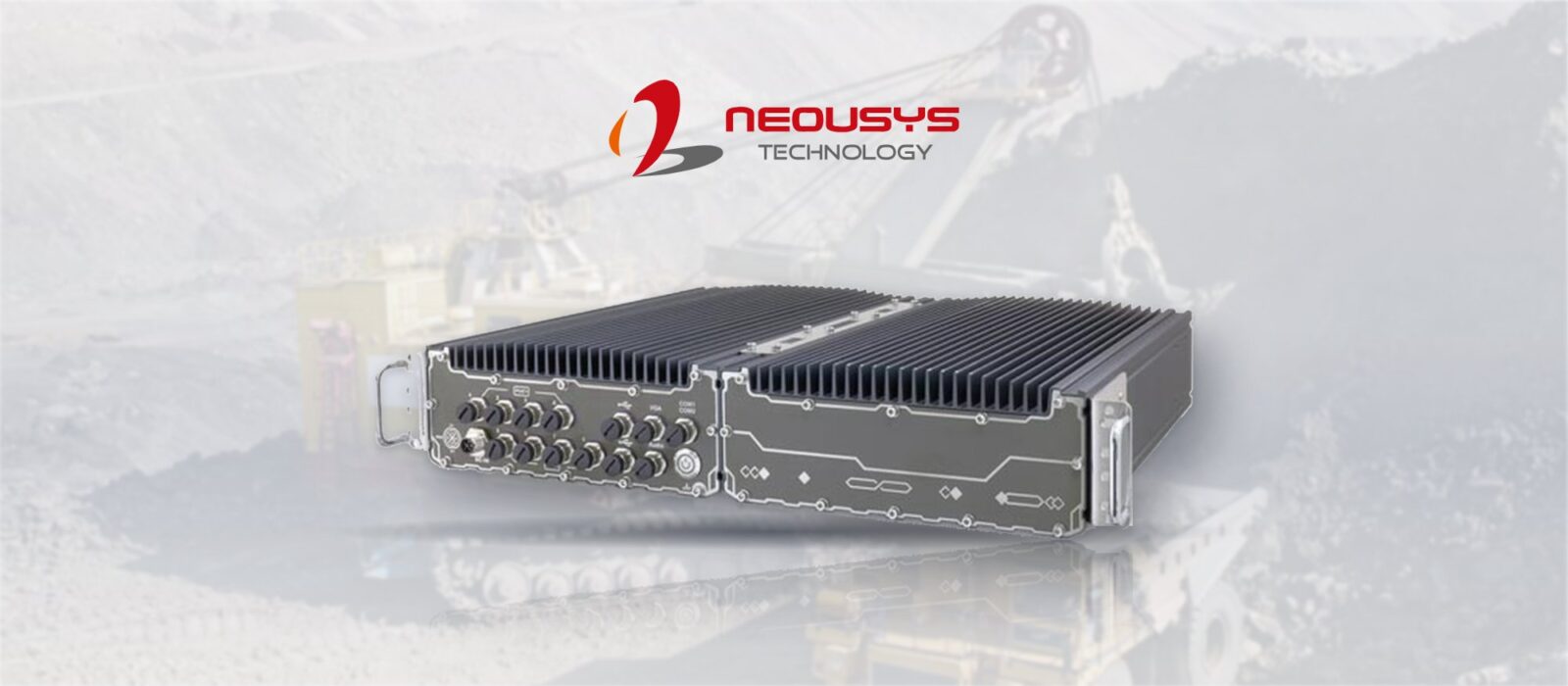
Waterproof rugged computers for autonomous mining trucks
Autonomous mining trucks haul ore around the clock with no driver in the cab. Each truck carries its own perception, control and recording systems, and each of them needs an industrial rugged computer that can live on the vehicle for years in dust, water, cold and constant vibration.
Autonomous mining moves the driver to a control room. The truck follows planned haul routes using cameras, LiDAR and positioning, while operators supervise the fleet remotely and step in when something unexpected happens. That puts more computing on the vehicle than a manned truck ever needed, and much of it has to sit outside the cab. Our waterproof computers carry their sealing in the chassis, so they mount straight onto the truck without a separate enclosure.
What autonomous mining trucks ask of their computers
A mine site is hard on electronics in every way at once, and an autonomous truck cannot stop for a technician every time a connector works loose.
-
01
Sealed against dust and water
Fine dust gets into any vent, and trucks are hosed down. Computers mounted outside the cab need an IP66 or IP67 rating of their own.
-
02
Connectors that stay put
Haul roads shake every cable for the whole shift. Locking M12 connectors hold their contact where standard plugs work loose.
-
03
Wide temperature range
Open pits run from freezing nights to hot afternoons, so fanless designs rated well below zero matter.
-
04
Vehicle power and ignition
A wide DC input and ignition control let each computer start and shut down cleanly with the truck.
-
05
GPU for perception
Camera and LiDAR models need a discrete GPU on the truck, because the decision to slow or stop cannot wait for a network.
-
06
A link to the control room
Status, alerts and video go back to the remote operators over the site's wireless or cellular network.
One computer for each job on the truck
Rather than one large computer doing everything, the truck uses a small set of systems, each sealed and sized for its position.
-
01 / 04Perception computer
Neousys SEMIL‑1700GC
The IP67 SEMIL-1700GC runs the perception models that turn camera and LiDAR data into a picture of the haul road. Its four PoE+ ports on X-coded M12 connectors power and connect the sensors directly, and the NVIDIA GPU sits inside the same fanless, sealed chassis.
- Platform
- NVIDIA RTX 2000 Ada (SEMIL‑1724GC‑ADA) or NVIDIA L4 (SEMIL‑1744GC‑ADA)
- Rated
- 8–48 V DC with ignition control; MIL‑STD‑810G shock and vibration

Fig. 01 Neousys SEMIL‑1700GC -
02 / 04Machine controller
Neousys POC‑766AWP
The POC-766AWP links the autonomy stack to the truck’s own systems. An isolated CAN 2.0B port reaches the vehicle bus, and isolated digital I/O handles switches and actuators, all on sealed M12 connectors in an IP67 chassis.
- Platform
- Intel Core i3-N305, eight cores within 15 W
- Rated
- 8–35 V DC with ignition control; MIL‑STD‑810H
- Network
- Isolated CAN, isolated RS‑232 and RS‑422/485, 2× 2.5GbE
Fig. 02 Neousys POC‑766AWP -
03 / 04Sealed gateway
Neousys POC‑465AWP
The POC-465AWP handles telemetry and the link to the control room. A mini PCIe socket with a micro SIM slot takes a 4G or Wi-Fi module, and the stainless steel and aluminium chassis keeps the boards away from dust and corrosion.
- Platform
- Intel Atom x6425E, 12 W TDP
- Rated
- IP66; −25 to 70 °C; MIL‑STD‑810G
- Network
- 2× 2.5GbE on M12 X-coded; isolated RS‑232 and RS‑422/485
Fig. 03 Neousys POC‑465AWP -
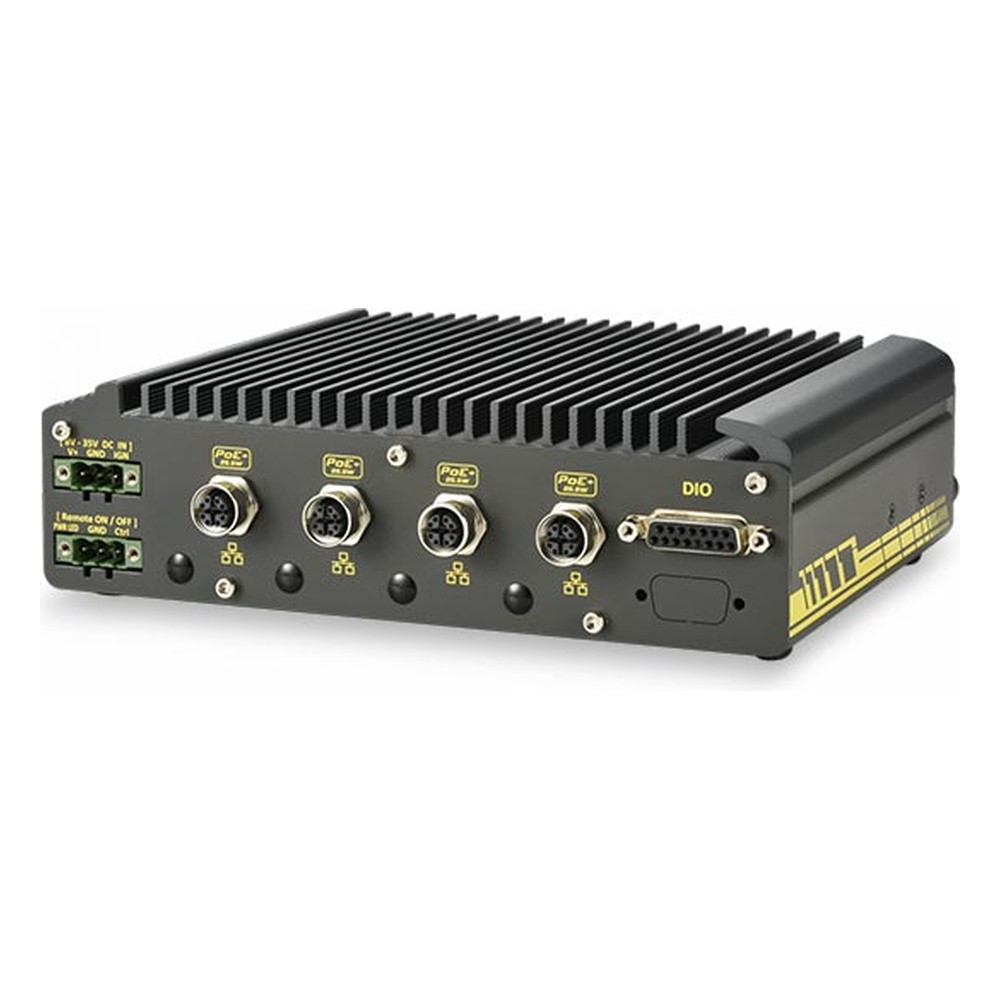
04 / 04In-cab camera recorder
Neousys Nuvo‑2610VTC
Inside the cab, the Nuvo-2610VTC records the truck’s cameras for incident review. It is not a waterproof computer, so it belongs in the cab, but it brings E-Mark certification, four PoE+ camera ports on locking M12 connectors and a front-accessible drive tray for video.
- Platform
- Intel Atom x6425E; 2.5-inch drive plus M.2 SATA SSD
- Rated
- 8–35 V DC with ignition control; −40 to 70 °C
- Network
- 4G or 5G module through an M.2 B key socket with two SIM slots
Fig. 04 Neousys Nuvo‑2610VTC
Computers on the truck
Two GPU builds of the SEMIL-1700GC for perception, two sealed controllers for the chassis and an E-Mark recorder for the cab.
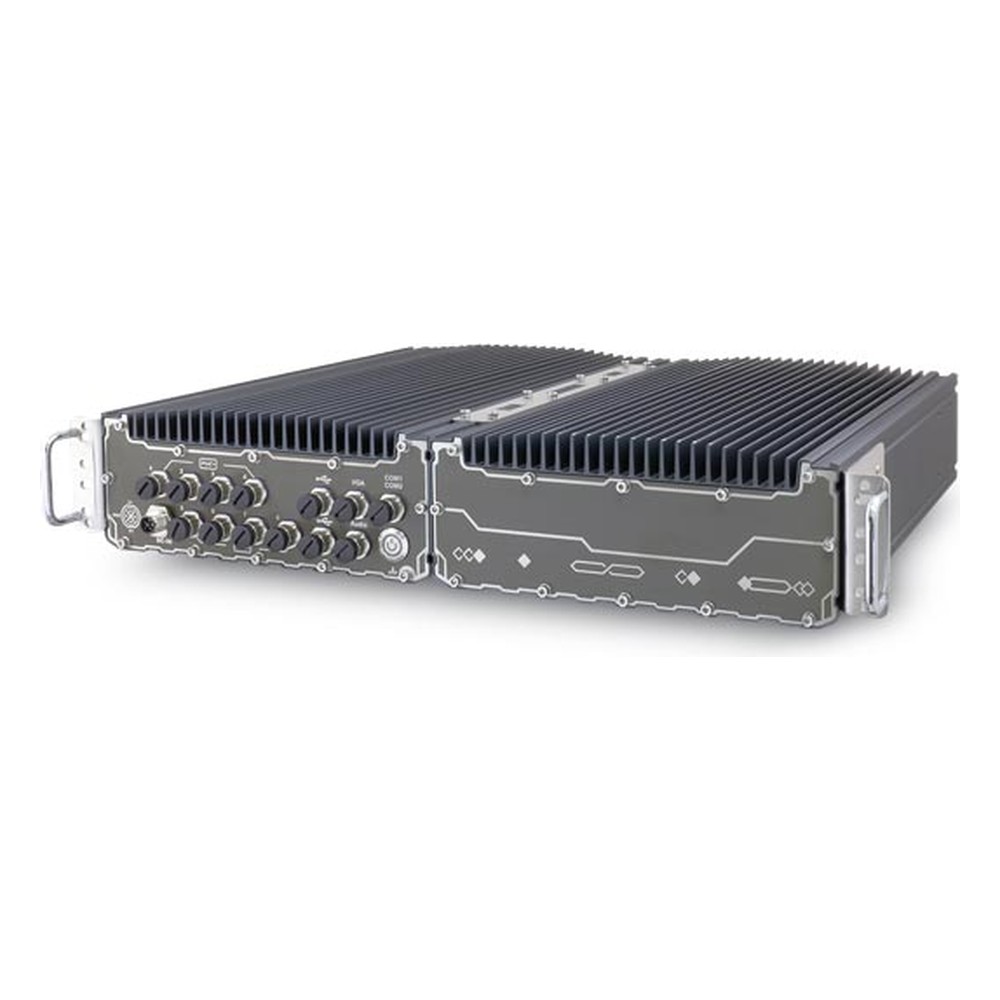
Intel Xeon E or 9th/8th Gen Core IP67 Tactical GPU Computer with RTX 2000 Ada and 4x PoE+
- CPU
- Intel Core 9th Gen (Coffee Lake)
- GPU
- NVIDIA RTX 2000 Ada
- AI
- 192 TOPS
Intel Xeon E or 9th/8th Gen Core IP67 Tactical GPU Computer with NVIDIA L4 and 4x PoE+
- CPU
- Intel Core 9th Gen (Coffee Lake)
- GPU
- NVIDIA L4
- AI
- 485 TOPS
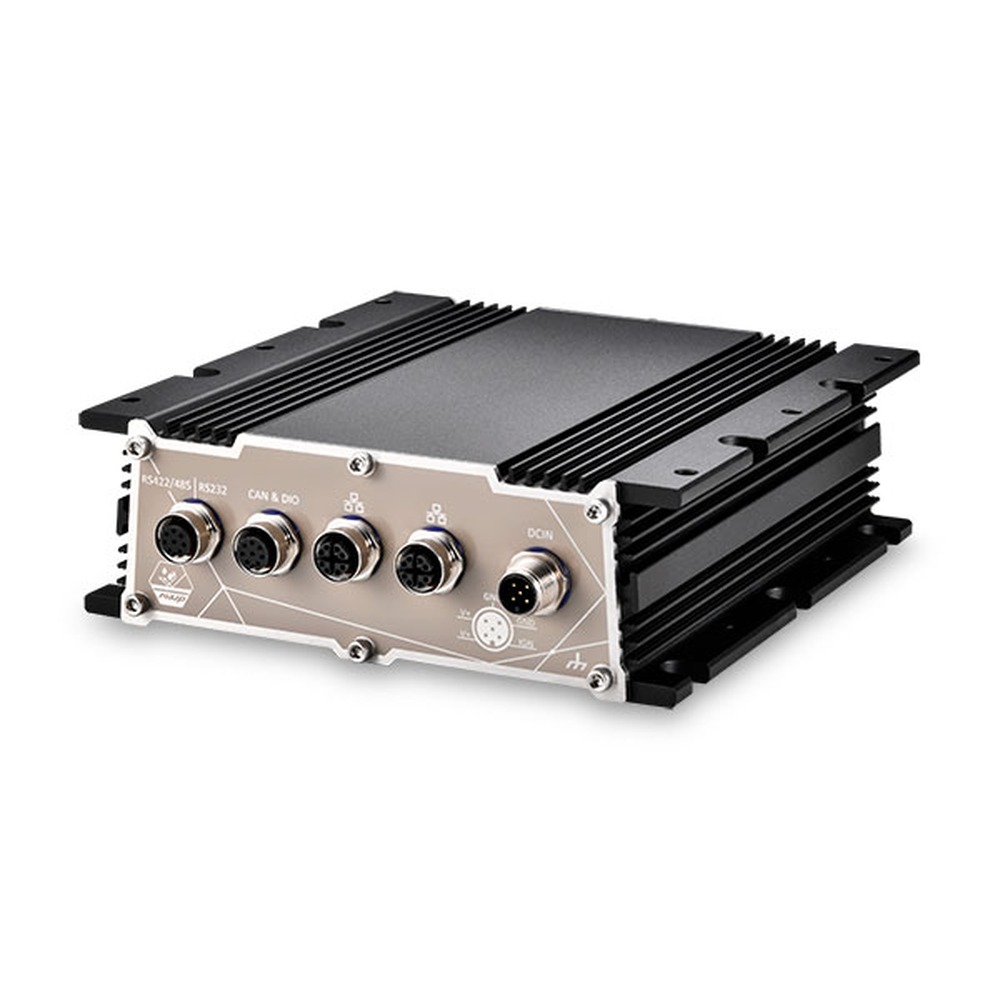
Intel Core i3-N305 IP67 Computer with M12 Connectors
- CPU
- Intel Core i3-N305 (Alder Lake)
- Ethernet
- 2× 2.5GbE
- IP Rating
- IP67
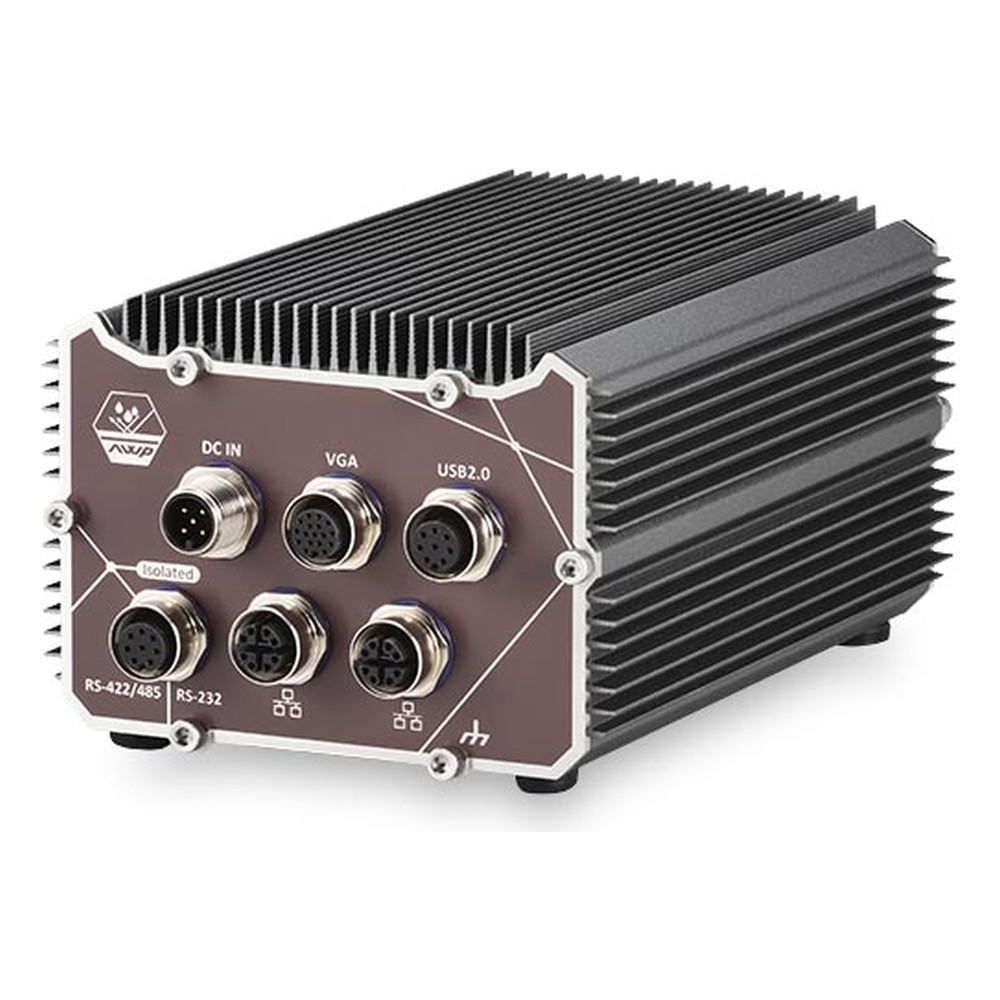
Intel Atom x6425E IP66 Rugged Mini PC with M12 2.5GbE and Isolated COM Ports
- CPU
- Intel Atom x6425E (Elkhart Lake)
- Ethernet
- 2× 2.5GbE
- IP Rating
- IP66
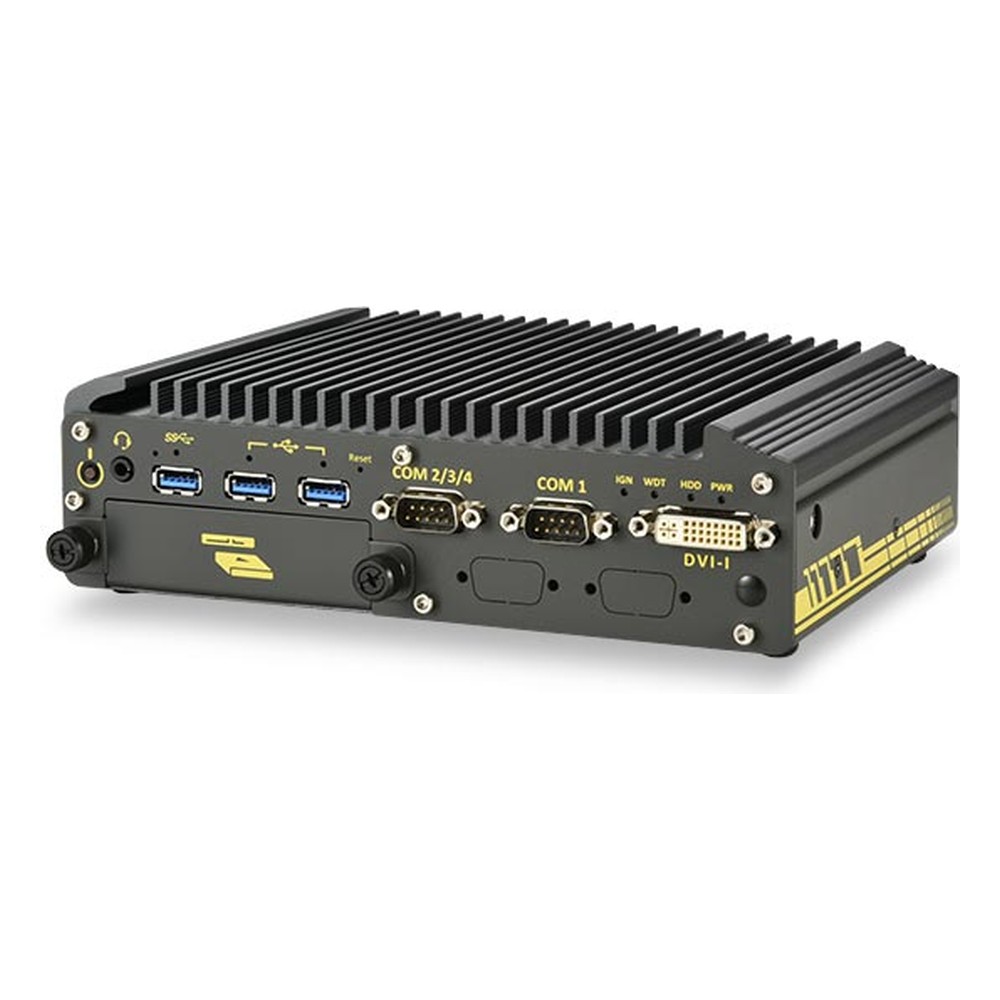
Intel Atom x6425E Rugged Fanless PC with 4x M12 PoE+, Ignition Control and E-Mark
- CPU
- Intel Atom x6425E (Elkhart Lake)
- Ethernet
- 4× GbE (4× PoE)
- Temp
- −40 to +70 °C
Where each computer sits
| Specification | Neousys SEMIL-1724GC-ADA | Neousys SEMIL-1744GC-ADA | Neousys POC-766AWP | Neousys POC-465AWP | Neousys Nuvo-2610VTC |
|---|---|---|---|---|---|
| Role on the truck | Perception | Perception, larger models | Machine control | Telemetry gateway | In-cab camera recorder |
| GPU | NVIDIA RTX 2000 Ada, 16 GB | NVIDIA L4, 24 GB | Intel UHD Graphics | Intel UHD Graphics | Intel UHD Graphics |
| Processor | Intel Xeon E or 9th/8th Gen Core | Intel Xeon E or 9th/8th Gen Core | Intel Core i3-N305 | Intel Atom x6425E | Intel Atom x6425E |
| Ingress protection | IP67 | IP67 | IP67 | IP66 | None (in-cab) |
| Camera and sensor ports | 4× GbE PoE+, M12 X-coded | 4× GbE PoE+, M12 X-coded | 2× 2.5GbE, M12 X-coded | 2× 2.5GbE, M12 X-coded | 4× GbE PoE+, M12 X-coded |
| Vehicle I/O | 2× RS-232, M12 | 2× RS-232, M12 | Isolated CAN, isolated DIO, RS-232, RS-422/485 | Isolated RS-232 and RS-422/485 | Isolated DIO, 5× serial |
| Power | 8–48 V DC, ignition control | 8–48 V DC, ignition control | 8–35 V DC, ignition control | 8–35 V DC, ignition control | 8–35 V DC, ignition control |
| Operating temperature | −40 to 70 °C (35 W CPU) | −40 to 70 °C (35 W CPU); NVIDIA requires 0 to 50 °C for L4 warranty | −25 to 70 °C | −25 to 70 °C | −40 to 70 °C |
| Shock and vibration | MIL-STD-810G | MIL-STD-810G | MIL-STD-810H | MIL-STD-810G | MIL-STD-810G, IEC 61373 |
| Certification | CE, FCC | CE, FCC | CE, FCC, UL 62368-1 | CE, FCC | CE, FCC, E-Mark |
The temperature row decides the GPU. The L4 carries more memory and AI performance, but NVIDIA’s warranty policy limits systems with an L4 to 0 to 50 °C, so the RTX 2000 Ada build is the one to choose for pits that freeze. We fit the GPU, processor, memory and storage for the models the truck runs, install the operating system, set ignition timing and BIOS power behaviour, and match the M12 cable sets to each mounting position. Our guide to M12 connectors explains the codings used on each port.
What this setup gives the operator
Splitting the work across sealed computers keeps each job on hardware suited to where it sits on the truck.
-
Outcome 01
No enclosures to maintain
IP66 and IP67 chassis mount directly on the truck, so there are no cabinet seals or glands to inspect.
-
Outcome 02
Decisions made on the vehicle
Perception runs on the onboard GPU, so the truck can react to the road without waiting on the network.
-
Outcome 03
Connections that hold
Locking M12 connectors on every external port stand up to the vibration of a haul road.
-
Outcome 04
Clean starts and shutdowns
Ignition control on every computer ties power-up and shutdown to the truck, protecting storage and software.
Autonomous mining FAQs
-
What Is the NVIDIA RTX 2000 Ada?
The NVIDIA RTX 2000 Ada is a low-profile professional GPU based on the Ada Lovelace architecture, with 16 GB of GDDR6 memory with ECC and a 70 W maximum power rating. It suits AI inference, vision and multi-display work in compact and rugged computers, and also comes as a single-slot 50 W RTX 2000E and an embedded MXM module.
-
What Is an Autonomous Haulage System?
An autonomous haulage system runs driverless haul trucks in a mine. Each truck uses positioning, radar, LiDAR and cameras to follow planned routes between loading and dumping points, while fleet management software assigns the work and staff in a control room supervise the fleet and step in when needed.
-
What Is the NVIDIA L4?
The NVIDIA L4 is a low-profile, single-slot GPU based on the Ada Lovelace architecture, with 24 GB of GDDR6 memory and a 72 W power rating. It is built for AI inference and video processing, and its low power and passive heatsink let it fit compact servers and rugged edge computers where larger GPUs will not.
-
What Is Autonomous Mining?
Autonomous mining uses driverless haul trucks, drills, loaders and dozers that operate without a person in the cab. The machines combine GNSS positioning, LiDAR, radar and cameras with onboard computers and a site control system, so they can haul, drill and load around the clock while keeping people out of hazardous areas.
-
What does IP67 mean?
IP67 means an enclosure is dust-tight and protected against temporary submersion in water up to 1 metre deep for 30 minutes. It is the standard rating for field-deployed equipment that might be briefly immersed — agricultural sensors, military field hardware, marine bilge installations — equivalent to NEMA 6 in North American markets.
-
What Is an M12 X-Coded Connector?
An M12 X-coded connector is the 8-pin M12 coding for Gigabit and 10 Gigabit Ethernet. Its four twisted pairs are separated by a cross-shaped shield that controls crosstalk at high speed, and it can carry Power over Ethernet with a suitable cable. It is defined in IEC 61076-2-109.
-
iGPU vs dGPU: What Is the Difference?
An iGPU (integrated GPU) is built into the processor and shares the system memory, so it adds little power, heat or cost. A dGPU (discrete GPU) is a separate graphics processor with its own memory, offering far more performance but needing more power, cooling and space. For edge AI, iGPUs suit lighter inference and dGPUs suit heavy workloads.
Specifying computers for a mining vehicle?
Tell us the truck, the sensors and the software it runs, and we'll match the sealing, processing and cabling to each position on the vehicle.