
 UK
SolidRun Bedrock R8000: a fanless Ryzen Embedded 8000 industrial PC
The SolidRun Bedrock R8000 is a fanless industrial PC built around the AMD Ryzen Embedded 8000 processor, with eight Zen 4 cores, 16 threads and speeds up to 5.1 GHz. We supply it for machine control, vision and edge AI where a high-power x86 processor has to run without a fan in a control cabinet or sealed enclosure.
What sets it apart is the thermal design. A dual-layer heatsink improves convective cooling by 1.7×, so the Bedrock R8000 can dissipate significantly more heat than fanless PCs of a similar size, and it adds room for up to three Hailo AI accelerators alongside the processor’s own NPU.
How the dual-layer heatsink works

The processor is coupled to the aluminium chassis with a liquid metal thermal interface material, which cuts thermal resistance. Stacked copper heat pipes spread the heat to every side of the chassis, where two layers take it away: aluminium air ducts that draw air through by the chimney effect, and a layer of conventional cooling ribs. Together they let the Bedrock R8000 dissipate over three times the heat of fanless PCs of a similar size, and processor power can be set from 8 to 54 W.
For sealed enclosures with no airflow, the ribbed walls can be swapped for flat walls with blind threads that bolt to a cold plate. Our explainer on how a fanless PC sheds heat walks through the heatsink, heat-pipe and chimney-effect principles behind the design.
What the Bedrock R8000 brings
- 01Ryzen Embedded 8000 performance
- Eight cores and 16 threads on the 8845HS, 8840U or Ryzen 9 PRO 8945HS, with Radeon 780M graphics and ECC memory support.
- 02Over 100 TOPS of AI
- A 16 TOPS Ryzen AI NPU plus up to three Hailo-8 or Hailo-10 accelerators.
- 03Dual-layer fanless cooling
- Liquid metal TIM, stacked copper heat pipes and chimney-effect air ducts, with a conduction-cooled Tile option.
- 04Up to 96 GB DDR5
- Two DDR5-5600 SO-DIMM sockets for ECC or non-ECC memory, with NVMe storage up to 4 TB.
- 05Wide temperature and power
- Builds rated 0 to 70 °C or −40 to 85 °C, with power modules that widen the input to 12–60 V DC.
Bedrock R8000
One configurable platform: choose the processor, enclosure, network board, AI accelerators and power module to suit the application.
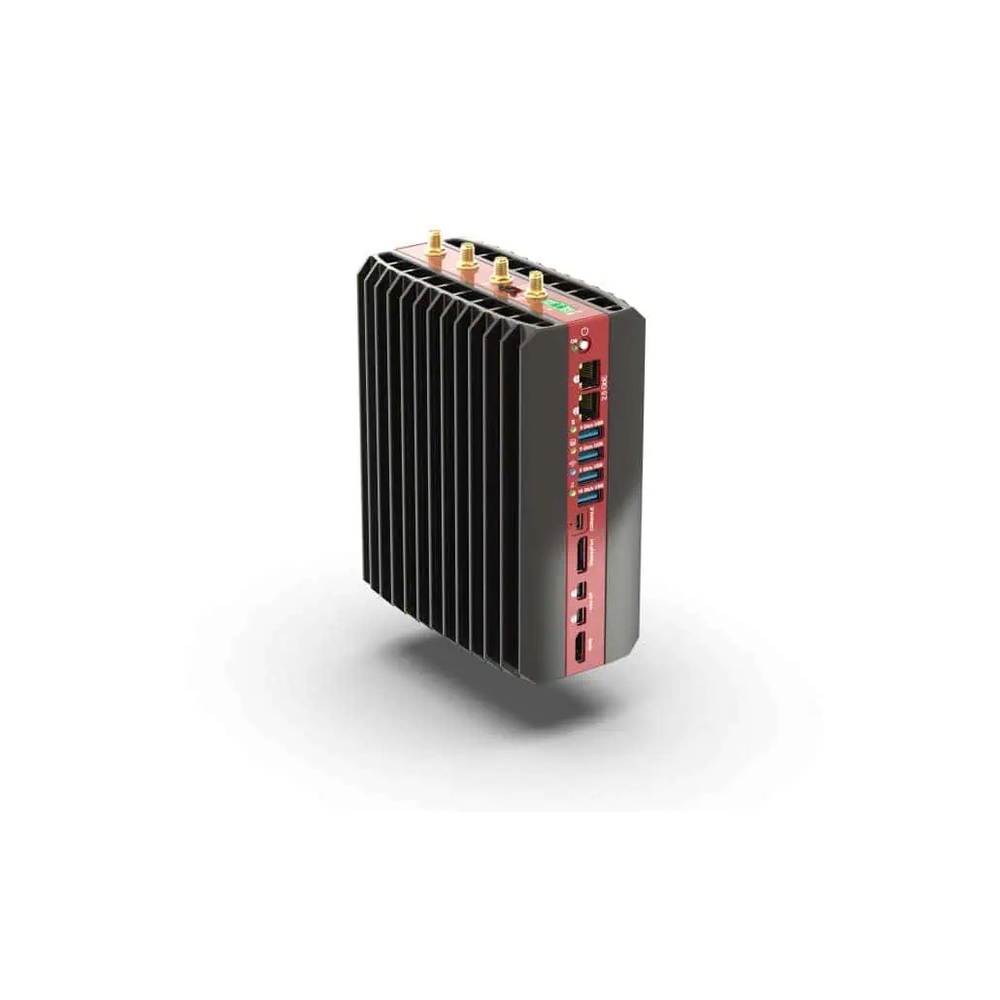
BEDROCK R8000
AMD Ryzen Embedded 8845HS DIN Rail Industrial PC with Hailo AI Options and 4x 2.5GbE
- AI accelerator
- 16–40 TOPS
- Processor
- AMD Ryzen Embedded 8000
- Networking
- 4× 2.5GbE
- Operating temp
- −40 to +85 °C
- Power Input
- 12–60 V DC Input [Terminal Block]
Specification highlights
| Specification | SolidRun Bedrock R8000 |
|---|---|
| Processor | AMD Ryzen Embedded 8845HS, Ryzen 9 PRO 8945HS (45 W), Ryzen Embedded 8840U (15 W) or Ryzen 3 7440U |
| Graphics and NPU | Radeon 780M; 16 TOPS Ryzen AI NPU |
| Memory | 2× DDR5-5600 SO-DIMM, up to 96 GB, ECC or non-ECC |
| Storage | NVMe SSD, 256 GB–4 TB; 960 GB Micron 7450 with power loss protection |
| AI expansion | 2× M.2 for Hailo-8, Hailo-10 or NVMe; M.2 key-E for Wi-Fi 6E or a third Hailo-8 |
| Networking | 4× 2.5GbE (Intel I226) with USB4, or 2× 2.5GbE |
| Cellular | LTE Cat 4, LTE Cat 12 or 5G modem |
| Display | Up to 4× via HDMI 2.1 and DisplayPort 2.1 |
| Enclosures | 60W, 30W or Tile (cold plate); DIN rail, wall, VESA or desk mounting |
| Power | 12–24 V DC; 12–60 V or 12–48 V with the PM 1260 or PM 1248 module |
| Temperature | 0 to 70 °C or −40 to 85 °C |
The enclosure follows the processor: the 60W enclosure for the 45 W parts, the 30W for the 15 W parts, and the Tile for either when the heat goes into a cold plate or chassis wall.
A closer look
-
01

60W enclosure
The Bedrock R8000 in the 60W fanless enclosure for the 45 W processors, shown with antennas.
-
02
30W enclosure
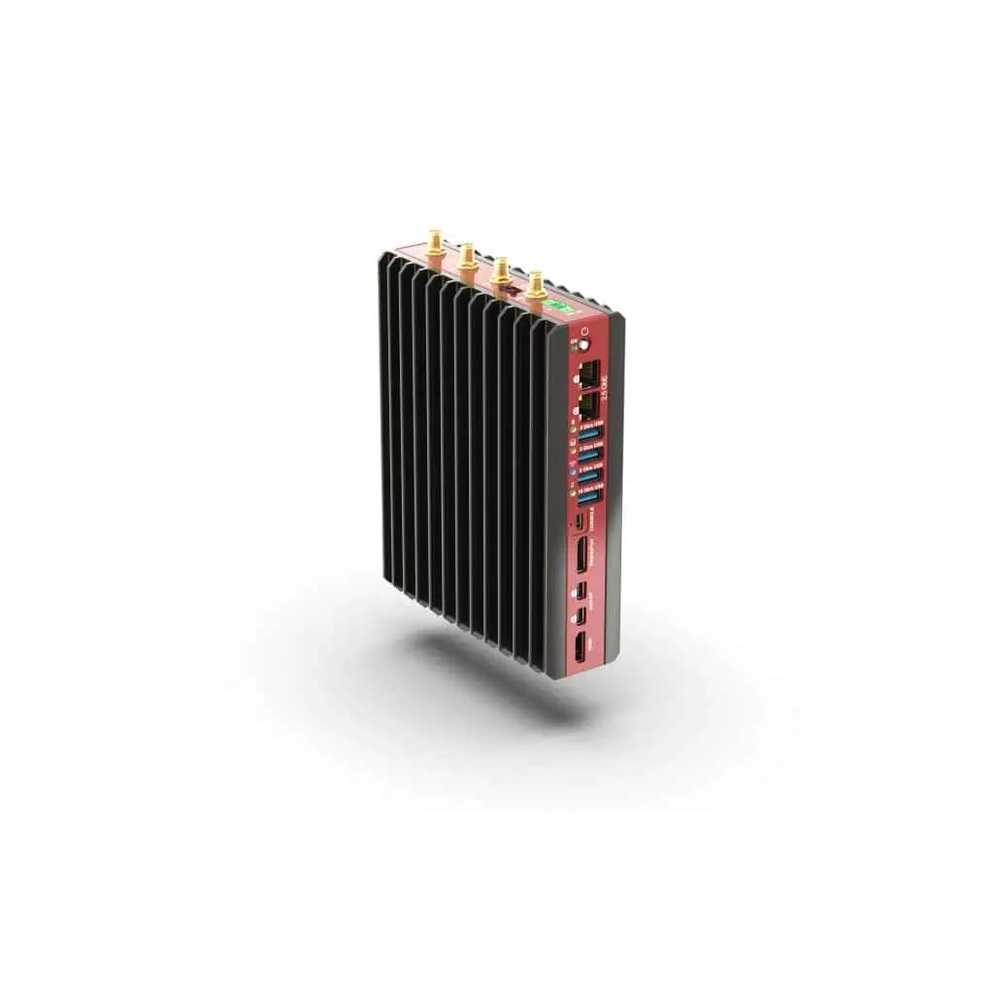
The narrower 30W fanless enclosure for the 15 W processors, with the antenna top panel.
-
03
Tile enclosure
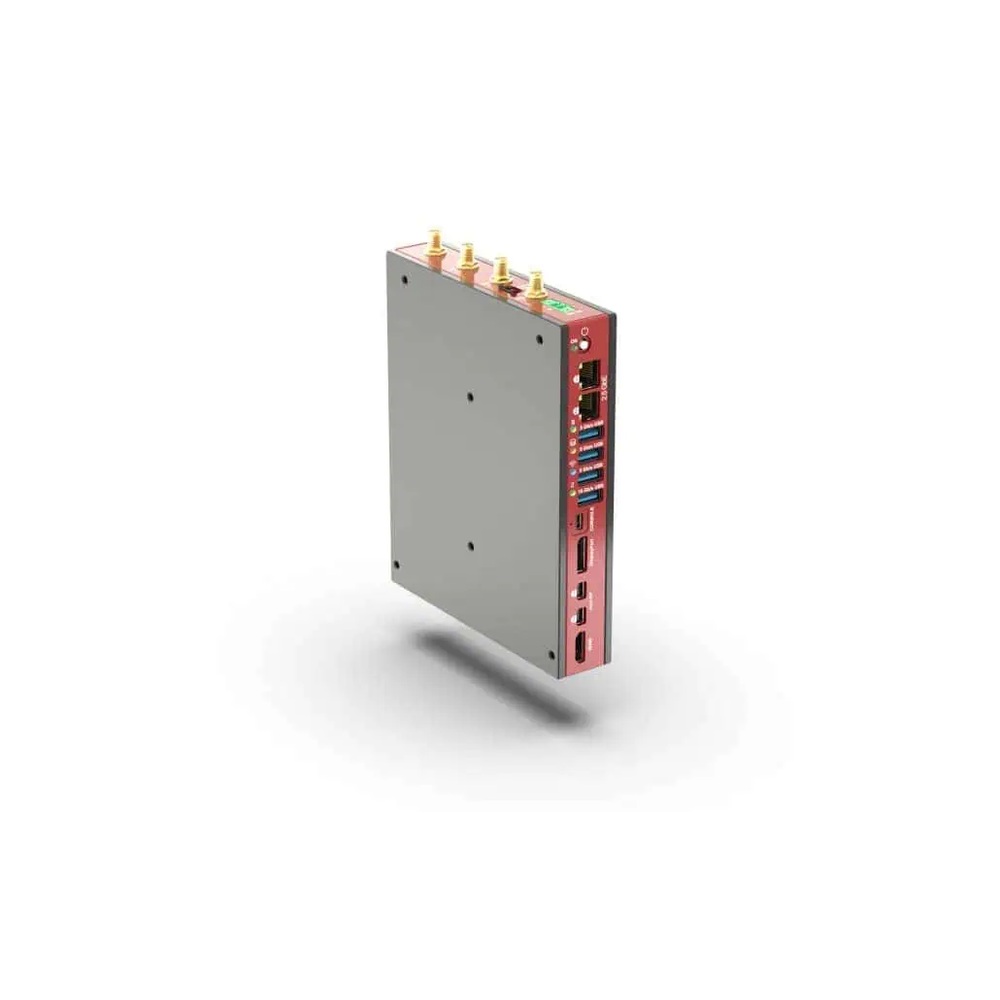
The low-profile Tile, cooled by conduction into a cold plate or chassis wall.
-
04

Configuration block diagram
How the network, AI, storage and power boards combine around the Ryzen Embedded 8000 processor.

Scaling AI with Hailo accelerators
The Ryzen AI NPU delivers 16 TOPS, and the full processor reaches 39 TOPS. On top of that, the Bedrock R8000 takes up to three Hailo AI accelerators: the Hailo-8 at 26 TOPS for efficient inference, and the Hailo-10 at 40 TOPS for generative AI. With all three slots in use, combined AI performance passes 100 TOPS.
Our guide to Hailo-8 for edge AI covers where a dedicated accelerator earns its slot.
Where the Bedrock R8000 fits
Applications that need eight-core x86 performance and AI in a fanless computer that can sit on a DIN rail or inside a sealed enclosure.
Machine control and vision
Control, vision and edge AI share one DIN rail computer in the control cabinet.

Video analytics
Multi-stream video analytics and recording, with Hailo accelerators taking the inference load.
Generative AI at the edge
Hailo-10 accelerators at 40 TOPS each run generative AI models on site rather than in the cloud.
Sealed enclosures
The Tile enclosure conducts heat into a cold plate where there is no airflow at all.
Robot fleet coordination
A Bedrock R8000 coordinating a cold-chain autonomous mobile robot fleet.
Read case studyHow the R8000 compares with the R7000
The Bedrock R8000 follows the R7000 in the same enclosures and mounting, so the step between them is mostly silicon and memory. The R7000 Edge AI is the closest comparison, as it also takes Hailo accelerators.
| Specification | SolidRun Bedrock R8000 | SolidRun Bedrock R7000 Edge AI |
|---|---|---|
| Processor | AMD Ryzen Embedded 8845HS, Ryzen 9 PRO 8945HS, Ryzen Embedded 8840U or Ryzen 3 7440U | AMD Ryzen 7 7840HS, Ryzen 7 7840U or Ryzen 3 7440U |
| Processor NPU | 16 TOPS Ryzen AI NPU | 10 TOPS NPU (7840U and 7840HS) |
| Hailo accelerators | Up to 3× Hailo-8 (26 TOPS) or Hailo-10 (40 TOPS) | Up to 3× Hailo-8 (26 TOPS each) |
| Memory | 2× DDR5-5600 SO-DIMM, up to 96 GB, ECC or non-ECC | 2× DDR5 SO-DIMM, up to 64 GB with ECC |
| Networking | 4× 2.5GbE (Intel I226) with USB4, or 2× 2.5GbE | 2× 2.5GbE (Intel I226) |
| Displays | Up to 4× via HDMI 2.1 and DisplayPort 2.1 | 4×: HDMI 2.1, DisplayPort 2.1, 2× mini DisplayPort 2.1 |
| Enclosures | 60W, 30W or Tile | 30W, 60W or Tile |
| Power | 12–24 V DC; 12–60 V or 12–48 V with a power module | 12–60 V DC |
| Temperature | 0 to 70 °C or −40 to 85 °C | −40 to 85 °C (industrial builds) |
Choose the R8000 for the larger NPU, Hailo-10 for generative AI, up to 96 GB of memory or four 2.5GbE ports. AMD guarantees 10-year availability for Ryzen Embedded 8000 processors, and AMD PRO technology adds security and reliability features. Both sit in the SolidRun Bedrock range alongside the V3000, and our range of fanless industrial PCs covers other processors.
The Bedrock R8000’s dual-layer heatsink cools 45 W Ryzen processors and up to three Hailo accelerators without a fan. Send us the enclosure, its airflow and the AI load, and we’ll match the 60W, 30W or Tile build to it.
Bedrock R8000 FAQs
-
What Are the Advantages of Fanless Computers?
Fanless computers cool themselves passively, through a finned heatsink chassis and heat pipes, instead of a fan. With no moving parts and no airflow drawing in dirt, they are more reliable in dusty or vibrating places, completely silent, low maintenance and easy to seal, which is why they are the standard choice for industrial and embedded use.
-
What Is the Industrial Temperature Range?
The industrial temperature range is −40 to 85 °C: the grade an electronic component must operate across to be called industrial, compared with 0 to 70 °C for commercial parts. Rugged computers built from industrial-grade components typically run from −25 or −40 °C up to 70 °C as a complete system.
-
Is 2.5GbE fast enough for edge AI?
Sufficient for lightweight workloads — single-camera inference, gateway aggregation — but usually insufficient for multi-camera analytics, multi-sensor fusion, or multi-node edge AI clusters.
-
NVMe vs SATA on M.2 — which should I specify?
An M.2 SATA SSD and an M.2 NVMe SSD look identical to the casual eye but their performance is in different leagues. Here's how to tell them apart and what to specify.
-
What is M.2 keying and why does it matter?
M.2 sockets carry up to 67 pins, but only certain interfaces are wired to certain pins. Physical key notches enforce which modules can install in which sockets — preventing electrical incompatibility before procurement.
Need a fanless Ryzen industrial PC for AI?
Tell us about your application and a member of our team will get right back to you.