
 UK
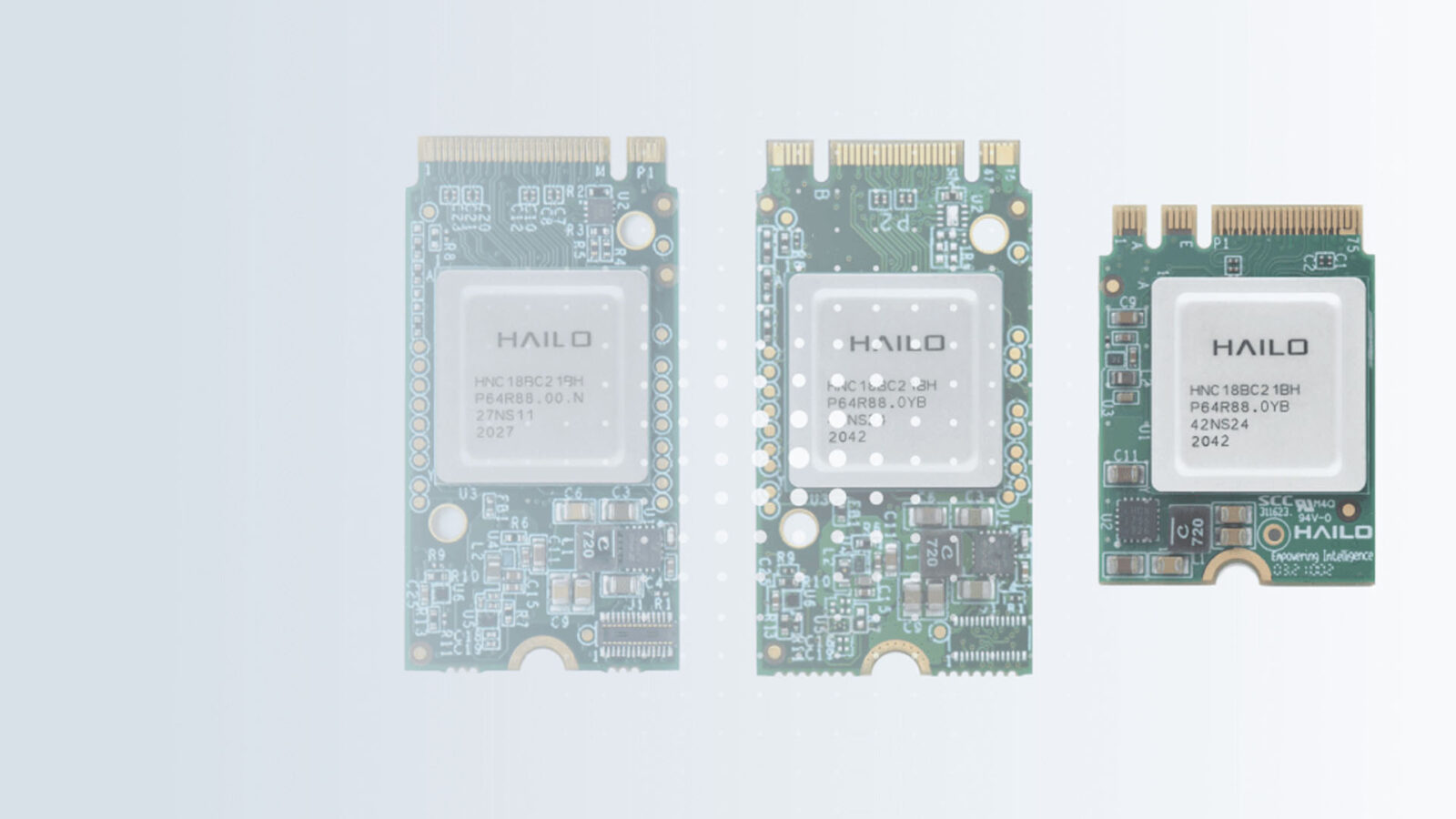
Hailo-8 AI Accelerators: Benefits and Integration for Edge Computing
The Hailo-8 runs deep learning inference at up to 26 TOPS on around 2.5 W. This guide covers how it works, how it compares with the Hailo-8L and Hailo-10H, and how to build it into an industrial edge computer.
The Hailo-8 is an AI accelerator chip that runs deep learning inference at up to 26 TOPS while drawing around 2.5 W, so a compact edge computer can run real-time vision models without a GPU. It sits beside the host processor on an M.2 or mini PCIe module and takes the neural network workload off the CPU.
Hailo was founded in Tel Aviv in 2017 to design processors for AI at the edge, and the Hailo-8 is its most widely deployed chip. It is used wherever video has to be analysed where it is captured: traffic junctions, factory lines, rail vehicles, shops and security systems. This guide covers how it works, how it compares with the Hailo-8L and Hailo-10H and with Jetson and on-chip NPUs, the module formats and PCIe lanes, the software path from a trained model to the chip, power and cooling, and how to build it into an industrial computer.
Running inference at the edge rather than in the cloud gives:
- Real-time decisions, with no round trip to a data centre
- Lower bandwidth, because only results or metadata leave the site
- Better data privacy, because images stay on the device
- Operation that continues when the network does not
- Lower running costs than streaming video to cloud inference
Our explainer on edge AI vs cloud AI sets out the trade-offs in more detail.
Key takeaways
- 0126 TOPS at a few watts
- The Hailo-8 delivers up to 26 TOPS at around 2.5 W typical, enough for detection, classification and tracking on several HD camera streams.
- 02No external memory
- The network runs in memory on the chip, so modules stay small and simple to integrate into fanless systems.
- 03Three chips, one toolchain
- The Hailo-8L covers lighter models at up to 13 TOPS and the Hailo-10H adds memory on the module for generative AI; all three use the same Dataflow Compiler and HailoRT.
- 04Any host processor
- The accelerator connects over PCIe, so it pairs with Intel, AMD or Arm processors and Windows or Linux.
- 05System choice matters most
- Temperature range, sealing, camera I/O and power input decide whether a Hailo-8 system survives the site; integration is where most of the engineering goes.
Hailo-8, Hailo-8L and Hailo-10H compared
Hailo now offers three accelerators for edge computers. They share a software stack, so a model can move between them as the application changes. Figures are from Hailo’s published specifications; check the current data sheet for the exact module.
| Feature | Hailo-8L | Hailo-8 | Hailo-10H |
|---|---|---|---|
| Performance | Up to 13 TOPS | Up to 26 TOPS | Up to 40 TOPS (INT4) |
| Typical power | Lower than Hailo-8 | Around 2.5 W | A few watts |
| Memory | On chip | On chip | 8 GB LPDDR4 on the module |
| Host interface | PCIe Gen3 | PCIe Gen3, up to 4 lanes | PCIe Gen3 |
| Form factors | M.2 modules, Raspberry Pi AI kits | M.2 M key, B+M key, A+E key and mini PCIe modules; multi-chip PCIe cards | M.2 M key module |
| Best for | Single-camera and lighter vision models | Multi-stream vision and video analytics | Generative AI: small language and vision language models |
For most industrial vision work the Hailo-8 is the default: it has the widest choice of modules and the most systems built around it. Choose the Hailo-8L when the model is small and cost or power is tight, and the Hailo-10H when the application needs a language or vision language model to run on site. See every system we build around them on our Hailo AI accelerator computers page.
Is Hailo-8 better than Jetson Orin Nano?
They are different tools rather than rivals. A Hailo-8 is an accelerator that adds AI to a computer you choose for other reasons; a Jetson Orin Nano is a complete computer with a GPU, Arm CPU and memory on one module. An NVIDIA GPU or Jetson Orin Nano offers more flexibility and a wider choice of software and models, at higher power. The NPU built into recent Intel Core Ultra and AMD Ryzen AI processors needs no extra hardware, but has less performance for multi-camera work. The Hailo-8 sits between them: dedicated performance at a few watts, added to almost any x86 or Arm computer.
| Option | Published AI rating | Precision | Power for the AI part | Host | Software | Best fit |
|---|---|---|---|---|---|---|
| Hailo-8 M.2 | 26 TOPS | INT8 (some INT4 and INT16 layers) | Around 2.5 W typical | Any x86 or Arm computer with PCIe | Dataflow Compiler, HailoRT | Adding vision AI to an industrial PC or Arm box |
| Jetson Orin Nano 8GB | 40 TOPS, 67 TOPS in Super mode | FP32, FP16, INT8 | 7–25 W module | Is the computer | JetPack, CUDA, TensorRT | Flexible models, GPU video pipelines, robotics |
| Intel Core Ultra NPU | Around 11–13 TOPS on H-series parts | INT8, FP16 | A few watts inside the processor | Built in | OpenVINO | Light models beside a Windows or Linux application |
| AMD Ryzen AI 300 NPU | 50 TOPS | INT8, block FP16 | A few watts inside a 15–54 W processor | Built in | Ryzen AI software | Newer AMD systems with a strong integrated NPU |
| NXP i.MX 8M Plus NPU | 2.3 TOPS | INT8 | Under a watt | Built in | eIQ | Low-power Arm gateways and HMIs |
| Rockchip RK3588 NPU | 6 TOPS | INT8, INT4, FP16 | A few watts | Built in | RKNN toolkit | Cost-sensitive Arm vision devices |
Choose a Hailo-8 when you want to keep an x86 application, Windows, or a specific industrial computer and add vision AI with little extra heat. Choose a Jetson when the models change often, need FP16 or a GPU, or the project needs CUDA. Choose the on-chip NPU when one or two light models are enough. For a fuller comparison, read our comparison of GPUs and NPUs for edge AI, our explainer on what an NPU does and our guide to how many TOPS an application needs.
How the Hailo-8 dataflow architecture works
A CPU or GPU fetches data from shared memory, processes it and writes it back, over and over. For neural networks that constant traffic costs time and power. The Hailo-8 instead uses a dataflow architecture: the compiler maps each layer of the network onto its own set of compute, memory and control resources on the chip, and data flows through them in sequence.
Compute
Many parallel processing elements are allocated to each layer according to how much work it needs, so full HD video streams can be processed in real time without down-sampling.
Memory
Weights and intermediate results are held in memory beside the compute elements that use them. The Hailo-8 needs no external DRAM, which keeps the module small and its power low. It also sets a limit: a model too large for the on-chip memory is split into contexts that the chip switches between, which costs throughput.
Control
A control fabric schedules the flow of data between layers and manages the PCIe link to the host, which only has to send frames in and read results out.
For larger workloads, several Hailo-8 chips can run together on multi-chip PCIe cards, sharing a model or running separate models side by side. Our explainer on AI accelerators places the dataflow approach alongside GPUs and other NPUs.
Hailo-8 form factors and PCIe lanes
Hailo-8 modules come in several formats. The chip talks to the host over PCIe Gen3 with up to four lanes, and the slot decides how many lanes it gets. The M key module uses all four lanes and gives the full 26 TOPS on heavy multi-stream work; B+M, A+E and mini PCIe slots usually carry fewer lanes, which suits lighter models or fewer cameras, and fits smaller boards and systems.
| Format | Typical PCIe link | Fits | Suits |
|---|---|---|---|
| M.2 M key, 2242 or 2280 | Gen3 x4 | NVMe-style M key sockets | Full throughput, multi-stream video |
| M.2 B+M key, 2242 or 2280 | Gen3 x2 | B key or M key sockets | Boards whose M.2 socket carries two lanes |
| M.2 A+E key, 2230 | Gen3 x1 or x2, depending on the socket | Wi-Fi style E key sockets | Compact boxes with a spare wireless slot |
| Mini PCIe | A single lane | Full-size mini PCIe slots | Older or very compact systems |
| PCIe add-in card | Several Hailo-8 chips behind a PCIe switch | PCIe x4 to x16 slots | Many cameras or several models in one server |
| Raspberry Pi AI HAT+ | One lane on the Raspberry Pi 5 | Raspberry Pi 5 | Prototypes and education, 13 or 26 TOPS versions |
Lane count matters most when a lot of data crosses the link: many high-resolution streams, large input images, or a model split into contexts that reloads weights. A single-lane slot can still give near-full throughput on a small detector with a modest input size. Our guide to M.2 slots and keys explains which modules fit which slots, and our explainer on M.2 keying covers the notch positions. Several systems in our range trade an NVMe socket for a Hailo module: the SolidRun RAI300 takes up to two Hailo-8 or Hailo-10 modules in its M.2 M key 2242 sockets.
Hailo software: Dataflow Compiler, HailoRT, TAPPAS and Model Zoo
Hailo supplies the tools to take a trained model to a running application on the device.
- Dataflow Compiler: converts a trained model from common frameworks such as TensorFlow and PyTorch (via ONNX) into a program for the chip, quantising it and mapping each layer to on-chip resources.
- HailoRT: the runtime and driver on the host, with C++ and Python APIs and GStreamer support for video pipelines on x86 and Arm.
- Model Zoo: pre-trained and pre-compiled models for detection, segmentation, pose estimation and classification, including popular YOLO networks, as a starting point for custom work.
- TAPPAS: example application pipelines that show multi-stream detection and tracking end to end.
From ONNX to HEF. The compiled output is a Hailo Executable Format (HEF) file that HailoRT loads onto the chip. The usual path has six steps.
| Step | What happens | Watch for |
|---|---|---|
| 1. Export | Export the trained PyTorch or TensorFlow model to ONNX or TensorFlow Lite | Fixed input size; supported operators |
| 2. Parse | The Dataflow Compiler reads the model into its own representation | Unsupported layers to replace or move to the host |
| 3. Optimise and quantise | Weights and activations are converted to 8-bit using a calibration set of your own images | Use representative images; check accuracy after quantisation |
| 4. Compile | Layers are allocated to compute and memory on the chip and written to a HEF file | Models too large for one context lose some throughput |
| 5. Run | HailoRT loads the HEF; GStreamer or the Python API feeds frames and reads results | Pre- and post-processing load on the host CPU |
| 6. Validate | Measure frames per second and accuracy on the real cameras | Thermal throttling in the sealed enclosure |
What models does Hailo-8 support? Convolutional networks for detection, classification, segmentation, pose estimation and re-identification are its home ground, and the Model Zoo also includes some transformer-based vision models. The quantisation step is the same idea as INT8 quantization on other accelerators. Large language models are not a fit, because the Hailo-8 has no external memory; that is the job of the Hailo-10H.
We supply Hailo-8 systems with the driver and runtime installed on a Windows or Linux image, so development starts on a working computer.
How much power does Hailo-8 use?
Hailo quotes around 2.5 W typical for the Hailo-8, which is why it fits fanless systems. Power rises with load, so a module running a large model on several streams draws more than one running a small detector, and short peaks can exceed the typical figure. Plan the heat path for several watts per module, and multiply by the number of modules in the system.
In a fanless computer, that heat has to reach the chassis. The module needs a heatsink or a thermal pad pressed against the case or an internal heat spreader, and the system has to be rated for the site temperature with the accelerator working. If the chip gets too hot it throttles to protect itself, and throughput falls. That is why we test Hailo systems under sustained load at temperature rather than on the bench alone; our explainer on thermal throttling explains the mechanism.
| System from our range | Hailo fit | Rated temperature | Power input |
|---|---|---|---|
| SolidRun Bedrock R7000 Edge AI 60W | Up to three Hailo-8 modules, 78 TOPS | −40 to 85 °C (industrial builds) | 12–60 V DC |
| Vecow ECX-3000 AI | Hailo-8, up to 26 TOPS | −40 to 65 °C with 35 W processors | 9–50 V DC |
| Sintrones RBOX-1001-M12X | Hailo accelerator up to 26 TOPS | −40 to 75 °C | 24–110 V DC, isolated |
| Premio WCO-3000-EHL 110V | Hailo-8 module, 26 TOPS | −40 to 60 °C | 48–110 V DC |
| Axiomtek RSC101-J6413-H | Hailo-8, up to 26 TOPS | −10 to 70 °C | 12–24 V DC |
Our guide to how a fanless PC works covers the cooling design behind these ratings.
Where the Hailo-8 is used
The Hailo-8 suits any site that needs video analysed where it is captured, within a tight power and space budget.
Intelligent transport
Vehicle counting, number plate reading and incident detection at the roadside, in cabinets with little power or cooling to spare.
View range
Factory inspection
Defect detection and measurement on the line, next to the machine control software on the same computer.
View range
Security and surveillance
Detection, tracking and event alerts across several camera streams, sending metadata rather than video.
View range
Rail
Onboard CCTV analytics and passenger counting in fanless railway computers with isolated power input.
View range
Smart cities
Footfall, parking and public-safety analytics on low-power edge devices across a city network.
View range
Outdoor and harsh sites
Sealed, wide-temperature computers for ports, utilities and exposed installations.
View rangeIndustrial Hailo‑8 and Hailo‑10H edge AI computers
Our latest systems built around Hailo accelerators, newest first: AMD Ryzen AI and Ryzen 8000 computers with Hailo-8 or Hailo-10 options, a railway computer and 13th Gen Intel Core systems with the Hailo-8, and sealed outdoor builds.
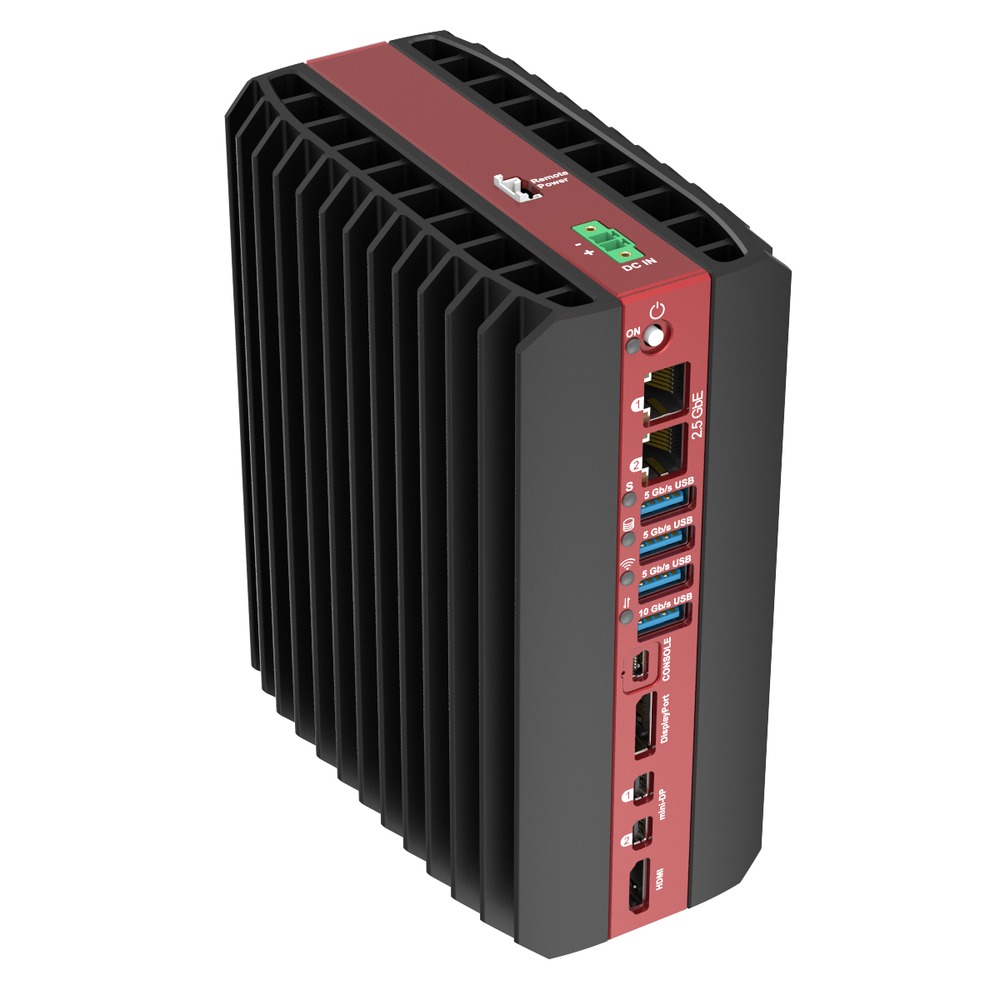
AMD Ryzen AI 9 HX 370 Industrial AI PC with NPU and Hailo AI Options
- AI
- 26–50 TOPS
- CPU
- AMD Ryzen AI 300 (Strix Point)
- Ethernet
- 4× 2.5GbE
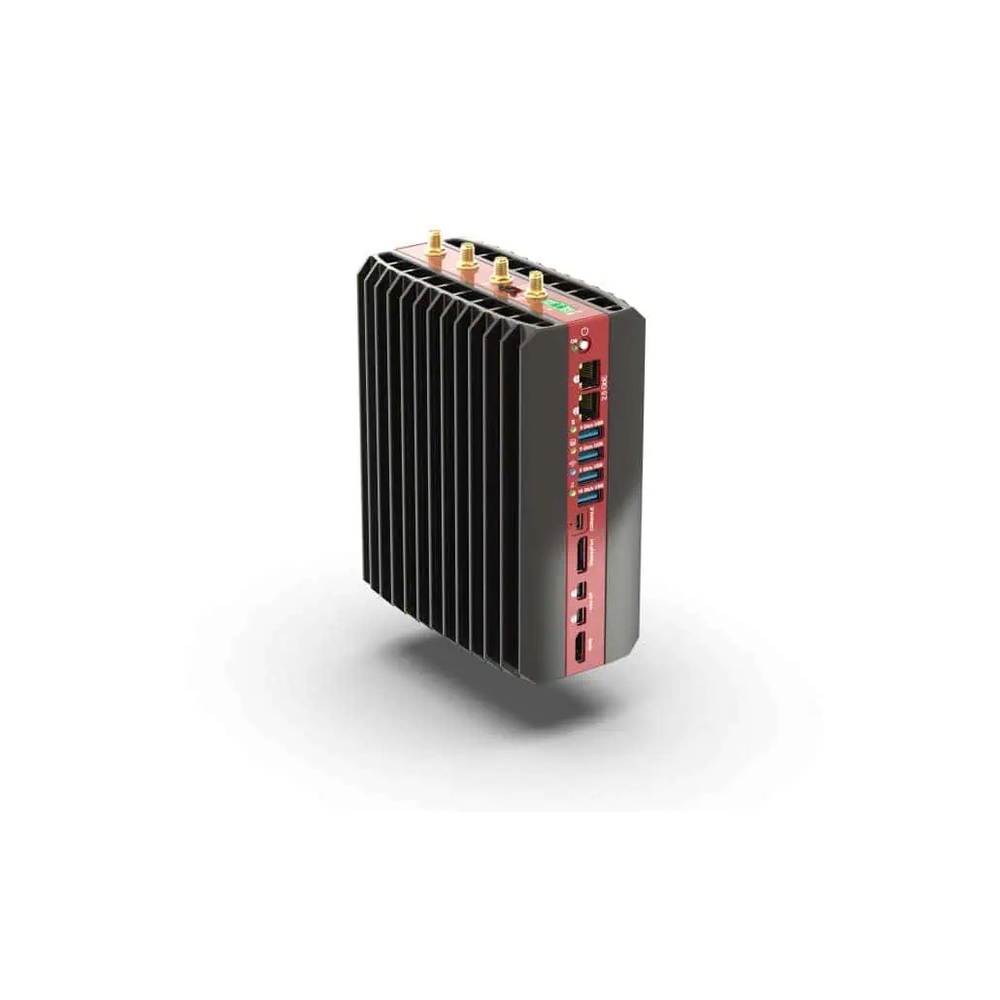
AMD Ryzen Embedded 8845HS DIN Rail Industrial PC with Hailo AI Options and 4x 2.5GbE
- AI
- 16–40 TOPS
- CPU
- AMD Ryzen Embedded 8000
- Ethernet
- 4× 2.5GbE
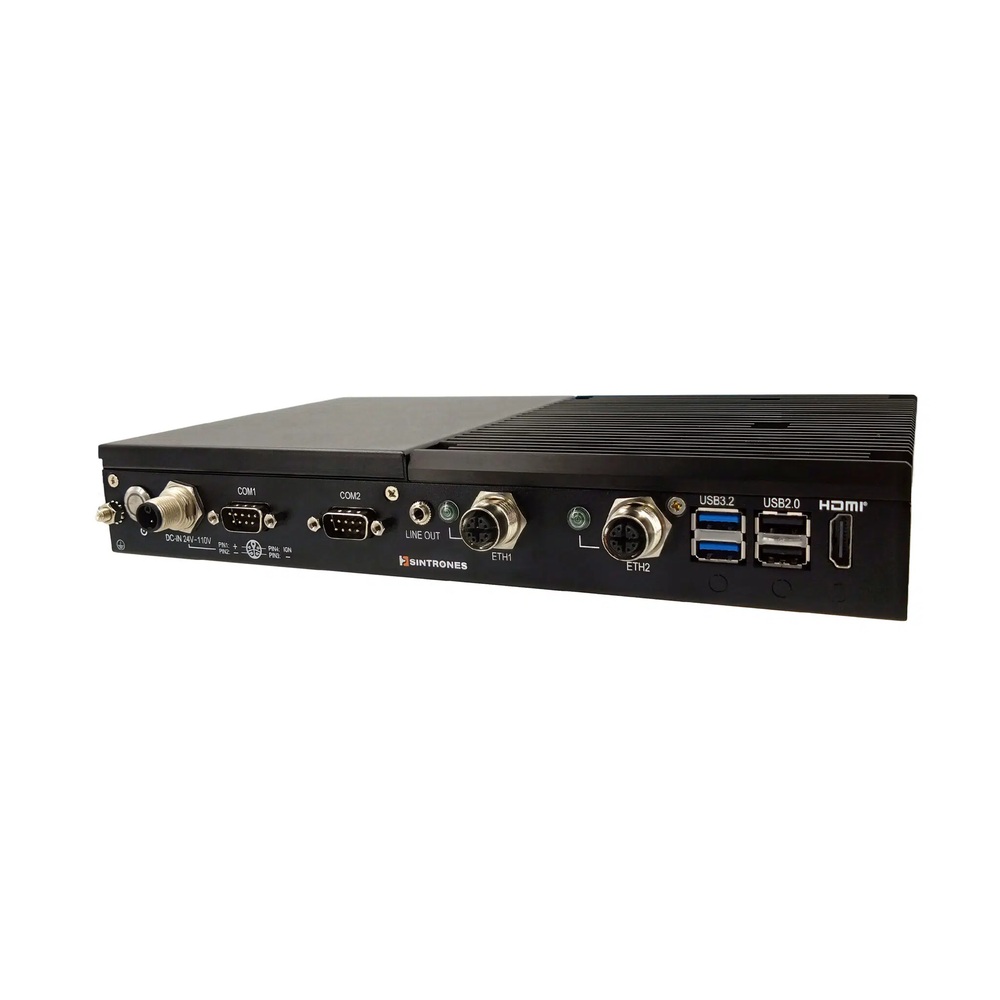
Intel Atom x7000RE EN 50155 Railway PC with Optional Hailo AI and 24-110V DC Isolation
- AI
- 26 TOPS
- CPU
- Intel Atom x7835RE (Amston Lake)
- Ethernet
- 4× 2.5GbE

Intel Core i9-13900E Hailo-8 AI Edge Computer with 4x LAN
- AI
- 26 TOPS
- CPU
- Intel Core 13th Gen (Raptor Lake)
- Ethernet
- 3× 2.5GbE, 1× GbE
Intel Core i9-13900E Hailo-8 AI Edge Computer with 4x 2.5GbE PoE
- AI
- 26 TOPS
- CPU
- Intel Core 13th Gen (Raptor Lake)
- Ethernet
- 9× 2.5GbE, 1× GbE (4× PoE)
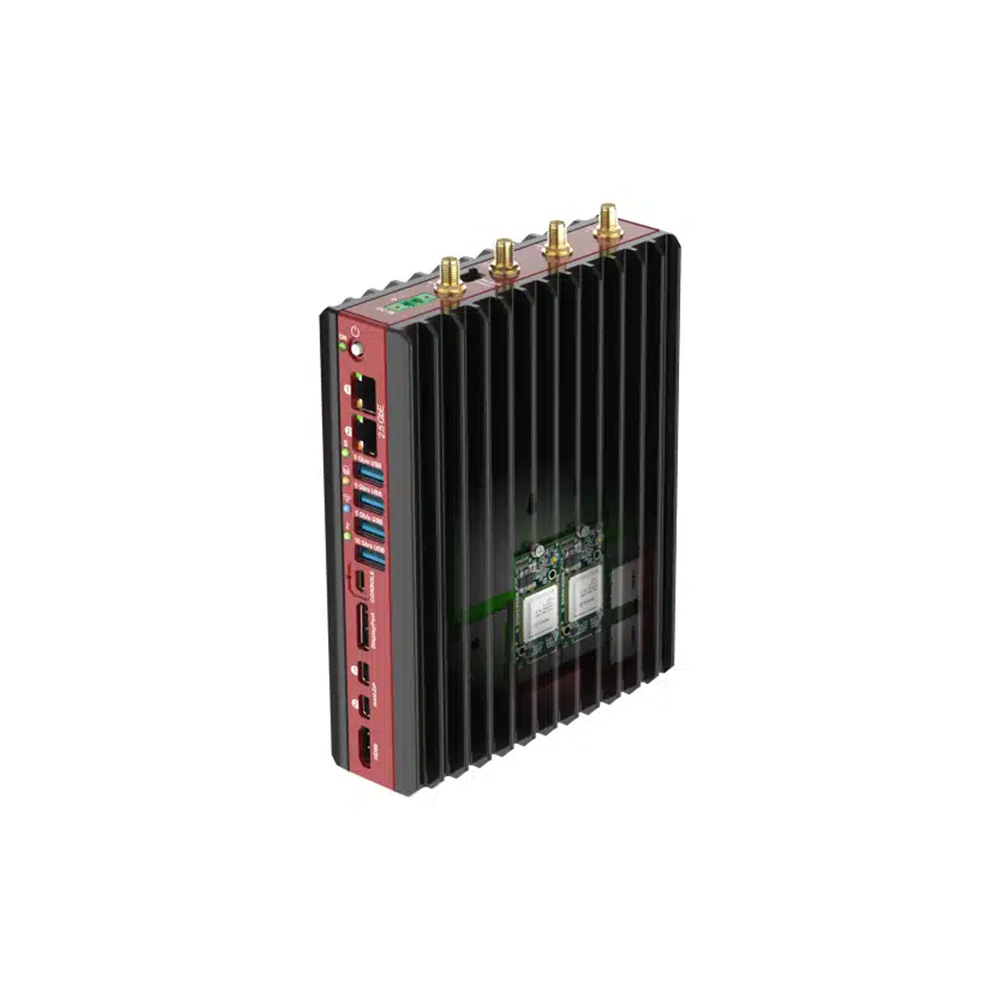
AMD Ryzen 7 Extended Temperature Edge AI Box PC with Hailo-8 Accelerator
- AI
- 10–26 TOPS
- CPU
- AMD Ryzen
- Ethernet
- 2× 2.5GbE
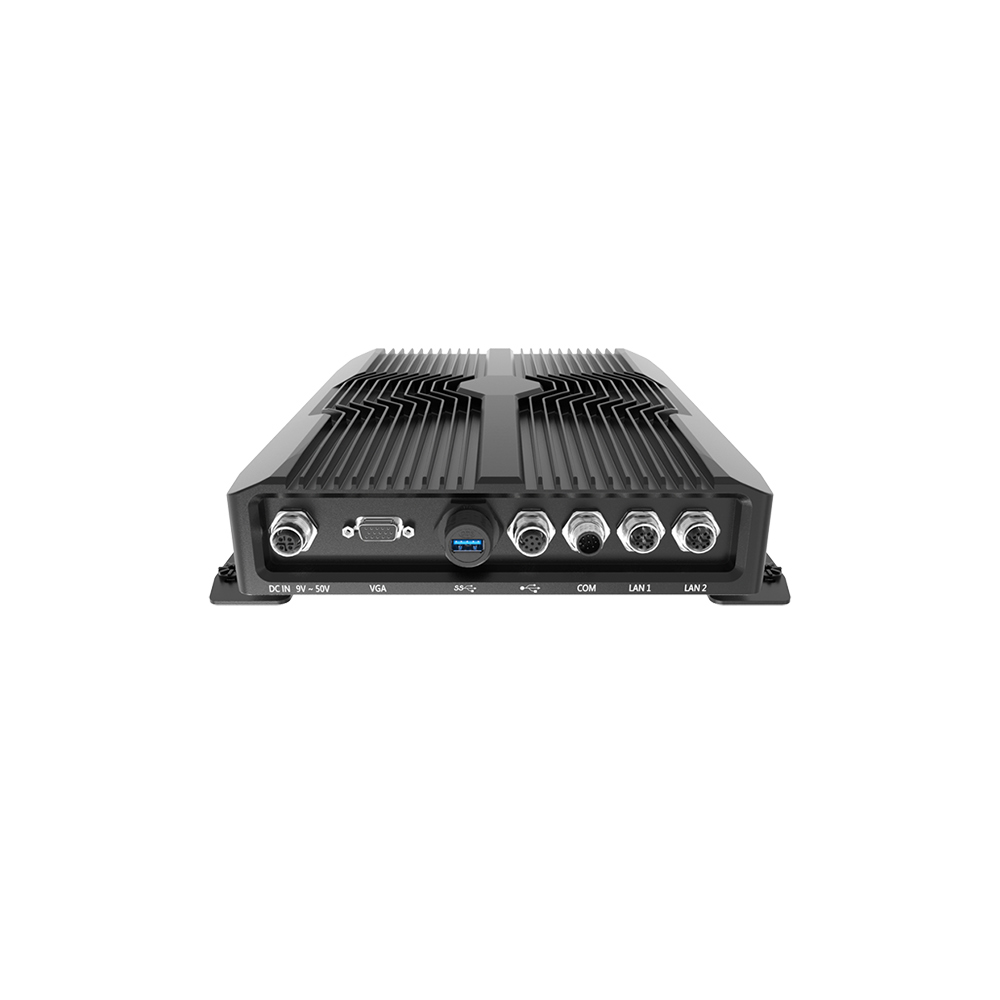
Intel Atom x6425E Hailo-8 Extended Temperature Waterproof Computer with 48-110 V DC Input
- AI
- 26 TOPS
- CPU
- Intel Atom x6425E (Elkhart Lake)
- Ethernet
- 1× 2.5GbE, 1× GbE
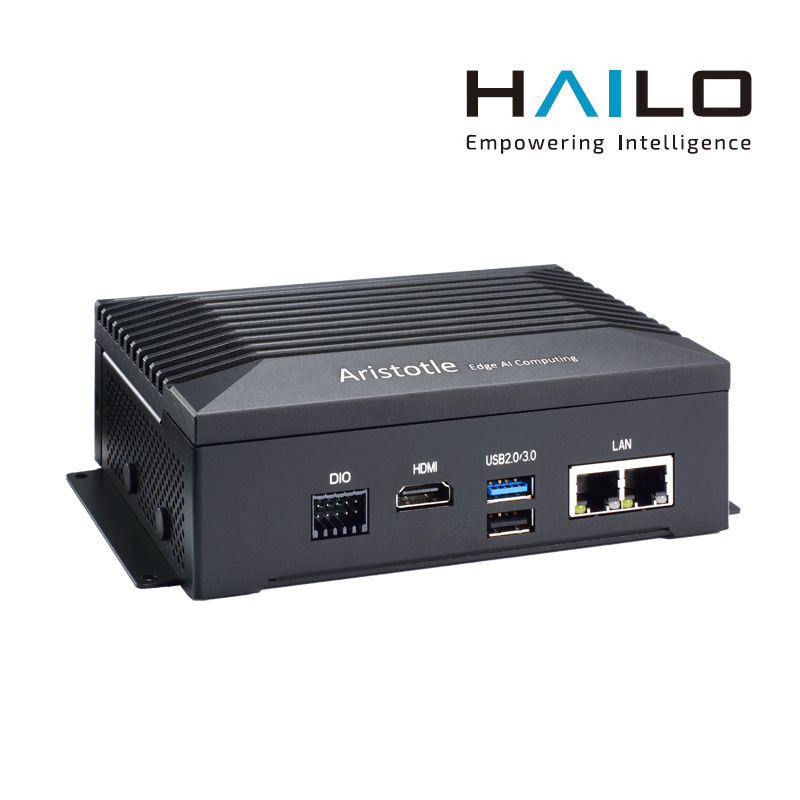
Intel Celeron J6413 Hailo-8 Fanless AI Edge Computer with -10 to 70 °C Operation
- AI
- 26 TOPS
- CPU
- Intel Celeron J J6413 (Elkhart Lake)
- Ethernet
- 2× GbE
Integrating a Hailo-8 into an industrial edge computer
The accelerator is the easy part. Whether a Hailo-8 system keeps running on site depends on the computer around it. We work through four areas before recommending a computer.
Environment
Industrial-grade Hailo-8 modules are rated from −40 °C to 85 °C, but the system must match: a fanless, sealed chassis keeps out dust and moisture, and the temperature range, sealing and shock rating should fit the site. For trains, vehicles and outdoor enclosures, see our rugged edge computers.
Performance
Match the host processor to everything that runs beside the model: decoding, pre-processing, the application and any control software. The Hailo-8 connects over PCIe Gen3 with up to four lanes; a slot with fewer lanes limits throughput on heavy multi-stream work. Processors with their own NPU, such as AMD Ryzen 8000 parts with a 16 TOPS NPU, can share the load.
Expansion
Check that the system has the right M.2 key or mini PCIe slot for the module, plus the camera ports the application needs: PoE for IP cameras, or USB, GMSL or frame grabbers for machine vision cameras.
Lifecycle
Industrial deployments run for years, so choose a computer with long availability and a stable software image, and plan how models will be updated in the field.
We configure, image and test every Hailo system: the module fitted and cooled, HailoRT and drivers installed in the operating system image, your HEF files loaded where you supply them, and the system run under load before it ships.
Planning a Hailo-8 deployment
Seven checks that settle the accelerator and the computer around it.
-
01
Model
Confirm the model parses and compiles with the Dataflow Compiler, or start from the Model Zoo.
-
02
Accuracy
Quantise with your own calibration images and check accuracy before committing.
-
03
Streams
Multiply cameras by frame rate by models per frame to size the number of modules.
-
04
Slot and lanes
Match the module key and size to the slot, and check how many PCIe lanes it carries.
-
05
Host load
Size the CPU for decoding, pre- and post-processing and the application.
-
06
Heat and temperature
Plan the heat path for each module and test at the maximum site temperature.
-
07
Hailo-8 or Hailo-10H
If the application needs a language model, choose the Hailo-10H instead.
Hailo-8: common questions
Quick answers
What is Hailo-8?
An AI accelerator chip for edge inference. It runs neural networks at up to 26 TOPS on around 2.5 W, on M.2 and mini PCIe modules that sit beside the host processor.
How many TOPS is Hailo-8?
Up to 26 TOPS. The Hailo-8L is rated at up to 13 TOPS and the Hailo-10H at up to 40 TOPS at INT4.
Hailo-8 vs Hailo-8L: what is the difference?
Half the performance, for less power and cost. The Hailo-8L suits single cameras and lighter models; the Hailo-8 suits several streams or heavier networks. Both use the same software.
Is Hailo-8 better than Jetson Orin Nano?
For adding AI to an existing computer at low power, often. A Jetson is a complete GPU computer with more flexibility for changing models and CUDA software.
Does Hailo-8 work with Raspberry Pi 5?
Yes. The Raspberry Pi AI HAT+ carries a Hailo-8 (26 TOPS) or Hailo-8L (13 TOPS) on the Raspberry Pi 5’s single PCIe lane.
How much power does Hailo-8 use?
Around 2.5 W typical. Power rises with load, so plan the heat path for several watts per module in a fanless system.
Can Hailo-8 run LLMs?
No. It has no external memory for large models. The Hailo-10H adds 8 GB on the module for small language and vision language models.
What models does Hailo-8 support?
Mainly convolutional vision models. Detection, classification, segmentation and pose estimation, including YOLO networks, compiled from ONNX or TensorFlow with the Dataflow Compiler.
Hailo and edge AI FAQs
-
What Is the Hailo-10H?
The Hailo-10H is an AI accelerator from Hailo for generative AI on edge devices. It delivers up to 40 TOPS (INT4) and carries 8 GB of LPDDR4 memory on an M.2 M key module, so small language models, vision language models and speech can run locally at a few watts, without a cloud connection or a large GPU.
-
What Does TOPS Mean in AI?
TOPS stands for tera operations per second: the number of trillion simple operations an AI processor can perform each second. It is the headline figure used to compare AI accelerators such as NVIDIA Jetson modules and the NPUs in Intel and AMD processors. It is usually quoted for 8-bit integer (INT8) maths, and sometimes with sparsity, which doubles the figure.
-
What Is an AI Accelerator?
An AI accelerator is hardware designed to run neural networks faster and more efficiently than a general-purpose CPU. The main types are GPUs, NPUs built into processors, dedicated accelerator chips such as Hailo modules, and FPGAs. Each takes over the repetitive maths of AI inference, so the CPU stays free for the rest of the system.
-
How Many TOPS Does an NPU Need?
There is no single figure: the TOPS an NPU needs depends on the model, image resolution, frame rate and number of camera streams. Check whether a rating is for the NPU alone or the whole platform, since vendors often add CPU and GPU TOPS together. The reliable test is to benchmark your own model on the target processor.
-
What Is INT8 Quantization?
INT8 quantization converts an AI model’s weights and calculations from 32-bit floating point (FP32) to 8-bit integers. The model becomes about a quarter of the size and runs faster on NPUs, GPUs and AI accelerators, usually with only a small loss of accuracy. It is a standard step when preparing a trained model for inference at the edge.
-
What Is ONNX?
ONNX, the Open Neural Network Exchange, is an open file format for AI models. A model trained in PyTorch or TensorFlow can be exported to ONNX and then run by different inference engines, such as ONNX Runtime, Intel OpenVINO and NVIDIA TensorRT, so the same model can move between hardware without being rebuilt.
-
What is M.2 keying and why does it matter?
M.2 keying is the pattern of notches on an M.2 card and socket that shows which interfaces the slot carries. The four keys in common use are A and E for Wi-Fi and Bluetooth, B for modems and SATA SSDs, and M for NVMe SSDs. A card with the wrong key will not fit the socket.
Planning a Hailo-8 deployment?
Send us the model you want to run, the number of cameras and where the system will be installed. We will recommend a Hailo-8 computer, then configure, image and test it for your application before it ships.