
 UK
UK 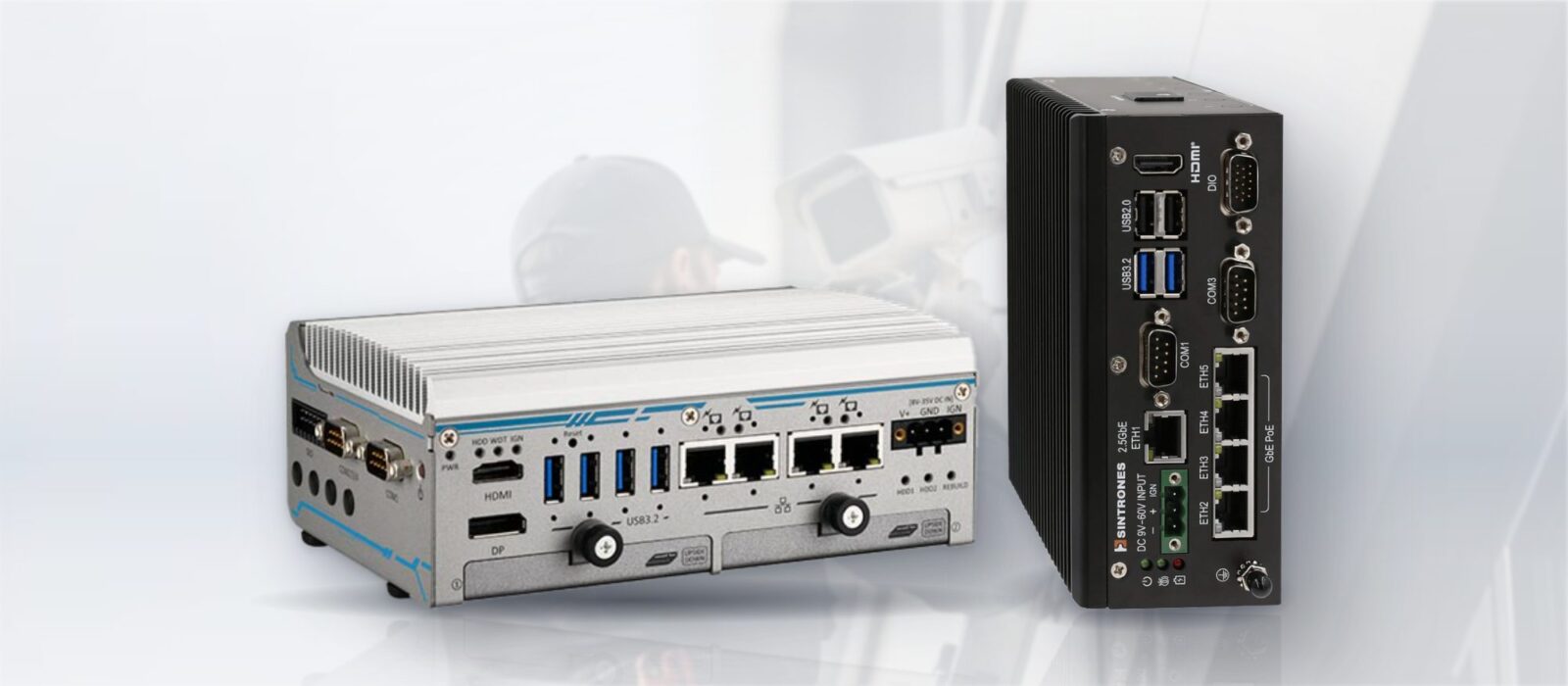
PoE in Surveillance and NVR Systems
PoE powers and connects IP cameras over a single cable, with the footage recorded on an NVR or an edge computer. This guide covers how PoE surveillance is wired and how to choose the recorder.
PoE is the backbone of modern IP surveillance: each camera takes its power and its network from one cable, so there is no separate power run at the camera position, often the most awkward part of an install. The footage is aggregated and recorded centrally, either on a dedicated network video recorder (NVR) or on an edge computer that records and analyses in the same box.
How PoE Surveillance Is Wired
The cameras are the powered devices. The source is either a PoE switch feeding a recorder, or an industrial PoE computer with built-in PoE ports that powers the cameras directly and records them, removing the separate switch. Which you choose depends on camera count, the power each camera needs, and whether you also want analytics running on the same box. Before settling on either, work out the PoE power budget for every camera at peak load, since a source’s total budget is often lower than its per-port figure suggests.
What to Specify
- 01Camera count and class
- How many cameras, and the PoE class each needs; PTZ and IR cameras draw more.
- 02Total PoE budget
- The source must cover the sum of the cameras, with headroom.
- 03Recording and storage
- Channels, resolution and retention set the storage and the recorder.
- 04Environment
- Indoor, outdoor or in-vehicle decides the ingress and temperature rating.
Indoor, Outdoor and Rugged Sites
Where the equipment lives shapes the build. An indoor recorder in a comms room has an easy life; a roadside cabinet, a depot or a vehicle does not. For those, a fanless, wide-temperature computer survives the environment, and the cameras themselves need the right ingress rating. The recorder can sit centrally or out at the edge near the cameras, depending on bandwidth and resilience.
Bandwidth, Recording and Storage
The number of channels, their resolution and frame rate, and how long you retain footage drive the storage and the recorder. More cameras and higher resolution mean more write bandwidth and more disk, which is why a surveillance computer often carries multiple drives, sometimes in RAID for redundancy. Size the storage for the retention you actually need, not the maximum the cameras can produce.
Running Edge AI on the Footage
Recording is only half of what modern surveillance does. A PoE-powered computer with an NPU or GPU can run analytics on the streams it records, for example licence-plate recognition, people counting or intrusion detection, without sending video to the cloud. These are edge AI computers: doing the inference on site cuts bandwidth and keeps the footage local.
The Recorder: NVR or PoE Computer
For straightforward recording, an industrial NVR captures and stores the streams. Where you want analytics as well, a PoE computer can power the cameras, record, and run the inference in one box. See our guide to industrial Power over Ethernet for the power side.
Power over Ethernet FAQs
-
PoE PD vs PSE: What Is the Difference?
In a PoE link the PSE (Power Sourcing Equipment) supplies the power and the PD (Powered Device) draws it. A PoE switch or a PoE computer acting as a source is the PSE; a camera, phone or access point is the PD.
-
How Much Power Does PoE Deliver?
PoE delivers up to about 15 W per port (802.3af), PoE+ up to about 30 W (802.3at), and PoE++ up to 60 W or 90 W (802.3bt), at around 48 V DC. Some power is lost in the cable, so the figure available at the device is a little lower than at the source.
-
PoE vs PoE+ vs PoE++: The 802.3af, 802.3at and 802.3bt Standards
802.3af (PoE), 802.3at (PoE+) and 802.3bt (PoE++) are the three IEEE Power over Ethernet standards. They differ mainly in power per port, roughly 15 W, 30 W, and up to 60 to 90 W, with the higher tiers using all four pairs of the cable.
Building a PoE Surveillance System?
Tell us the camera count and resolution, the storage you need and the environment, and we'll recommend an NVR or PoE computer to suit.