
 UK
UK 
Wide operating temperature
The VBOX-3631 operates from −40 to 70 °C with 0.6 m/s airflow, in a fully fanless design, and stores from −40 to 80 °C.
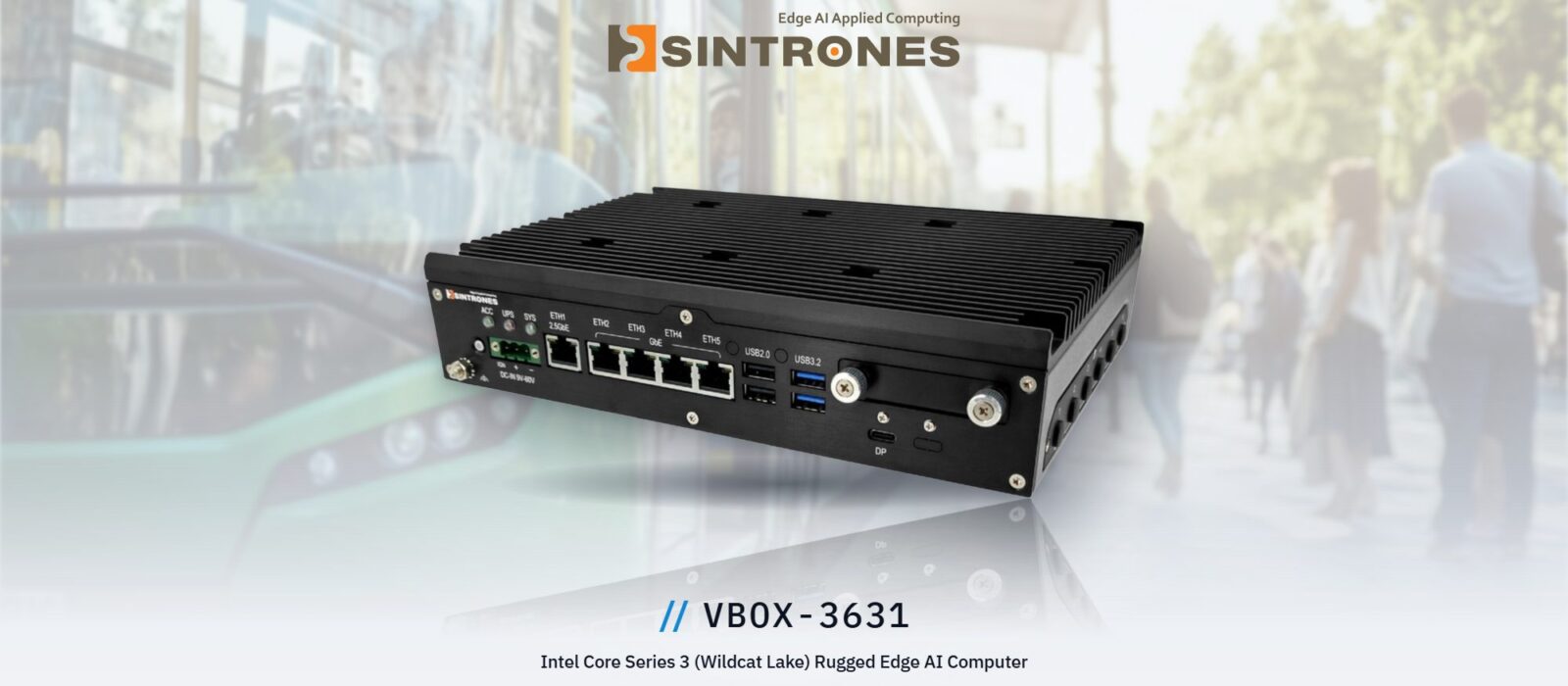
The Sintrones VBOX-3631 is a fanless in-vehicle edge AI computer built on Intel Core Series 3 processors, codenamed Wildcat Lake, with a built-in NPU rated up to 17 TOPS. It carries E-Mark approval, and we supply it for fleet management, intelligent transportation and defence logistics across automotive and railway environments.
The launch signals where in-vehicle compute is heading: AI inference is moving from add-in accelerator cards into the host processor itself. The VBOX-3631 carries no discrete GPU or separate accelerator module for its baseline AI capability; the NPU sits on the Wildcat Lake die, which changes the thermal, power and form-factor maths for a fanless box. For fleet and transit operators specifying perception or analytics at the vehicle, that integration is the headline.
The VBOX-3631 is among the first rugged in-vehicle computers announced on Intel Core Series 3. The Core 7 350 and Core 5 320 pair two performance cores with four low-power efficiency cores; the Core 3 304 uses one performance core with four. Processor base power is 28 W. That mix lets the system drop into a low-power mode for routine tasks and scale up to turbo for demanding edge workloads, which matters in a fanless box where the sustained thermal budget is finite.
The integrated NPU provides up to 17 TOPS for inference, giving three compute engines on one die (CPU, GPU and NPU) to share perception, analytics and application work. That is a mid-range inference budget, well suited to single-stream or modest multi-stream perception, in-cabin analytics, driver or operator monitoring and classification. It is not pitched at heavy multi-camera cascades that demand a discrete GPU or several dedicated accelerators.
A discrete accelerator, such as a Hailo M.2 module or a GPU, is separate silicon on PCIe. An on-die NPU avoids that cost, power and mechanical overhead, at the trade-off of a fixed inference budget that cannot be expanded by adding more modules. Our comparison of GPU and NPU for edge AI covers when each makes sense.
Heavy multi-camera perception, large-model inference or workloads needing tens to hundreds of TOPS still point towards edge AI computers with discrete GPUs or multiple dedicated accelerators. The VBOX-3631 is deliberately not that box. Within the same family, the VBOX-3650 steps up to Intel Core Ultra Series 3.
Because the NPU is on-die, the VBOX-3631 keeps a single-chip thermal and power profile, which is what lets the fanless design, the wide temperature range and a compact chassis coexist with real AI capability. With wide-voltage input, ignition control and M12 options, it is built to drop into in-vehicle and railway deployment without a ruggedisation programme around it.
Two builds of the same platform: RJ45 for cabinet and cab installs, M12 X-coded where vibration would shake a standard connector loose.
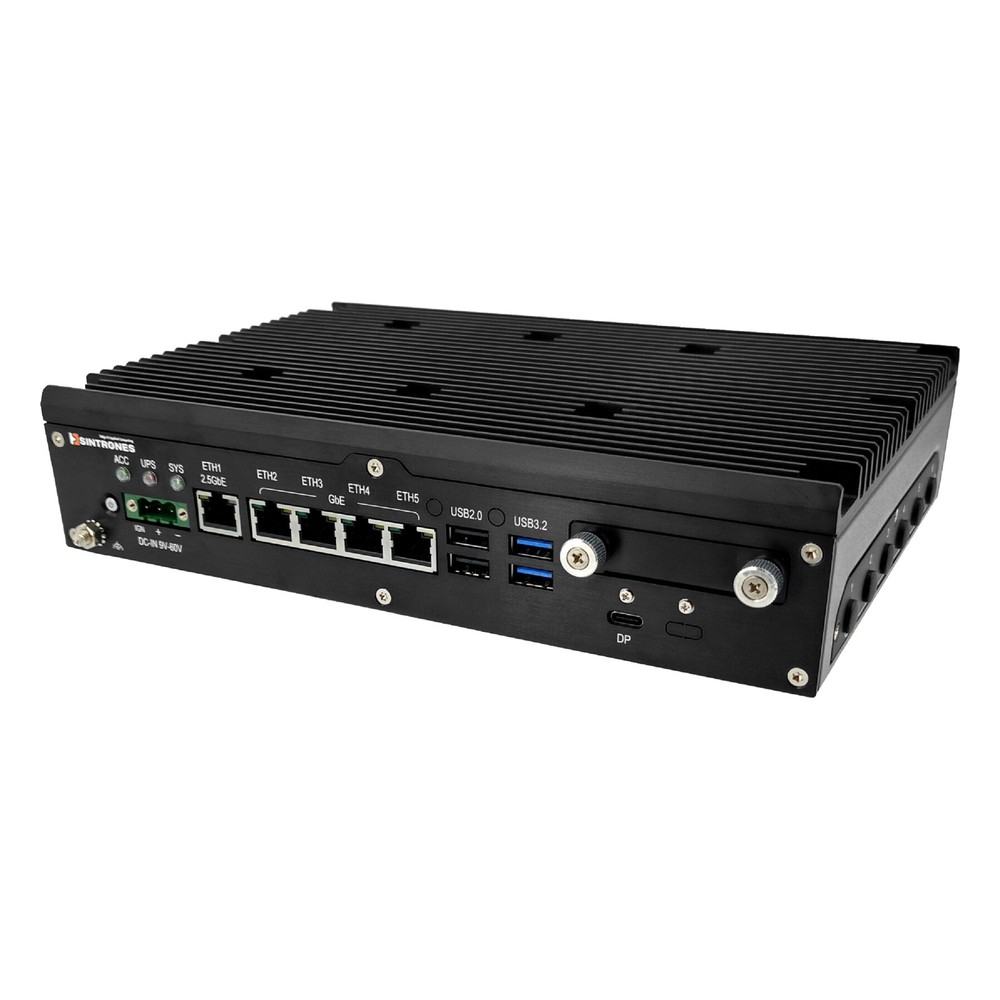
Intel Core Series 3 (Wildcat Lake) Rugged Edge AI Computer with 5x LAN and 2x CAN FD
Intel Wildcat Lake Rugged Edge AI Computer with M12 LAN and 2x CAN FD
| Specification | Sintrones VBOX-3631 | Sintrones VBOX-3631-M12X |
|---|---|---|
| Processor | Intel Core 7 350 (up to 4.8 GHz), Core 5 320 (up to 4.6 GHz) or Core 3 304 (up to 4.3 GHz) | As VBOX-3631 |
| AI and graphics | Built-in NPU up to 17 TOPS; Intel Graphics | Built-in NPU up to 17 TOPS; Intel Graphics |
| Memory | 1× DDR5-6400 SO-DIMM, up to 64 GB, In-Band ECC | 1× DDR5-6400 SO-DIMM, up to 64 GB, In-Band ECC |
| LAN | 1× 2.5GbE (Intel I226-LM) + 4× GbE (Marvell switch), RJ45 | 1× 2.5GbE (Intel I226-LM) + 2× GbE, M12 X-coded |
| Vehicle I/O | 2× isolated CAN FD, 2× RS-232/422/485, 6× DI, 4× DO, 1× isolated DO | 2× isolated CAN FD, 2× RS-232/422/485, 6× DI, 4× DO, 1× isolated DO |
| USB | 2× USB 3.2, 2× USB 2.0 | 2× USB 3.2, 2× USB 2.0 |
| Displays | HDMI, DVI-D, USB Type-C DisplayPort; three displays, up to 4K | HDMI, DVI-D, USB Type-C DisplayPort; three displays, up to 4K |
| Expansion | 2× M.2 2280 Key M (NVMe), 2× M.2 Key B (5G/LTE, dual nano SIM), 1× M.2 Key E (Wi-Fi/Bluetooth), 1× mini PCIe (shares with one Key B) | 2× M.2 2280 Key M (NVMe), 2× M.2 Key B (5G/LTE, dual nano SIM), 1× M.2 Key E (Wi-Fi) |
| Power | 9–60 V DC, 3-pin terminal block, ignition detection | 9–60 V DC, M12 K-coded, ignition detection |
| Temperature | −40 to 70 °C fanless (0.6 m/s airflow) | −40 to 70 °C fanless (0.6 m/s airflow) |
| Shock and vibration | MIL-STD-810H Method 514.8 and 516.8; IEC 60068-2-64 | MIL-STD-810H Method 514.8 and 516.8; IEC 60068-2-64 |
| Security | TPM 2.0 (FIPS 140-3), hardware watchdog | TPM 2.0 (FIPS 140-3), hardware watchdog |
| Standards | CE, FCC Class A, UKCA, E-Mark | CE, FCC Class A, UKCA, E-Mark |
For railway or other certified deployments, we confirm the current certificate status for the exact build before you order.
The VBOX-3631 in its finned enclosure, angled to show the five LAN ports and terminal-block DC input.
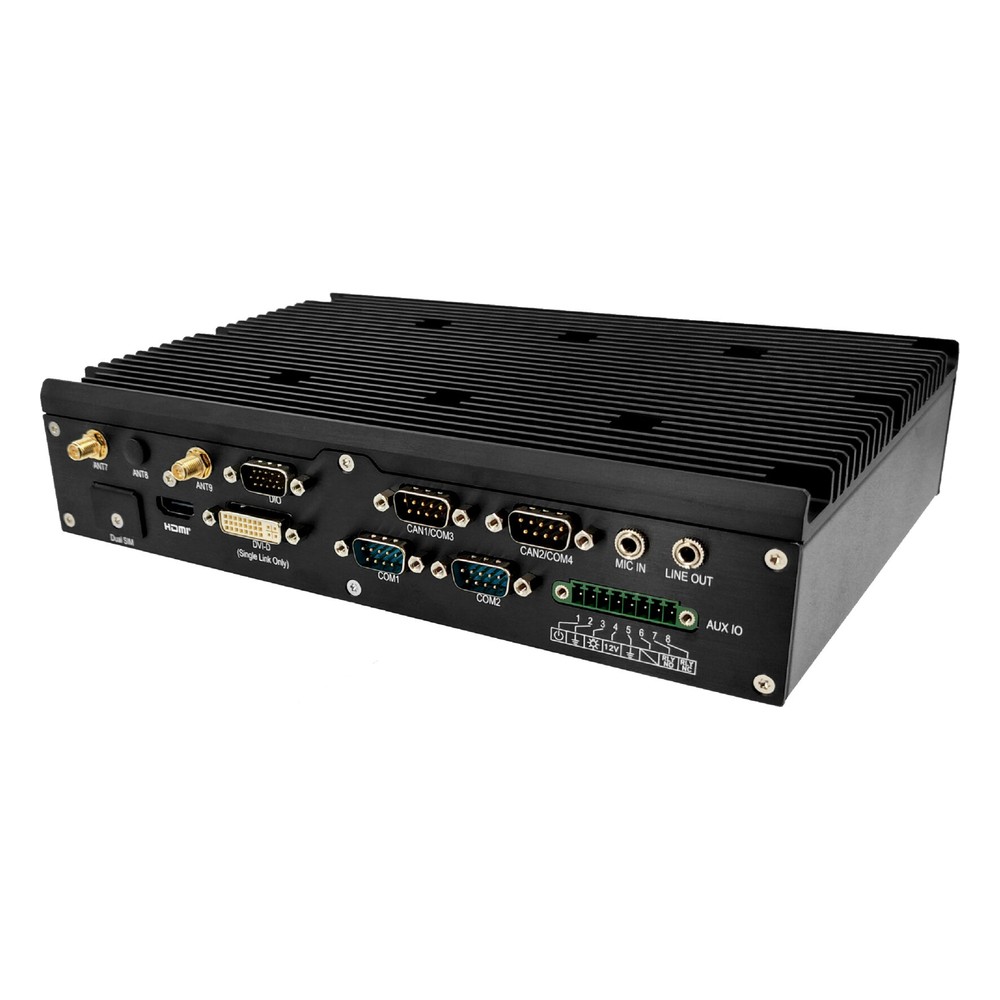
CAN FD and COM ports, antenna mounts and the dual SIM slot for vehicle-bus and cellular links.
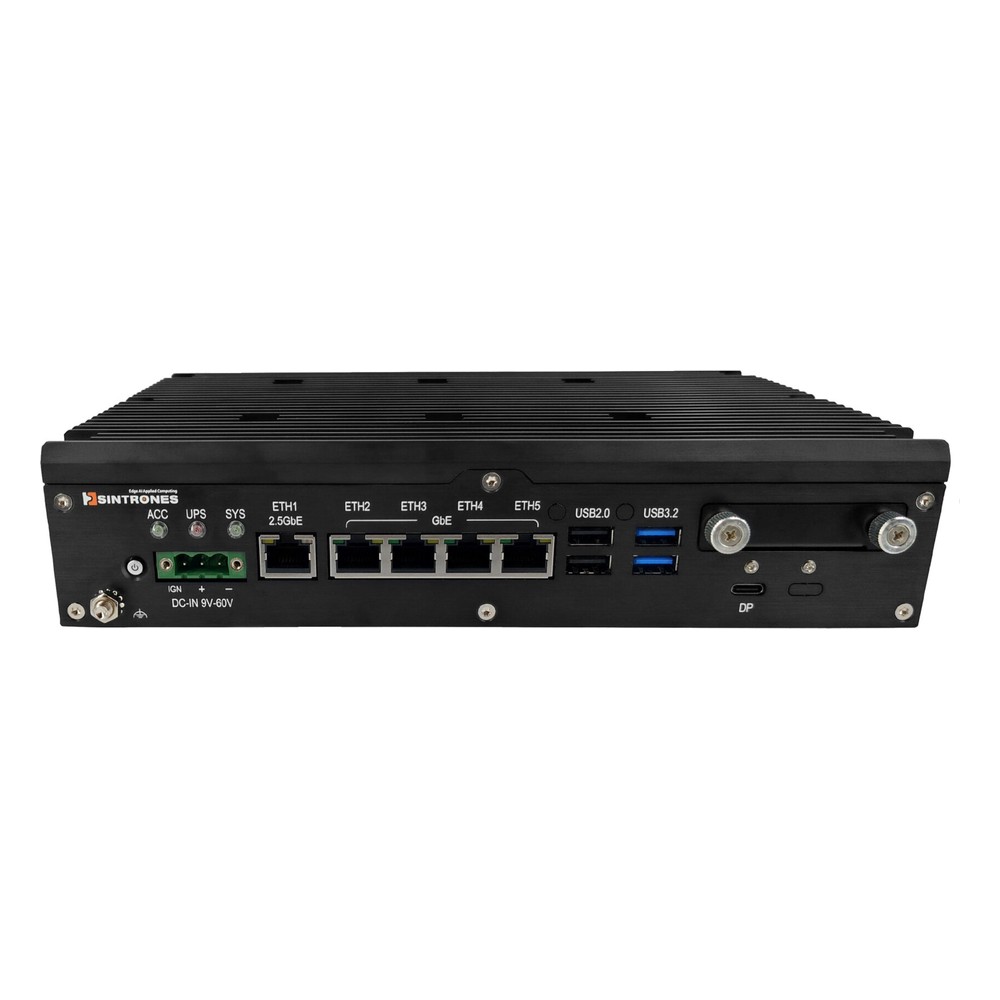
DC input, 2.5GbE and four GbE ports, USB, DisplayPort over Type-C and the front-access tray.
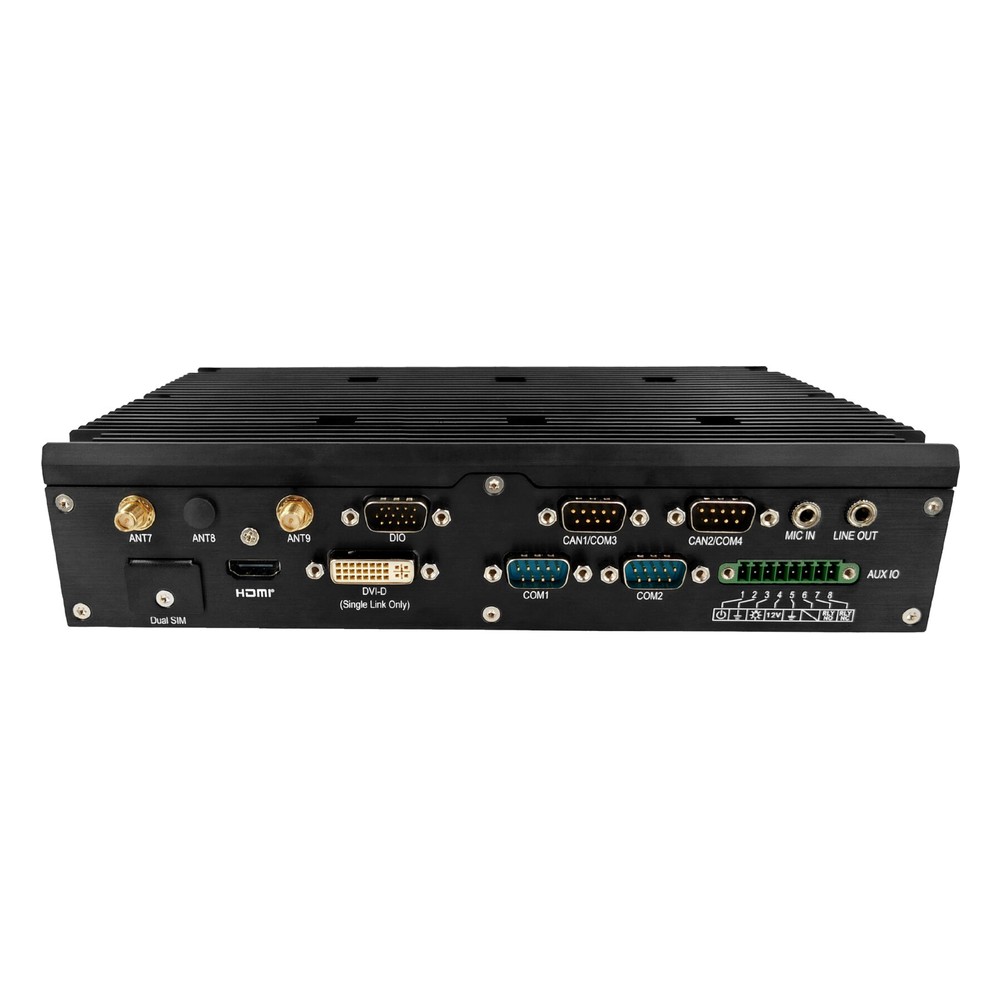
HDMI and DVI-D outputs, digital I/O, CAN and COM ports, audio and auxiliary I/O.
The rugged credentials are what separate an in-vehicle computer from a repackaged mini PC. Sintrones has built the VBOX-3631 to the environmental and compliance envelope that automotive and railway deployment demands.
The VBOX-3631 operates from −40 to 70 °C with 0.6 m/s airflow, in a fully fanless design, and stores from −40 to 80 °C.
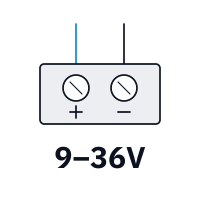
A 9–60 V DC input through a 3-pin terminal block or M12 K-coded connector covers 12 V, 24 V and 48 V vehicle systems from one SKU, with over-current, over-voltage, surge and reverse-polarity protection.

The VBOX-3631-M12X moves the LAN and power to screw-locking M12 connectors, which Sintrones targets at military vehicles, excavators, snowplows, off-road vehicles, track-side CCTV and railway station surveillance.

The hardware is designed to comply with E-Mark and EN 50155. Our guide to E-Mark for automotive computers and our summary of the EN 50155 rolling stock standard explain what each requires.

Vibration is tested to IEC 60068-2-64 (random, 2.5G at 5–500 Hz, 1 hour per axis) and MIL-STD-810H Method 514.8 Procedure I Category 4; shock to MIL-STD-810H Method 516.8 Procedure I for trucks and semi-trailers at 15G (11 ms).

Ignition detection and smart power management give controlled start-up and shutdown, and the optional BAT-2300v2 battery backup provides up to five minutes for a graceful shutdown after vehicle power is removed. Our note on configuring ignition control covers the detail.
Efficient, integrated AI compute in a rugged fanless in-vehicle box, where 17 TOPS is a comfortable budget rather than a ceiling.
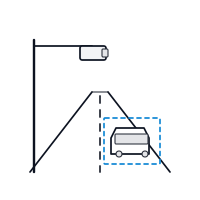
Connected-fleet edge processing, telematics and analytics aggregation on the vehicle, with 5G or LTE back to base.

Driver and operator monitoring and in-cabin analytics on the NPU, without a discrete accelerator.

Roadside and on-vehicle intelligent transportation systems running single-stream or modest multi-stream perception.

Onboard and track-side compute designed to EN 50155, including track-side CCTV and station surveillance.
View range
Military and logistics vehicles that need wide DC input, MIL-STD-810H shock testing and sealed M12 Ethernet.
Excavators, snowplows and off-road vehicles, where the M12 X-coded build keeps Ethernet links secure under vibration.
Fleet operators have been adding accelerator cards to get AI on the vehicle. The VBOX-3631 does it on-die, at 17 TOPS, in a fanless E-Mark box. Send us the camera streams and the vehicle, and we’ll confirm whether 17 TOPS covers it.
An M12 X-coded connector is the 8-pin M12 coding for Gigabit and 10 Gigabit Ethernet. Its four twisted pairs are separated by a cross-shaped shield that controls crosstalk at high speed, and it can carry Power over Ethernet with a suitable cable. It is defined in IEC 61076-2-109.
MIL-STD-810G (2008) and MIL-STD-810H (2019) are successive revisions of the US military environmental test standard. 810H is the current version; it refined and reorganised test methods and tightened guidance, but both define test methods rather than a pass or fail certificate.
Sufficient for lightweight workloads — single-camera inference, gateway aggregation — but usually insufficient for multi-camera analytics, multi-sensor fusion, or multi-node edge AI clusters.
The industrial temperature range is −40 to 85 °C: the grade an electronic component must operate across to be called industrial, compared with 0 to 70 °C for commercial parts. Rugged computers built from industrial-grade components typically run from −25 or −40 °C up to 70 °C as a complete system.
Fanless computers cool themselves passively, through a finned heatsink chassis and heat pipes, instead of a fan. With no moving parts and no airflow drawing in dirt, they are more reliable in dusty or vibrating places, completely silent, low maintenance and easy to seal, which is why they are the standard choice for industrial and embedded use.
An M12 Ethernet port connects to an RJ45 network with an M12 to RJ45 cable or adaptor that matches the port's coding. A 4-pin D-coded M12 carries 10/100 Mbps Ethernet on RJ45 pins 1, 2, 3 and 6; an 8-pin X-coded M12 carries Gigabit Ethernet on all eight RJ45 pins.
Tell us the workload, the vehicle or railway environment, the connectivity and compliance needs and the deployment scale, and we'll work through the options with you.