
 UK
Intrinsically Safe HMIs Deployed for Wastewater Management in Hazardous Areas
Water and wastewater treatment sites handle gases that are both toxic and flammable. Sewage and sludge give off methane and hydrogen sulphide, and treatment chemicals add their own risks, so parts of a pump station or treatment works are classified as hazardous areas where ordinary electrical equipment cannot be installed.
A leading wastewater management company asked us for a hazardous area HMI to control its pump stations: a large touchscreen computer certified for the area, mounted in the station cabinets and connected back to its management centre. We specified Winmate’s 23.8 inch (23.8″) W24ITWS-MHA2-EX, from its M-Series EX range of Class I, Division 2 panel PCs.
What the HMI had to deliver
Our technical sales team worked through the customer's requirements before choosing a platform.
-
01
Class I, Division 2 certified
Approved for installation in hazardous areas where flammable gas may be present under abnormal conditions.
-
02
Open Intel x86 platform
A standard Intel architecture, so the customer's own software and operating system would run without porting.
-
03
Wireless and Ethernet
Cloud-enabled connectivity, so technicians can monitor and manage each station remotely.
-
04
Large HD touchscreen
Enough resolution and screen area for the customer's application GUI, with a modern look.
-
05
Panel mounting
A front that fits a cut-out in the station cabinets and seals against the panel.
What Class I, Division 2 means here
Class I, Division 2 covers areas where flammable gases or vapours are only expected if something goes wrong, such as a leak, which describes most of the space around pumps and wet wells. It corresponds broadly to Zone 2 in the ATEX zone system used in Europe.
Equipment for these areas is usually non-incendive rather than intrinsically safe: it cannot ignite the atmosphere in normal operation, which suits a powerful computer with a large display. Our intrinsically safe vs non-incendive FAQ explains the difference, and why it matters when you choose equipment for each area.
The W24ITWS-MHA2-EX
Winmate's 23.8 inch Class I, Division 2 HMI panel PC, the largest model in the M-Series EX range.
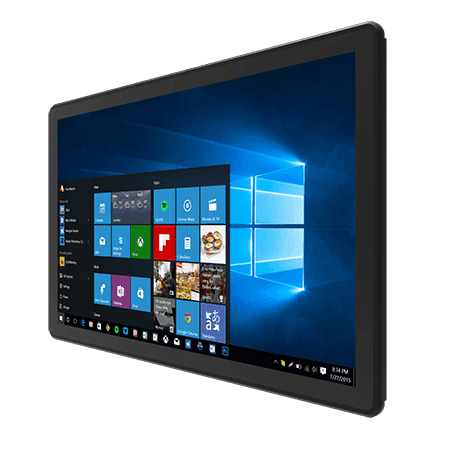
W24ITWS‑MHA2‑EX
23.8″ Class I Division 2 HMI Panel PC with Intel Core i5-1135G7 and PCAP Touch
- Display
- 23.8″ (4:3, 1024×768, XGA)
- Brightness
- 250 nits
- Touch Controller
- Multi Touch PCAP
- Processor
- Intel Core 11th Gen (Tiger Lake)
- Ingress Protection
- Front IP65
Why it suited the pump stations
- 0123.8 inch Full HD touch
- A 1920×1080 projected capacitive screen gave the application GUI room for more pump station controls on one view.
- 02Class I, Division 2, Groups A–D
- Certified for the full range of Class I gas groups, so it can be specified across classified Division 2 areas.
- 03Intel Core i5-1135G7
- An 11th Gen Intel Core processor with up to 32 GB DDR4 runs the HMI software on a standard x86 platform, with low power draw.
- 04Wireless and wired networking
- WLAN sends real-time data to the management centre without a hardwired LAN on site, with two Intel GbE ports where cabling exists.
- 05Fanless, IP65 front
- Passive cooling from −20 to 60 °C for 24/7 running, and a true flat glass front sealed to IP65 for panel mounting.
Built for cabinets and easy cleaning
The true flat, edge-to-edge front has no bezel lip for dirt to gather in, so the screen wipes clean, and the glass cover lens resists scratches. The IP65 front seals against the cabinet panel to keep out dust and water jets; our IP rating chart shows how IP65 compares with higher ratings.
Inside, a 9 to 29 V DC terminal block input, three serial ports, four USB 3.2 ports and PCIe, mini PCIe and M.2 expansion leave room to connect pump controllers and add modules over the life of the station.
| M-Series EX model | Screen | Resolution |
|---|---|---|
| R12ITWS-MHM2-EX | 12.1 inch | 1024×768 |
| R15ITWS-MHB1-EX | 15 inch | 1024×768 |
| R17ITWS-MHA1-EX | 17 inch | 1280×1024 |
| R19ITWS-MHA3-EX | 19 inch | 1280×1024 |
| W22ITWS-MHB1-EX | 21.5 inch | 1920×1080 |
| W24ITWS-MHA2-EX | 23.8 inch | 1920×1080 |
Every model shares the same Class I, Division 2 rating and Intel Core i5 platform, so one software image can run on smaller stations and larger control points alike. Screen size decides how much of the station fits on one view, and our HMI selection guide sets out how to size and specify a panel PC for the job.
What changed at the pump stations
A certified, large-format HMI in each cabinet gave operators more control on site and more visibility from the management centre.
-
Outcome 01
More controls on one screen
The 23.8 inch display gave the GUI the footprint for an increased number of pump station controls.
-
Outcome 02
Remote monitoring without cabling
WLAN sends real-time data to the management centre with no hardwired LAN needed at the station.
-
Outcome 03
Certified for the area
Class I, Division 2 certification lets the HMI sit in the station cabinets, where the hazardous area is.
-
Outcome 04
Low maintenance
A fanless chassis and flat glass front keep the HMI running 24/7 and easy to clean.
Hazardous area FAQs
-
What Is Class 1 Division 2?
Class 1 Division 2, often written C1D2, is a North American hazardous location rating. Class 1 means flammable gases or vapours may be present; Division 2 means they are only expected under abnormal conditions, such as a leak or equipment failure. Equipment rated C1D2 will not ignite the atmosphere during normal operation.
-
Intrinsically Safe vs Non-Incendive: What Is the Difference?
Intrinsically safe equipment limits electrical and thermal energy so it cannot ignite a hazardous atmosphere even when faults occur, which allows use in the most hazardous areas. Non-incendive equipment cannot cause ignition in normal operation, but is not protected against faults, so it is limited to Division 2 or Zone 2 areas.
-
What Are ATEX Zones?
ATEX zones classify a hazardous area by how often an explosive atmosphere is present. For gases and vapours, Zone 0 means continuously or for long periods, Zone 1 means likely in normal operation, and Zone 2 means unlikely and only briefly. Dust areas follow the same pattern as Zones 20, 21 and 22.
-
What Is ATEX?
ATEX is the European framework for equipment and workplaces where an explosive atmosphere of gas, vapour or dust can occur. The name comes from the French “ATmosphères EXplosibles”. One directive sets the safety rules for equipment sold into these areas; the other requires employers to classify hazardous areas into zones and use suitably certified equipment.
-
What Is the Difference Between HMI and SCADA?
An HMI is the operator screen for one machine or process. SCADA (supervisory control and data acquisition) is a system that gathers data from many PLCs and sites, stores history, manages alarms and lets operators supervise a whole plant or network. SCADA includes HMI screens, but an HMI does not need SCADA.
Specifying HMIs for a hazardous area?
Tell us about your application and a member of our team will get right back to you.