
 UK

Environment
Water exposure (rain, spray, submersion, wash-down), dust load, temperature range, vibration profile.
A working guide to ingress protection ratings under IEC 60529 and DIN 40050-9: the IP rating chart, what IP65, IP66, IP67, IP68 and IP69K mean, how each is tested, how they map to NEMA enclosure types and how to choose the right rating for an industrial computer.
An IP (ingress protection) rating is a two-digit code, defined in IEC 60529, that tells you how well an enclosure keeps out solids and liquids. The first digit runs from 0 to 6 for dust and objects, the second from 0 to 9K for water. For industrial computers the ratings that matter are IP65 (low-pressure jets), IP66 (powerful jets), IP67 (temporary immersion), IP68 (continuous immersion) and IP69K (hot, high-pressure washdown), and the IP rating chart below shows every level.
The IP ratings table below lists every level of both digits. Read the first digit from the solids chart and the second from the liquids chart: IP65, for example, is dust-tight (6) and protected against water jets (5).
| Digit | Protected against | In practice |
|---|---|---|
| 0 | No protection | Open equipment |
| 1 | Solid objects over 50 mm | The back of a hand |
| 2 | Solid objects over 12.5 mm | Fingers |
| 3 | Solid objects over 2.5 mm | Tools and thick wires |
| 4 | Solid objects over 1 mm | Most wires, screws and small tools |
| 5 | Dust-protected | Limited dust ingress that does not affect operation |
| 6 | Dust-tight | No dust ingress at all |
| Digit | Protected against | Test |
|---|---|---|
| 0 | No protection | None |
| 1 | Dripping water | Vertically falling drops |
| 2 | Dripping water when tilted | Drops with the enclosure tilted up to 15° |
| 3 | Spraying water | Spray up to 60° from vertical |
| 4 | Splashing water | Splashes from any direction |
| 5 | Water jets | 6.3 mm nozzle, 12.5 litres per minute, 30 kPa at 3 m |
| 6 | Powerful water jets | 12.5 mm nozzle, 100 litres per minute, 100 kPa at 3 m |
| 7 | Temporary immersion | Up to 1 m depth for 30 minutes |
| 8 | Continuous immersion | Beyond 1 m, conditions set by the manufacturer |
| 9K | High-pressure, high-temperature jets | 80 °C water at 8 to 10 MPa from 100 to 150 mm (DIN 40050-9) |
Ingress protection (IP) ratings are the international standard for classifying how well a sealed enclosure resists dust and water. They are published as IEC 60529 by the International Electrotechnical Commission, adopted in the United Kingdom as BS EN 60529, recognised in the United States as ANSI/IEC 60529, and extended by the German DIN 40050-9 standard for high-pressure, high-temperature wash-downs (the “K” in IP69K).
For industrial computers, displays and panel PCs, the IP rating is the single most consequential specification line item for any deployment outside a controlled office environment. The right rating matches the environment: one step too low and the system fails in the field, one step too high and the budget goes on protection the application will never need.
In North America, the parallel NEMA 250 enclosure type system (published by the National Electrical Manufacturers Association) is widely used alongside IP. The two systems overlap on water and dust ingress but diverge on corrosion, ice and oil — for deployments in food and beverage, marine, outdoor cold climate, or coastal environments, both ratings often appear on the specification line. This guide covers how IP ratings are structured, how each of the five most commonly specified ratings is tested, how they map to NEMA, and how to choose the right rating for an industrial computing deployment.
An IP rating consists of the letters “IP” followed by two digits. The first digit (0 to 6) describes the level of protection against solid particles. The second digit (0 to 9K) describes the level of protection against liquids. A higher digit indicates greater protection.
The two digits are independent. An enclosure can be dust-tight without being waterproof, or vice versa — though in practice, almost all industrial computers specified above IPx5 also achieve IP6x dust-tightness, because the construction that resists water also resists dust.
A rating of IPX5 (with a letter X) means the enclosure has been tested only for the second digit. This is rare on industrial computing equipment, where both digits matter, but appears occasionally on specialised components.
Industrial computers, displays and panel PCs from front IP65 to full IP69K, with front-of-panel and full-enclosure options.
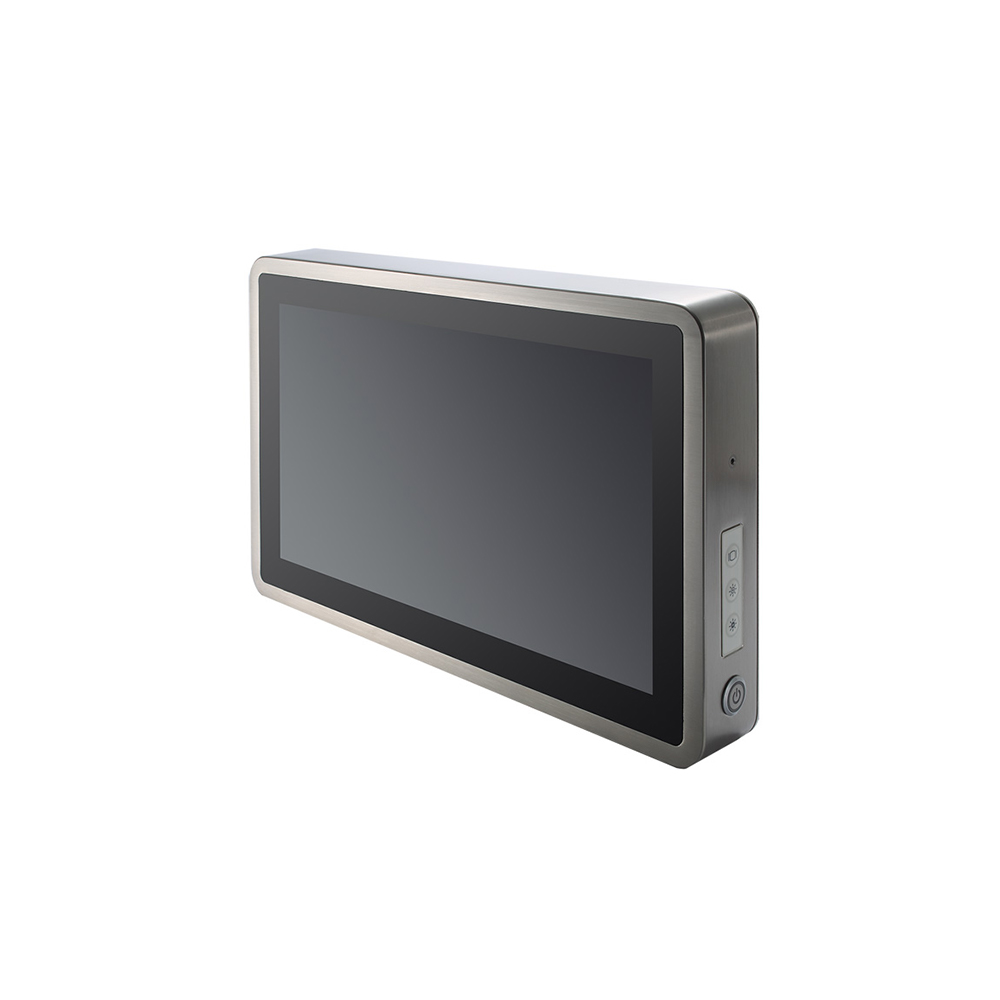
Front IP65 to full IP69K panel PCs for washdown, outdoor and panel-mount HMIs.
View range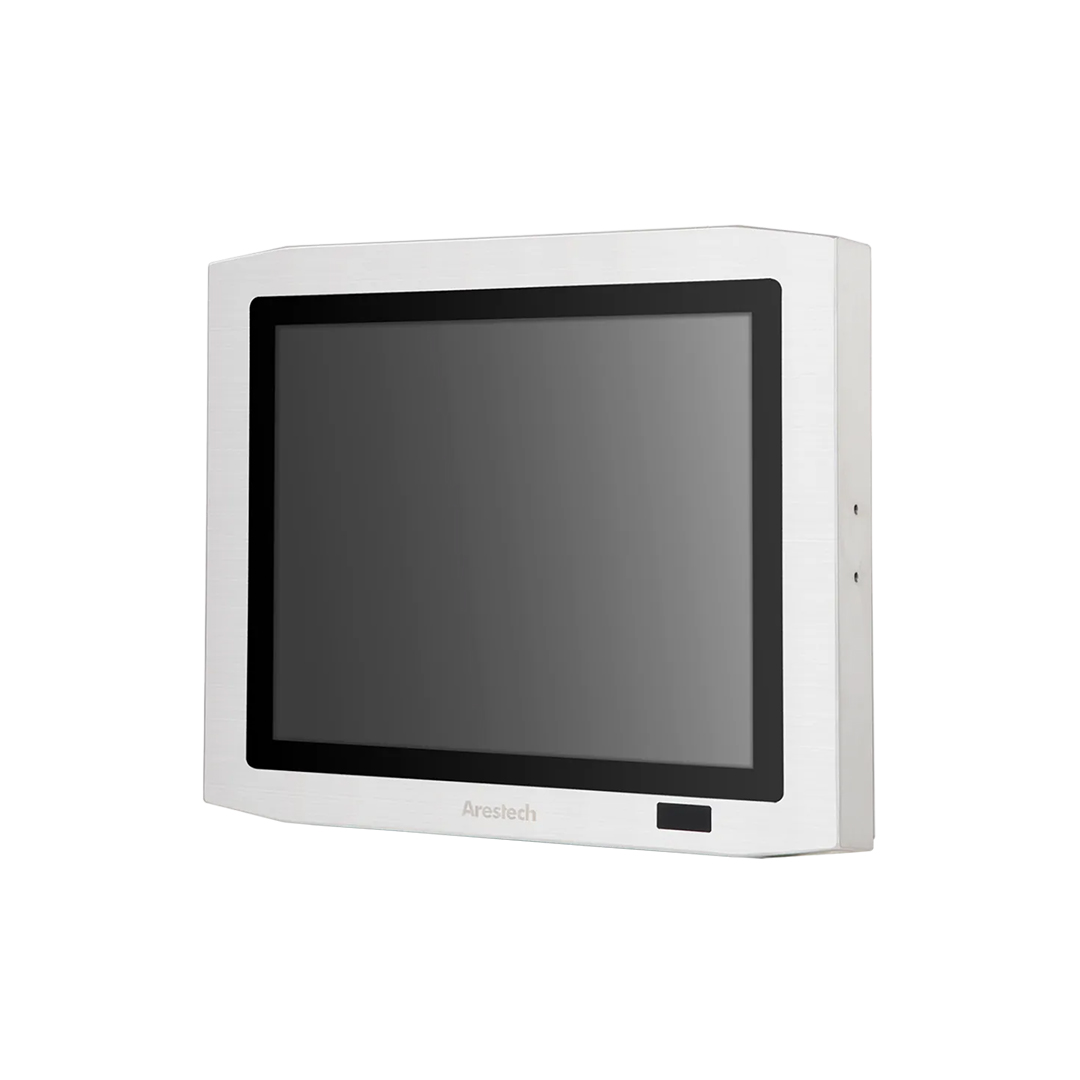
Front and fully sealed monitors from IP65 to IP69K.
View range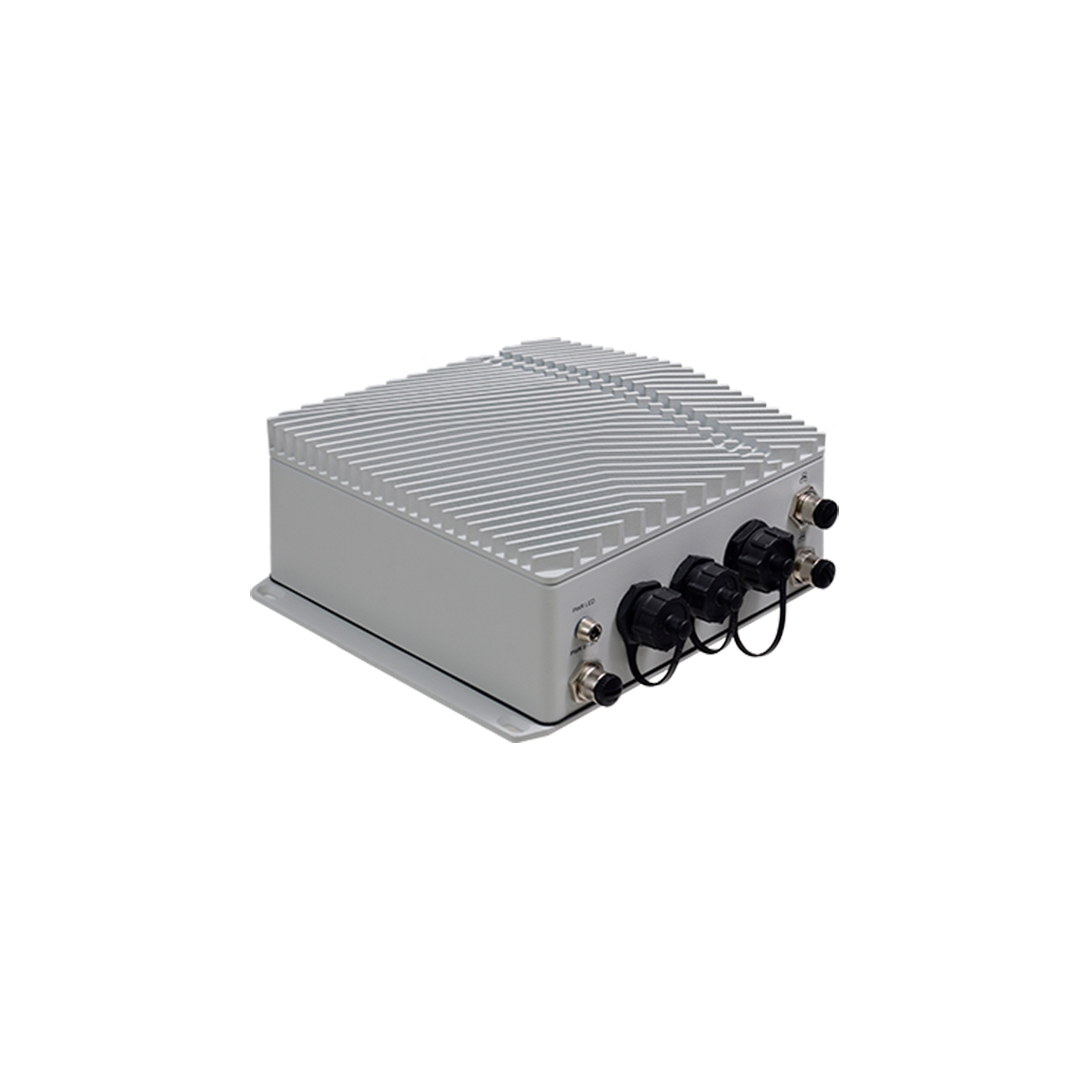
Sealed box PCs from IP65 to IP69K with M12 I/O.
View range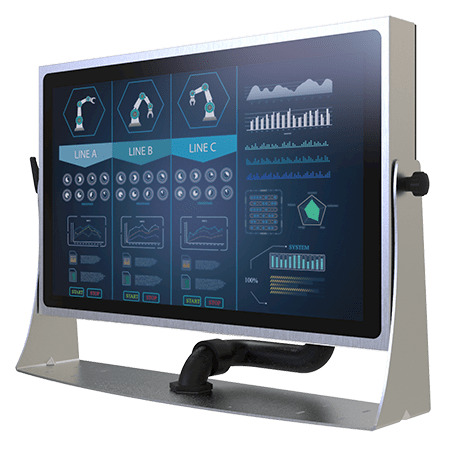
Stainless steel computers for hot, high-pressure washdown.
View rangeThe IP test methodology is set by IEC 60529 (or DIN 40050-9 for IP69K) and is identical across the BS EN and ANSI/IEC adoptions. All tests are performed in controlled laboratory conditions on production-representative samples.
The tests are pass/fail. A product is either IP65 or it is not. There is no “partial IP65” or “IP65 in most conditions” — though front-of-panel and full-enclosure ratings are distinguished separately (see What Is IP65? below).
Jump to a rating, or read on for each one in turn. All five are dust-tight; they differ in what the water does.
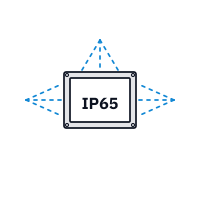
Dust-tight and protected against low-pressure water jets. The minimum for waterproof.
View range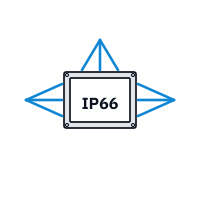
Dust-tight and protected against powerful water jets, for hosing and storms.
View range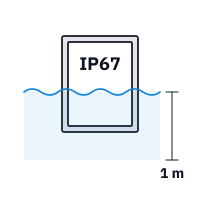
Dust-tight and protected against temporary immersion to 1 m for 30 minutes.
View range Dust-tight and protected against continuous immersion to a stated depth.
View range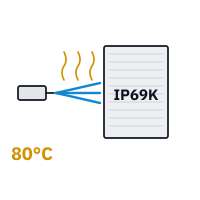
Dust-tight and protected against hot, high-pressure washdown.
View rangeAn IP65 rating means an enclosure is dust-tight and protected against low-pressure water jets from any direction. It is the practical minimum for any “waterproof” claim on an industrial computer, and the most common rating on panel-mount displays and panel PCs.
| Property | IP65 |
|---|---|
| Solids | 6: dust-tight |
| Liquids | 5: low-pressure water jets |
| Test | 6.3 mm nozzle, 12.5 litres per minute, 30 kPa |
| NEMA equivalent | NEMA 4 (approximately) |
| Typical use | Outdoor kiosks, signage, panel-mount HMIs |
The first digit, 6, means the enclosure is dust-tight: no dust enters at all during an eight-hour dust chamber test. The second digit, 5, means it is protected against water jets from a 6.3 mm nozzle at any angle. The jets are low pressure, enough to cover rain, hosing and wipe-down cleaning, but not a pressure washer.
Industrial displays and panel PCs are often specified with a “Front IP65” or “Front IP66” rating rather than full enclosure protection. The distinction matters and is frequently misunderstood.
A Front IP65 panel PC in an outdoor kiosk is correct specification — the back of the unit is inside the kiosk enclosure and never sees weather. A Front IP65 panel PC bolted to the outside of a forestry vehicle is the wrong specification — the back is exposed and the system will fail in months.
When in doubt, check whether the published rating specifies “Front” or “Full”. If the manufacturer doesn’t say, ask. The difference is not cosmetic.
Front IP65/IP66 only. The display is rated when installed in a panel aperture with the front bezel and seal exposed. The back of the unit, where I/O connectors live, is NOT rated — it sits inside the protected enclosure on the dry side of the panel.
Full IP65/IP66. The entire enclosure is rated. All sides, including I/O. This usually requires M12 waterproof connectors instead of standard RJ45, USB, HDMI etc., because conventional connectors compromise the rating.
IP65: Common Questions
Water-resistant, not submersible. It keeps out rain, splashes and low-pressure hosing, but not powerful jets, pressure washing or immersion; those need IP66, IP69K and IP67 respectively.
Yes, for most outdoor installations. It handles rain, wind-driven spray and dust, which is why kiosks, signage and building-mounted equipment use it. For storm-driven rain or hosing step up to IP66, and to IP67 where brief submersion is possible.
Our front IP65 panel PCs and front IP65 monitors are sealed at the bezel for panel mounting, and fully sealed units are listed under IP65 computers. The IP65 FAQ covers the rating in brief.
An IP66 rating means an enclosure is dust-tight and protected against powerful water jets from any direction: a 12.5 mm nozzle at 100 kPa, over three times the pressure and eight times the flow of the IP65 test. It is the step up from IP65 for equipment that is hosed down or faces storm-driven rain.
| Property | IP66 |
|---|---|
| Solids | 6: dust-tight |
| Liquids | 6: powerful water jets |
| Test | 12.5 mm nozzle, 100 litres per minute, 100 kPa |
| NEMA equivalent | NEMA 4 or 4X (approximately) |
| Typical use | Hosed-down equipment, marine decks, exposed outdoor sites |
The first digit, 6, is the same as IP65: no dust enters during the eight-hour dust chamber test. The second digit, 6, means protection against powerful water jets from any direction, strong enough to cover hosing, heavy seas washing over a deck and storm-driven rain.
IP66: Common Questions
Yes, against powerful jets and heavy rain. It does not include immersion, so equipment that may be submerged needs IP67 as well, which is why many rugged units carry IP66/IP67 together.
Yes, including exposed and coastal sites. It suits equipment in the open, on ships and on hosed-down vehicles. For salt air, pair it with stainless steel or NEMA 4X construction, because IP ratings do not test corrosion.
Our IP66 computers, IP66 panel PCs and IP66 monitors are sealed all round; as with IP65, front IP66 panel-mount units are sealed at the bezel only. The IP66 FAQ covers the rating in brief.
Recent IP66 launches include the sealed, fanless iBOX-650P-IP66 AGX Orin computer, the compact iBOX-602P-IP66 with PoE for cameras and the SBOX-2624P-IP66 waterproof industrial PC.
An IP67 rating means an enclosure is dust-tight and protected against temporary immersion in water to 1 m for 30 minutes. It is the standard rating for vehicles, field equipment and anything that might be dropped in water or caught in a flood.
| Property | IP67 |
|---|---|
| Solids | 6: dust-tight |
| Liquids | 7: temporary immersion |
| Test | 1 m depth for 30 minutes |
| NEMA equivalent | NEMA 6 (approximately) |
| Typical use | Vehicles, agriculture, field and military equipment |
The 6 is the same dust-tight rating as IP65 and IP66. The 7 means the enclosure keeps water out when fully submerged for a limited time, under test conditions fixed by IEC 60529 rather than set by the manufacturer.
IP67: Common Questions
Yes, to 1 m for 30 minutes. It is not tested against water jets, so equipment that is also hosed down should carry IP66 or IP69K as well.
For short periods only. IP67 covers brief, accidental immersion, such as a vehicle fording a stream or a unit dropped in a tank. For equipment that stays under water, specify IP68 with the depth and duration stated.
See our IP67 computers, IP67 panel PCs and IP67 monitors. The IP67 FAQ covers the rating in brief.
An IP68 rating means an enclosure is dust-tight and protected against continuous immersion under conditions stated by the manufacturer, typically deeper than 1 m and longer than 30 minutes. Unlike IP65 to IP67, the test is not fixed, so two IP68 products can protect to very different depths.
| Property | IP68 |
|---|---|
| Solids | 6: dust-tight |
| Liquids | 8: continuous immersion |
| Test | Set by the manufacturer, beyond IP67 |
| NEMA equivalent | NEMA 6P (approximately) |
| Typical use | Sub-sea instruments, permanently wet installations |
The 6 is dust-tight, as for every industrial rating. The 8 means protection against continuous immersion, but IEC 60529 leaves the depth and duration to the manufacturer, provided they are more severe than the IP67 test. The rating only means something alongside those stated conditions.
IP68: Common Questions
Yes, to the depth and time the manufacturer states. “IP68” alone does not tell you whether a unit survives 2 m for an hour or 50 m for a week, so always read the stated conditions.
For immersion, yes; for everything else, no. Neither IP67 nor IP68 includes a jet test, so equipment that is hosed or pressure-washed still needs IP66 or IP69K alongside it.
IP68 is rarely needed on industrial computers, and our standard range stops at IP67 for immersion. If equipment must work under water permanently, tell us the depth and duration and we will advise. The IP68 FAQ covers the rating in brief.
An IP69K rating means an enclosure is dust-tight and protected against close-range, high-pressure, high-temperature water jets, as defined by DIN 40050-9. It is the food and beverage industry standard for equipment cleaned every shift with hot water, steam and chemical disinfectants.
| Property | IP69K |
|---|---|
| Solids | 6: dust-tight |
| Liquids | 9K: hot, high-pressure jets |
| Test | 80 °C water at 8 to 10 MPa from 100 to 150 mm |
| NEMA equivalent | None; NEMA 4X is closest for corrosion |
| Typical use | Food and beverage washdown, pharmaceutical, vehicles |
The 6 is dust-tight. The 9K, from the German standard DIN 40050-9, means protection against close-range, high-pressure, high-temperature water jets: the conditions of a pressure washer or steam cleaner used in food plants and on vehicles.
IP69K: Common Questions
No. The 9K test covers hot, high-pressure jets and includes no immersion. Where equipment may be submerged and washed down, look for a combined rating such as IP67/IP69K.
They describe a near-identical hot, high-pressure jet test from two standards. IP69K comes from DIN 40050-9, written for pressure-washed road vehicles and adopted by food processing; IEC 60529 later added its own IPX9 level. In industrial computing, IP69K is still the rating specified and tested.
See our IP69K computers, IP69K panel PCs and IP69K monitors, and our guide to hygienic design. The IP69K FAQ covers the rating in brief.
The five industrial ratings differ only in the second digit, so the choice comes down to what the water does: falls, jets, submerges or blasts.
| Rating | Dust | Water | Typical use |
|---|---|---|---|
| IP65 | Dust-tight | Low-pressure jets | Outdoor kiosks, signage, panel-mount HMIs |
| IP66 | Dust-tight | Powerful jets | Hosed-down equipment, marine decks, exposed outdoor sites |
| IP67 | Dust-tight | Immersion to 1 m for 30 minutes | Vehicles, agriculture, field equipment |
| IP68 | Dust-tight | Continuous immersion, maker-specified | Sub-sea and permanently wet installations |
| IP69K | Dust-tight | Hot, high-pressure jets | Food and beverage washdown |
Both are dust-tight; the difference is jet strength. IP66 is tested with a larger nozzle at over three times the pressure and eight times the flow, so choose it where equipment is hosed down or faces driving rain.
IP65 protects against water jets; IP67 against temporary immersion to 1 m. IP67 does not include a jet test, so a unit that may be both submerged and hosed needs both ratings.
IP66 is for powerful jets, IP67 for brief immersion. They test different things, which is why rugged vehicle and outdoor equipment often carries IP66/IP67 together.
Both cover immersion. IP67 is fixed at 1 m for 30 minutes; IP68 goes further, to a depth and duration the manufacturer must state, so always read the conditions behind an IP68 claim.
IP55 allows limited dust ingress; IP65 allows none. Both resist low-pressure jets. IP55 suits indoor enclosures in light dust; IP65 is the minimum for a genuinely waterproof, dust-tight industrial computer.
NEMA — the National Electrical Manufacturers Association — publishes a parallel enclosure rating system used widely in the United States and Canada, defined in NEMA 250. The two systems test slightly different things: NEMA tests cover environmental factors IP does not (corrosion resistance, external ice formation, oil ingress, gasket aging across service life), and IP tests cover precision liquid pressures NEMA does not.
There is no exact one-to-one mapping. The closest practical equivalents are:
| NEMA type | Description | Approximate IP rating |
|---|---|---|
| NEMA 1 | Indoor, general purpose | IP20 |
| NEMA 3 / 3R / 3S | Outdoor, rain and snow, external ice operation | IP54 |
| NEMA 4 | Indoor or outdoor, watertight | IP65 or IP66 |
| NEMA 4X | Nema 4 plus corrosion resistance | IP66 |
| NEMA 6 | Occasional submersion, limited depth | IP67 |
| NEMA 6P | Prolonged submersion | IP68 |
| NEMA 12 / 13 | Indoor, dust-tight, oil resistant | IP54 or IP65 |
The mapping is approximate because NEMA additionally tests against rust, ice, oil and gasket aging — IP does not. For deployments where corrosion or chemical resistance matters (food, pharma, offshore marine), the NEMA 4X or 6P designation may be the more meaningful specification line even where the project nominally uses IP.
For equipment specified into projects that span both the UK and North American markets — common in food and beverage processing, marine, defence, and multinational manufacturing — calling out both ratings on the specification line is the safer approach. “IP66 / NEMA 4X stainless steel” tells UK and US buyers everything they need to verify compliance against their local standard.
The right rating is determined by the environment, not by aspiration. The pattern is to identify the dominant water and dust exposure in the deployment, pick the rating that meets it, and add no more than one step of margin for unknowns.
Margin should be added carefully. An IP67-rated computer specified for an IP65 application costs more, weighs more, and may require more elaborate connector seals — none of which serves the deployment. The right specification is precise to the environment, not maximally protective.
| Environment | Recommended rating |
|---|---|
| Indoor office, climate-controlled | IP20 or unrated. No waterproofing needed. |
| Indoor factory floor, dusty, occasional cleaning | IP54 to IP55 (NEMA 12 in North America). Sealed against dust accumulation, tolerates light cleaning spray. |
| Indoor heavy industrial, regular wash-downs | IP65 (front) or IP66 (full). NEMA 4 equivalent. Withstands routine cleaning. |
| Outdoor sheltered (under canopy, building-mounted) | IP65 / NEMA 4. Protected against wind-driven rain and dust. |
| Outdoor fully exposed (forecourt, transport hub, kiosk) | IP66 / NEMA 4X. Protected against driving rain and storm wash. NEMA 4X stainless adds corrosion resistance for coastal sites. |
| Outdoor cold climate (UK winter, US northern states, Canadian provinces) | IP66 plus NEMA 3R for ice-load validation — the dual specification is meaningful here. |
| Field-deployed mobile equipment (agricultural, forestry, military) | IP67 / NEMA 6. Survives temporary submersion if the vehicle fords a stream or rolls. |
| Marine deck-mounted equipment | IP66 minimum, IP67 preferred. NEMA 4X stainless for salt-water corrosion. UK MCA and Lloyd’s Register, and US Coast Guard (USCG) and ABS, may require additional marine-specific approvals on top of IP/NEMA. |
| Sub-sea or permanent immersion | IP68 with manufacturer-specified conditions. NEMA 6P equivalent. |
| Food and beverage processing, daily sanitary wash-down | IP69K. Stainless-steel construction typical. UK BRC and FSA standards, and US FDA and USDA food-safety requirements, layer on top. |
| Pharmaceutical, cleanroom | IP65 minimum, with fanless construction to prevent air-particle circulation. UK MHRA Good Manufacturing Practice (GMP) and US FDA GMP set additional cleanroom-class requirements. |
| Hazardous area (oil & gas, chemical processing) | IP66/IP67 plus zone certification. UK HSE / DSEAR with ATEX zone marking; US OSHA / NEC with Class/Division marking. |
Things Embedded supplies industrial computers, displays and panel PCs across the IP65 to IP69K range — Front-of-panel and Full-enclosure options for panel-mount equipment, dual IP / NEMA marking on equipment supplied to North American buyers, and industry-specific approval layered on (marine, food, pharmaceutical, defence, hazardous area) where the deployment demands it.
Specifying the right rating starts with the deployment environment, not the product catalogue. Tell us about these five things and our engineers will shortlist practical options for the application.
Water exposure (rain, spray, submersion, wash-down), dust load, temperature range, vibration profile.
Wipe-down, low-pressure spray, pressure jet, or full sanitary wash-down with chemicals.

Panel aperture, free-standing enclosure, vehicle mount, marine deck.

UK, US, EU, or multinational — and any industry-specific certification overlay (BRC, FDA, MCA, USCG, ATEX, OSHA, MIL-STD-810G, DEF STAN).

Years in service, last-time-buy planning horizon, gasket-replacement tolerance.
IP65 defines the minimum waterproof rating for any "weather-resistant" claim — dust-tight against all particle ingress, and protected against low-pressure water jets from any direction. Here is what that means in practice, how it is tested, and when it is the right specification.
IP66 is the rating above IP65 — dust-tight, and protected against powerful water jets. It is the standard specification for outdoor industrial computing in storm-exposed locations, marine deck equipment and light wash-down food handling, equivalent to NEMA 4 / 4X in North American markets.
IP67 means an enclosure is dust-tight and protected against temporary submersion in water up to 1 metre deep for 30 minutes. It is the standard rating for field-deployed equipment that might be briefly immersed — agricultural sensors, military field hardware, marine bilge installations — equivalent to NEMA 6 in North American markets.
IP68 means an enclosure is dust-tight and protected against continuous immersion under manufacturer-specified conditions exceeding the IP67 envelope. It is the rating for permanent or long-duration underwater deployment — sub-sea instrumentation, deep-fluid handling, certain mining applications — equivalent to NEMA 6P in North American markets.
IP69K means an enclosure is dust-tight and protected against high-pressure, high-temperature water jets per DIN 40050-9 — 80°C water at 8—10 MPa from close range. It is the food and beverage industry standard for sanitary wash-down on both sides of the Atlantic — and it does NOT imply submersion protection.
NEMA and IP are parallel enclosure rating systems used in North America and internationally — they overlap, but they are not equivalent. Here is the practical mapping between them, what each system tests that the other does not, and which to specify when both matter.
Tell us where the equipment will be installed, how it is cleaned and the standards your market requires. We will recommend computers, displays and panel PCs with the right front or full rating, and build them into a system ready to install.