
 UK
UK PC/104
The 1992 original with a 104-pin ISA connector. Still manufactured and used in slower-speed systems that benefit from modularity and ruggedness.
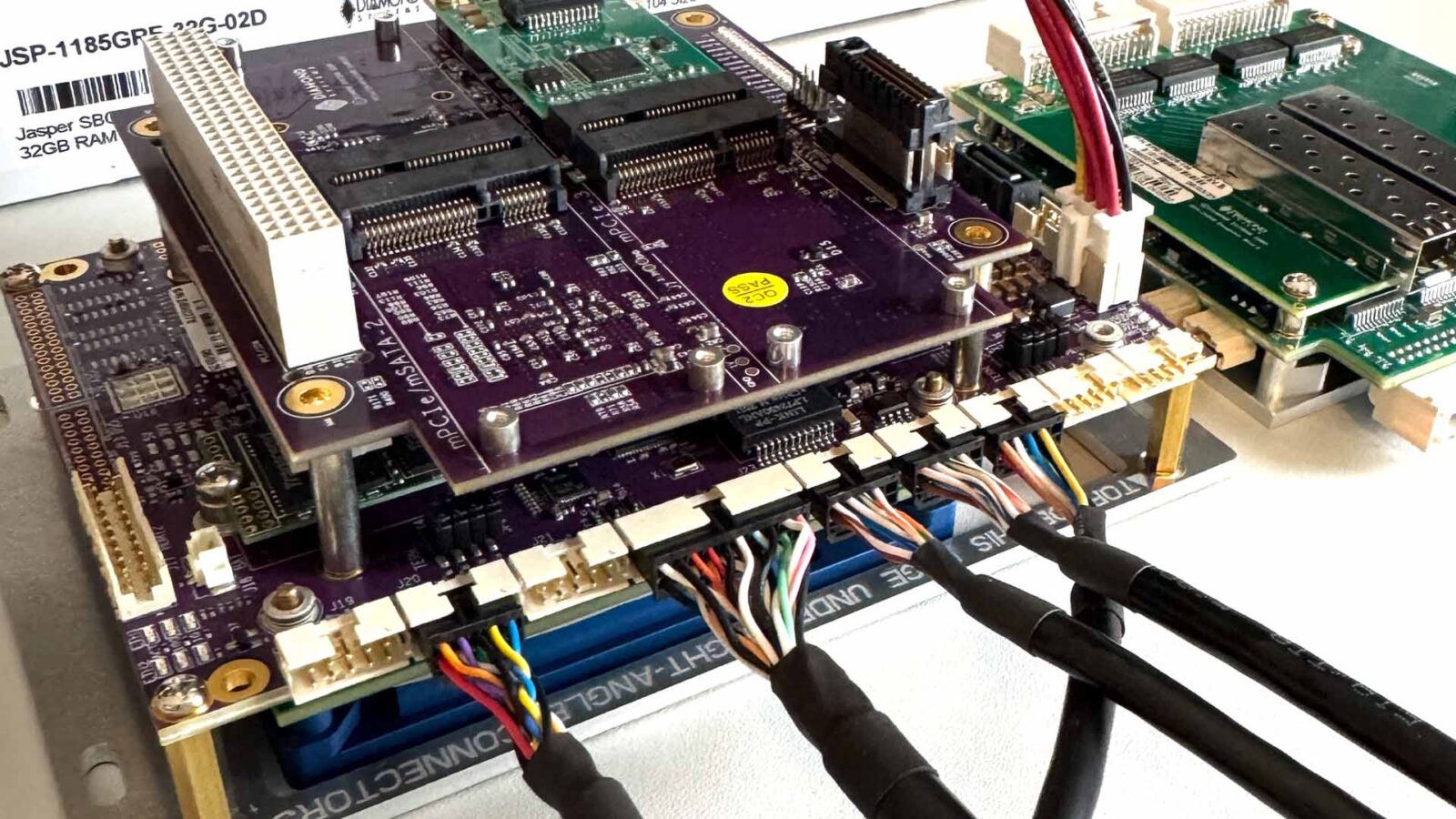
PC/104 is a 90 × 96 mm stackable board standard for rugged embedded computers. This guide covers the form factor, how a stack is built, the bus generations, where it is used and how it compares with COM Express and 3.5-inch boards.
PC/104 is a standard for small embedded computer boards that stack on top of each other instead of plugging into a backplane. Each board measures 3.550 × 3.775 in (90 × 96 mm), carries the same four corner mounting holes and connects to its neighbours through pin-and-socket bus connectors that pass every signal up the stack. A single board computer forms the base, I/O modules and a DC/DC power supply bolt on above it on 0.6-inch stand-offs, and the result is a self-contained computer that fits in the hand and tolerates the shock and vibration that would shake a card out of a slot. The name comes from the 104 pins of the original ISA bus connector, and the format has been in continuous production since 1992.
The reason it persists is that the PC/104 form factor solves a problem boxed computers cannot. It lets a designer put exactly the processor, I/O and power the application needs into a package sized for a vehicle chassis, an avionics bay or a piece of test equipment, and then change any single layer years later without redesigning the rest. This guide explains how a stack is built, what the bus generations mean, where PC/104 is used and when another form factor is the better choice.
A PC/104 stack starts with a host board, usually a single board computer with the processor, memory, storage interfaces and a set of on-board I/O. Its bus connector has pins on the top and sockets on the bottom, so a module placed above it plugs straight in and presents the same connector again to the next board. Four stand-offs at the corners take the mechanical load, and the specification fixes the spacing at 0.600 in (15.24 mm) so that every board, heat sink and tall component is designed to fit inside the same layer height.
Modules add what the host lacks: analog input for sensors, digital I/O for switches and relays, serial ports for legacy equipment, CAN bus for vehicle networks, extra Ethernet ports, or a managed switch. A DC/DC power supply on the same footprint converts a vehicle or battery input into the regulated rails the stack needs and delivers them through the bus connector, so there is no power harness inside the enclosure. A typical stack is three to five boards; larger ones exist, limited by bus loading and by the height of the enclosure.
Cooling is almost always passive. Boards are specified for wide temperature operation, and conduction-cooled variants add a heat spreader that carries processor heat to the enclosure wall. The finished stack is usually bolted into a sealed aluminium housing with the connectors brought out through MIL-DTL-38999 or M12 connectors, at which point it becomes a rugged mission computer rather than a set of boards.
The format is more than thirty years old, and newer standards exist for most of the things it does. It stays in use because five properties come together in one package.
The trade-off is bandwidth. The original ISA and PCI buses are slow by modern standards, and even PCIe/104 stops at PCI Express Gen 3. Where an application needs the fastest interconnect available, a COM Express or COM-HPC module on a custom carrier is the better fit; where it needs rugged, expandable I/O in a small space, PC/104 remains hard to beat.
The variants share the footprint and differ in the connector. The short version is below; our guide to the PC/104 bus variants covers the connectors, the two PCIe/104 connector types and how to mix buses in one stack.
The 1992 original with a 104-pin ISA connector. Still manufactured and used in slower-speed systems that benefit from modularity and ruggedness.
Adds a 120-pin PCI connector alongside ISA, for higher-bandwidth video and communications modules while keeping legacy I/O in the same stack.
PCI only, with the ISA connector removed. Needs a PCI-capable host board and suits modules that never needed ISA.
PCI Express on the stack. Type 1 carries four x1 links and a x16 link; Type 2 carries four x1 links, two x4 links, USB 3.0 and SATA.
Both the PCI and the PCI Express connectors on one board, so legacy PCI modules and new PCIe modules share a stack without a bridge.
The host board sets the bus and the processor. PC/104 single board computers range from low-power Vortex86 and AMD Geode boards on the ISA bus, which keep long-running programmes supplied, to PCIe/104 and PCI/104-Express boards with Intel Atom and 11th Gen Intel Core processors for current designs. Some carry a COM Express module on a PC/104 carrier, so the processor can be upgraded by swapping the module while the carrier and its I/O stay in service. Most include data acquisition on the board itself.
PC/104 I/O modules add the channels the host lacks: 16-bit analog input and output with autocalibration, digital I/O with counters and timers, opto-isolated inputs and relay outputs, RS-232/422/485 serial ports, isolated CAN bus channels and extra Ethernet ports. PC/104 power supplies convert a wide vehicle or battery input to regulated rails, with versions that add a UPS and battery charger or filtering to the requirements of MIL-STD-461, MIL-STD-704 and MIL-STD-1275. Where the system needs networking, a managed Ethernet switch board on the same footprint adds Gigabit and 10G ports; our guide to board-level switch modules explains that option.
Storage and wireless usually go on the host board’s own mini PCIe or M.2 sockets rather than on a stack layer, which keeps the stack short and the antennas close to the enclosure wall.
The format appears wherever a computer has to be small, tolerant of its surroundings and in service for a long time. Military ground vehicles are the largest single market: a PC/104 stack with a MIL-STD power supply sits behind a display, runs a sensor or controls a turret, and stays in the fleet for the vehicle’s lifetime. Aircraft and helicopter avionics use it for mission and data-recording computers where weight and size are constrained. Unmanned aircraft, ground vehicles and underwater vehicles use it for flight and payload computers for the same reasons.
Outside defence, PC/104 is common in railway and transport equipment, in industrial machinery and process control, in test and measurement rigs that need many analog channels, and in research platforms where a custom I/O module is easier to design for a stack than for any other form factor. In each case the buying pattern is the same: a programme selects a stack architecture once and then supports it, with incremental upgrades, for ten years or more.
Three board-level approaches cover most rugged embedded designs, and they answer different questions.
COM Express separates the processor from the I/O. The computer-on-module carries the CPU, memory and chipset; the designer builds a custom carrier board with exactly the connectors the product needs. It gives the most freedom and the highest bandwidth, at the cost of designing and qualifying a carrier. Our COM Express range and the COM-HPC vs COM Express guide cover that route.
3.5-inch single board computers put processor and a fixed set of I/O on one 146 × 102 mm board, ready to run with no carrier and no stack. They are the fastest route to a working system when the on-board I/O is enough. The 3.5-inch SBC range includes boards with a PCIe/104 connector, so a 3.5-inch host can still take PC/104 modules.
PC/104 sits between the two. There is no carrier to design, but the I/O is not fixed either: the stack grows to fit the application, and any layer can be changed later. The hybrids show how close the three have become. A PCI/104-Express board that carries a COM Express Type 6 module gives an upgradeable processor on a stackable base, and a 3.5-inch board with PCIe/104 expansion gives fixed I/O plus a stack.
PC/104 has been an open, multi-vendor standard since the PC/104 Consortium was formed in 1992. On 16 October 2025 the consortium renamed itself the RMS Consortium, for Rugged, Modular, Stackable, to reflect a remit that now extends beyond the PC/104 family. It continues to publish the PC/104, PC/104-Plus, PCI-104, PCIe/104 and PCI/104-Express specifications, along with the larger EPIC and EBX board formats that use the same stack connectors, and it has a new specification, UxV/35, in development for unmanned systems. The current PC/104 specification is version 2.6; PCIe/104 is at revision 2.1, which added rules for PCI Express Gen 2 and Gen 3.
For a buyer, the practical consequence is that the mechanical and electrical rules are public and stable. A board that meets the specification from one vendor stacks with a board from another, and a module designed today fits a host built fifteen years ago, provided the bus matches.
PC/104 is the right starting point when an application needs a small, rugged computer with I/O that can be specified now and changed later, and when the programme will run long enough for that flexibility to pay back. It is the wrong starting point when the deciding factor is raw bandwidth or the smallest possible footprint with fixed I/O.
We supply the full PC/104 range: host boards on every bus generation, the I/O modules and power supplies that stack on them, and switch boards for the network. We start from the application rather than a part number, recommend a host board and bus generation that fit the I/O and the environment, and build, image and validate the complete stack before it ships. Where the requirement points elsewhere, we say so and suggest a rugged single board computer or a COM Express design instead.
Tell us the application, the I/O you need to reach and the environment the stack will live in, and we will recommend a host board, matching modules and a power supply to start from.