
 UK
UK 
4× PoE+ GbE
The box can act as both compute and power source for a small camera array, which simplifies cabling on multi-camera inspection cells. Our guide to PoE power budgeting covers sizing the camera load.
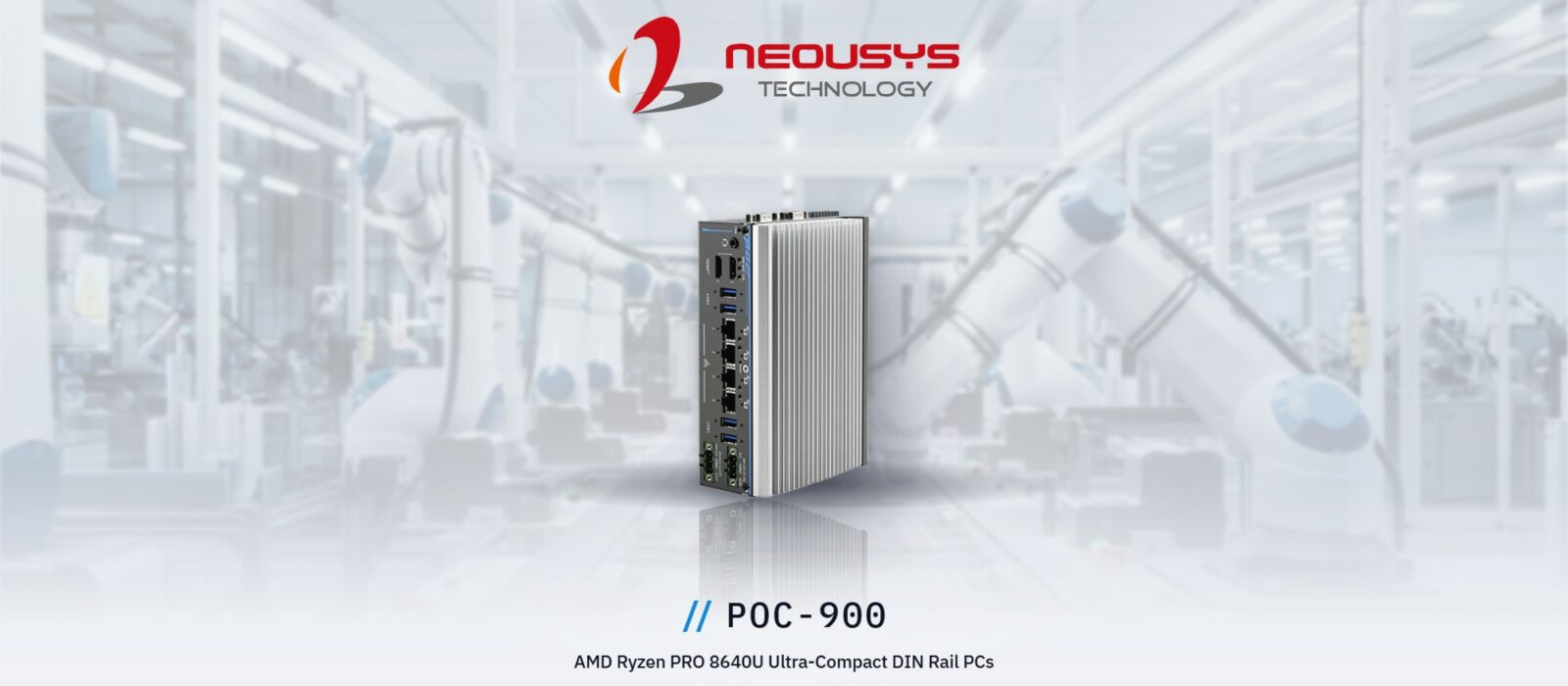
The Neousys POC-900 series is the first AMD Ryzen generation of the POC ultra-compact DIN rail platform, pairing a Ryzen PRO 8640U with an on-die NPU rated at 16 TOPS. It sits alongside the Intel-based POC-500 and POC-700 series in the same DIN rail footprint, with the AI silicon those earlier generations did not carry.
DIN rail computers earn their place because they fit where nothing else does: between a PLC and a contactor, on a panel rail next to the safety relays, in a cabinet with no room for a tower or a 1U rack. What has changed is the workload. A box that once ran a control loop and a few Modbus polls is now asked to handle vision pre-processing, on-device inference, multi-camera PoE feeds and the occasional model update. The mechanical envelope has not grown; the compute expectations have.
The POC-900 series keeps the envelope and DIN rail mounting that the POC-500 and POC-700 series have used for years. That matters where the computer has to fit a panel layout someone already approved, on a rail with a defined extent, in a mechanical drawing that is not being redrawn for this generation. The table sets the POC-915 against the POC-715, the four-PoE+ build of the previous generation.
| Specification | Neousys POC-915 | Neousys POC-715 |
|---|---|---|
| Processor | AMD Ryzen PRO 8640U, 6 cores / 12 threads, 3.5 GHz base, 4.9 GHz boost | Intel Core i3-N305, 8 cores / 8 threads, 1.8 GHz base, 3.8 GHz burst |
| TDP | 15 W fanless; 30 W configurable | 15 W |
| AI | Ryzen AI NPU 16 TOPS; 31 TOPS total SoC | Intel UHD Graphics (32 EUs) with OpenVINO support; no NPU |
| Graphics and displays | AMD Radeon RDNA3; 2× HDMI 2.0b, 3840 × 2160 at 60 Hz | Intel UHD Graphics; DP++ (4096 × 2160) and HDMI 1.4b (3840 × 2160) |
| Memory | 1× DDR5-5600 SODIMM, up to 32 GB | 1× DDR5-4800 SODIMM, up to 16 GB |
| Storage | 1× M.2 2280 PCIe Gen4 x4 NVMe | 1× M.2 2280 PCIe Gen3 x1, NVMe or SATA |
| Networking | 4× GbE (Intel I350-AM4) with 802.3at PoE+, 100 W total budget | 4× GbE (Intel I350-AM4) with 802.3at PoE+, 100 W total budget |
| I/O | 4× USB 3.2 Gen2 (screw-lock), 1× RS-232/422/485, 3× RS-232, 4-channel isolated DI and DO | 4× USB 3.2 Gen2 (screw-lock), 1× RS-232/422/485, 3× RS-232, 4-channel isolated DI and DO |
| Expansion | 1× full-size mini PCIe with micro SIM; MezIO port for COM, DIO, LAN, USB or ignition control | 1× mini PCIe with micro SIM |
| Security | dTPM 2.0 | dTPM 2.0 |
| Power | 8–35 V DC terminal block, remote on/off | 8–35 V DC terminal block, remote control |
| Temperature | −25 to 70 °C fanless at 15 W; 30 W to 45 °C, or to 70 °C with the fan kit | −25 to 70 °C fanless |
| Standards | MIL-STD-810H vibration and shock; CE/FCC Class A; UL 62368-1 | MIL-STD-810H vibration and shock; CE, FCC (UL via the POC-715-UL) |
| Weight and mounting | 1.2 kg; DIN rail as standard, wall-mount kit | 1.2 kg; DIN rail as standard, wall mount |
What carries across is the cabinet-facing side: the four PoE+ ports and 100 W budget, the screw-lock USB, the serial and isolated DIO set, the 8–35 V DC input, the −25 to 70 °C fanless rating and the 1.2 kg chassis. What moves forward is the silicon. Neousys quotes up to 2.7× higher CPU performance than the POC-500 series, and memory and storage have moved with the CPU to DDR5-5600 and Gen4 x4 NVMe.
The NPU is the bigger change. Defect classification, presence detection and operator-action recognition have historically been pushed onto a discrete GPU or a separate appliance, because the CPU could not run them with predictable latency. With 16 TOPS of dedicated AI silicon on-die, those workloads stay local to the cabinet. Our explainer on neural processing units sets out what an NPU does and where it fits in edge AI.
Two points for specifiers. In the UL-certified configuration the PoE+ budget is limited to 32 W, so check camera power draw early when UL listing is a requirement. And for vision models that need more than an integrated accelerator offers, the Neousys POC-960GC pairs the same Ryzen PRO 8640U with a low-profile NVIDIA GPU slot up to 70 W, in a compact wall-mount box rather than a DIN rail chassis. For installation, our step-by-step guide to mounting DIN rail computers covers rail types, clips and cabinet placement.
The POC-915 launches the series, with four PoE+ ports to power and process a small camera array from one DIN rail computer.
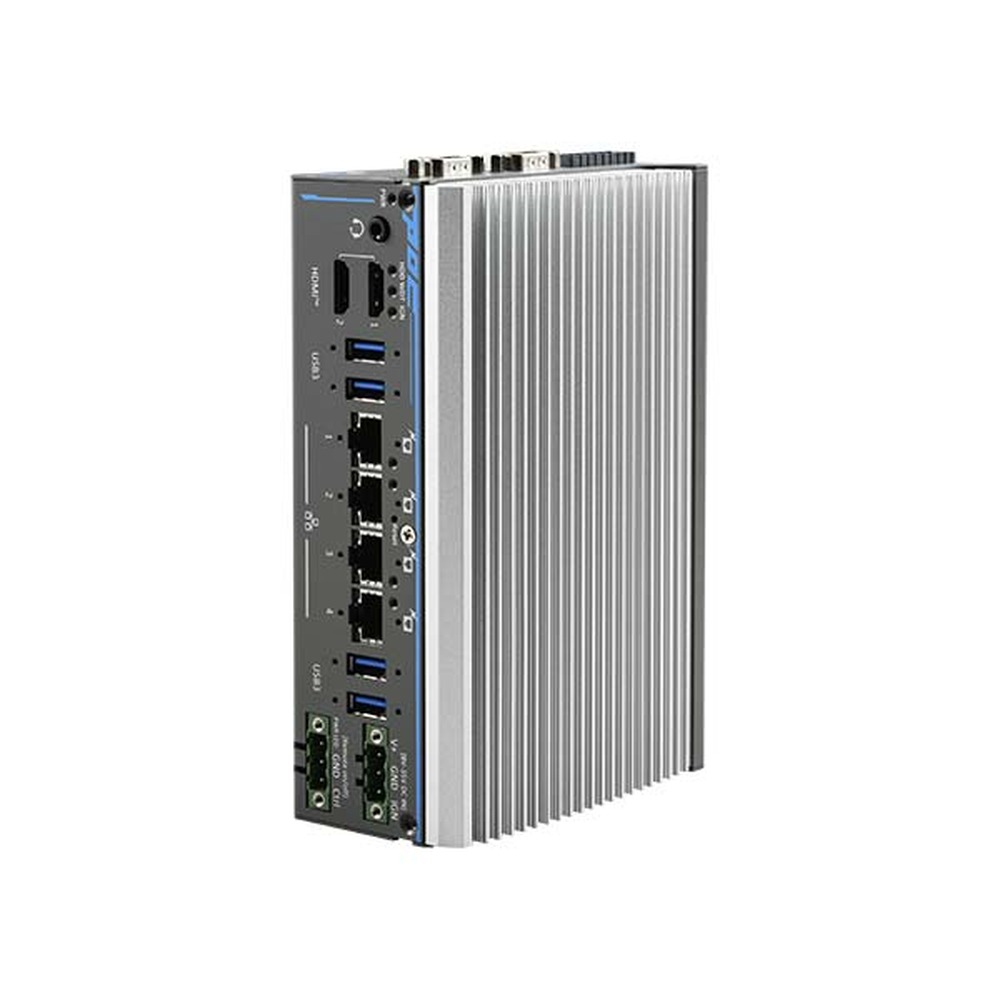
AMD Ryzen PRO 8640U Ultra-Compact DIN Rail PC with NPU and 4x PoE+
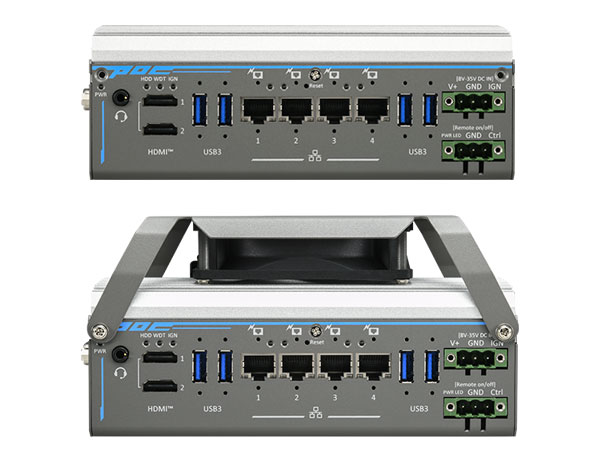
Fanless by default (top), or with the external fan kit fitted (bottom) for 30 W TDP in warmer cabinets.
The finned chassis that runs the POC-900 without a fan from −25 to 70 °C at 15 W.
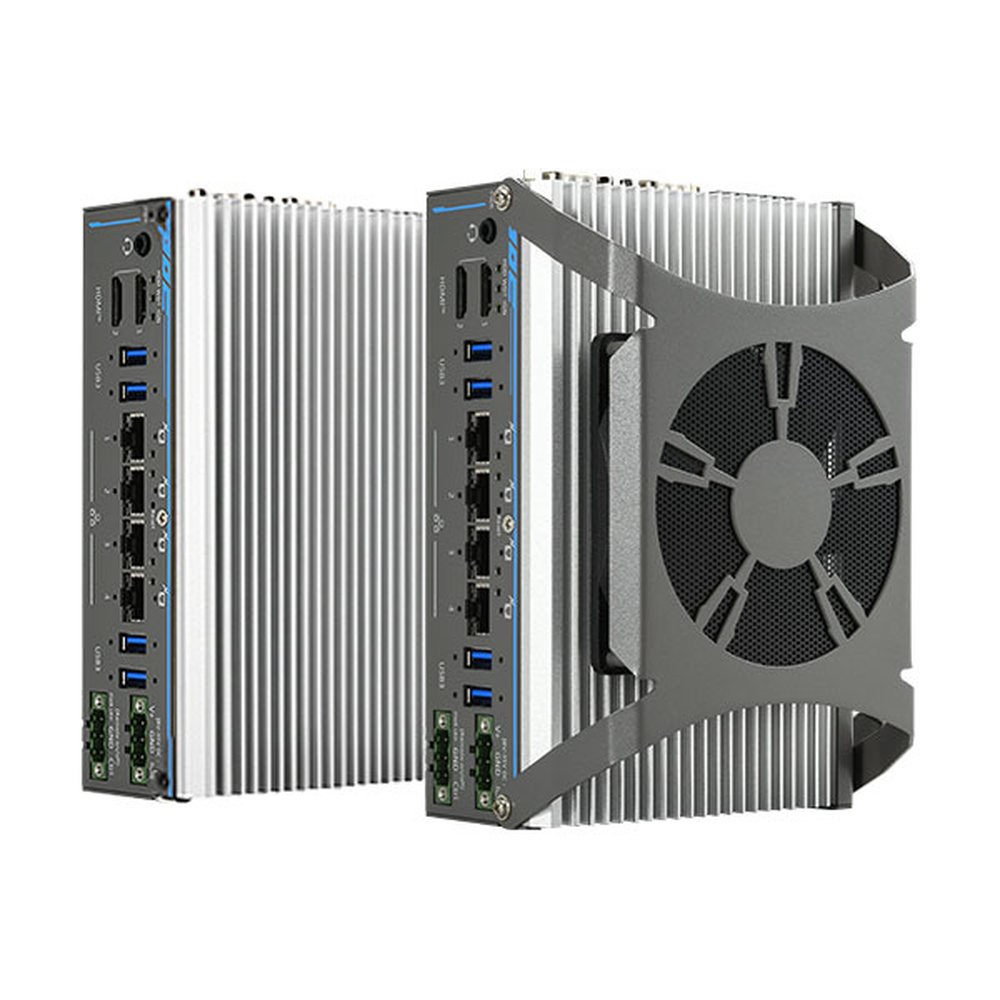
The fan kit mounts outside the chassis, adding cooling without a moving part inside the sealed box.
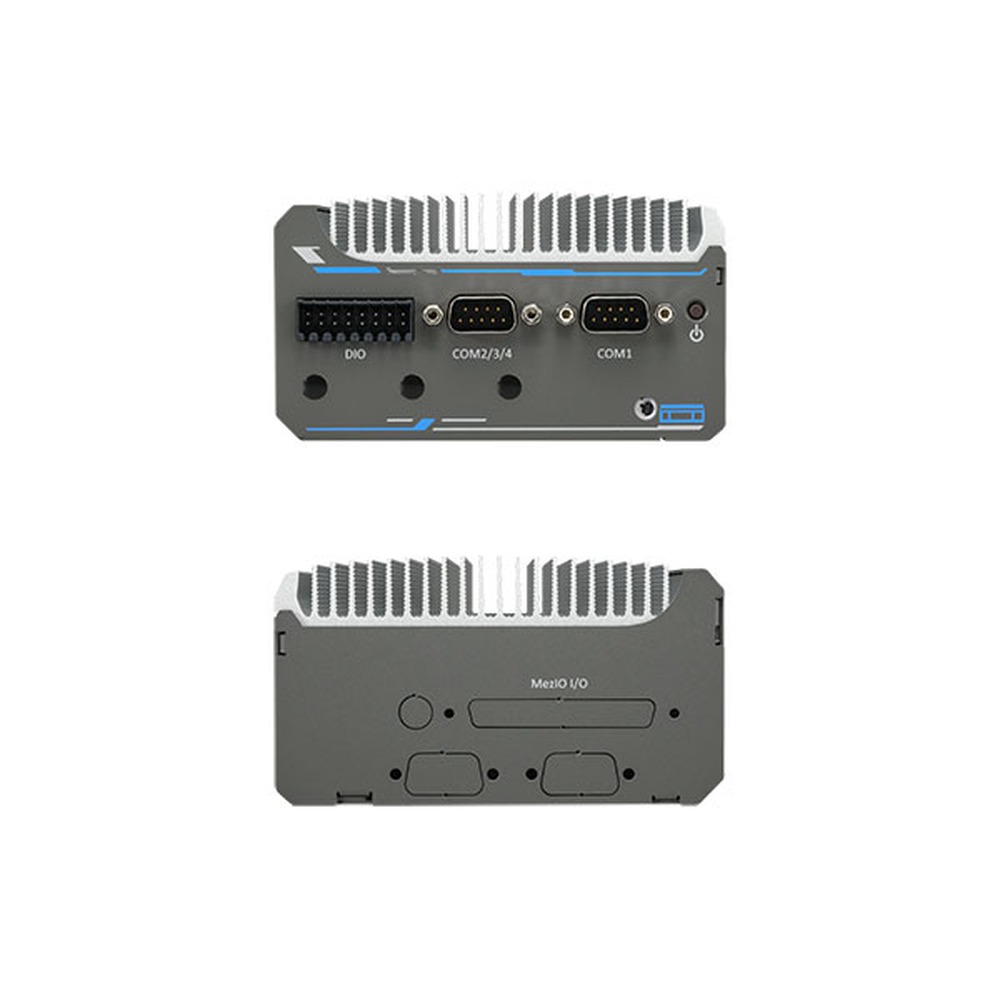
Isolated DIO and COM ports on one face, and the MezIO expansion interface on the other.
Fixed I/O and modular expansion together let one platform sit across inspection systems, factory automation cells and mobile robotics without a different computer for each.
The box can act as both compute and power source for a small camera array, which simplifies cabling on multi-camera inspection cells. Our guide to PoE power budgeting covers sizing the camera load.

Enough for cameras, dongles and a service engineer’s keyboard, with screw-lock retention to keep cables seated.
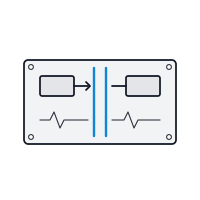
Keeps control inputs cleanly separated from the system ground, so a field input cannot put a ground loop through the computer.
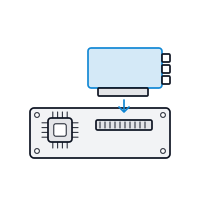
MezIO modules add LAN, COM, DIO or ignition control, which helps when one site needs more than another. Ignition control matters for vehicle and mobile installations, where the box must shut down cleanly when the keyswitch goes off.
Cabinet and panel projects where inference has moved closer to the line but the DIN rail space has not grown.
Cells where the existing controller has run out of headroom for newer models and a second compute node would mean a panel rebuild.

Gateways asked to do more than aggregate data, as inference moves closer to the production line.

Installations where MezIO ignition control, the wide temperature rating and the compact form factor all earn their place.
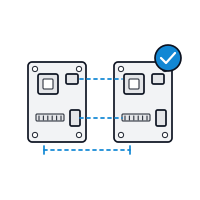
Cabinets already built around earlier POC systems, where the same footprint brings on-die AI without redrawing the panel.
802.3af (PoE), 802.3at (PoE+) and 802.3bt (PoE++) are the three IEEE Power over Ethernet standards. They differ mainly in power per port, roughly 15 W, 30 W, and up to 60 to 90 W, with the higher tiers using all four pairs of the cable.
PoE delivers up to about 15 W per port (802.3af), PoE+ up to about 30 W (802.3at), and PoE++ up to 60 W or 90 W (802.3bt), at around 48 V DC. Some power is lost in the cable, so the figure available at the device is a little lower than at the source.
Fanless computers cool themselves passively, through a finned heatsink chassis and heat pipes, instead of a fan. With no moving parts and no airflow drawing in dirt, they are more reliable in dusty or vibrating places, completely silent, low maintenance and easy to seal, which is why they are the standard choice for industrial and embedded use.
The industrial temperature range is −40 to 85 °C: the grade an electronic component must operate across to be called industrial, compared with 0 to 70 °C for commercial parts. Rugged computers built from industrial-grade components typically run from −25 or −40 °C up to 70 °C as a complete system.
MIL-STD-810G (2008) and MIL-STD-810H (2019) are successive revisions of the US military environmental test standard. 810H is the current version; it refined and reorganised test methods and tightened guidance, but both define test methods rather than a pass or fail certificate.
Tell us the workload, the cabinet and the I/O, and we'll help with variant selection, MezIO modules, mounting and the right cooling configuration.