
 UK
UK 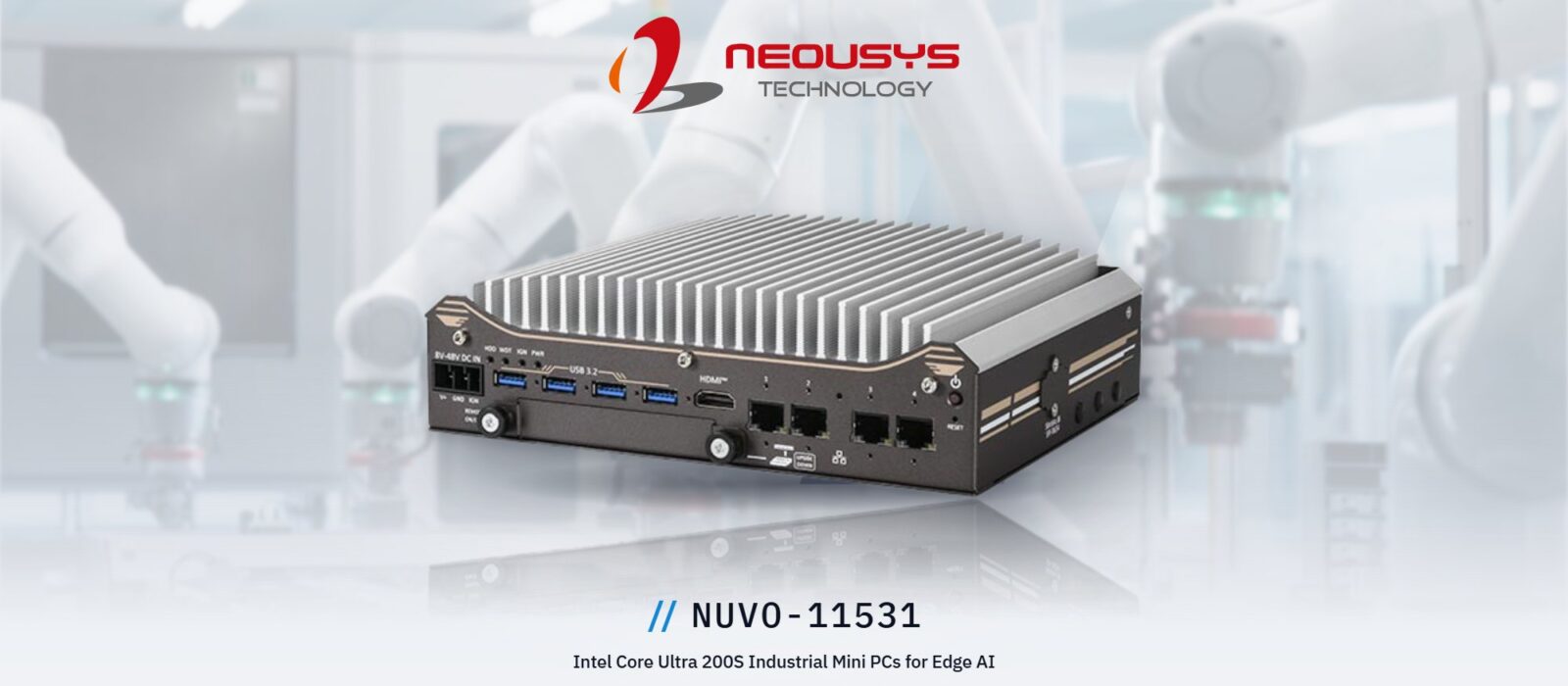
Neousys Nuvo-11531: a compact rugged computer for edge AI in tight spaces
The Neousys Nuvo-11531 puts Intel Core Ultra 200S and up to 36 TOPS of edge AI into a 212 x 165 x 63 mm fanless rugged chassis, with PoE+ camera I/O and wide DC power for robots, machine vision and in-vehicle deployment.
Edge AI rarely gets the luxury of space. A robot arm, an autonomous mobile robot or a roadside cabinet has to hold real compute and the I/O to drive cameras and sensors, often sealed up with no room for a fan.
The Neousys Nuvo-11531 is built for that gap: a compact rugged computer that puts Intel Core Ultra 200S and up to 36 TOPS of on-board edge AI into a fanless chassis rated from −25 to 60 °C. We configure it for robots, machine vision and in-vehicle builds, with the camera, storage and wireless options each platform needs.
Nuvo-11531 vs Nuvo-11588
Both models share the same Intel Core Ultra 200S (Arrow Lake-S) processors, fanless chassis and rugged rating. Core Ultra 200S pairs performance and efficient cores with an integrated NPU and Xe GPU, giving up to 36 TOPS of on-board AI without a separate accelerator; Intel Core Ultra explained covers the family in more detail. The difference between the two is expansion.
| Specification | Neousys Nuvo-11531 | Neousys Nuvo-11588 |
|---|---|---|
| Processor | Intel Core Ultra 9 285, Ultra 7 265 or Ultra 5 245 (35 W / 65 W) | Intel Core Ultra 9 285, Ultra 7 265 or Ultra 5 245 (35 W / 65 W) |
| Chipset | Intel H810 | Intel Q870 |
| AI performance | Up to 36 TOPS (NPU + Xe GPU) | Up to 36 TOPS (NPU + Xe GPU) |
| Memory | Up to 64 GB DDR5-6400 | Up to 64 GB DDR5-6400 |
| Networking | 4× 2.5GbE, optional PoE+ (100 W budget) | 4× 2.5GbE, PoE+ as standard (100 W budget) |
| External PCIe | None | SlimSAS 8i, PCIe Gen4 x8 (NVMe/U.2 storage, PCIe cameras or a GPU) |
| Isolated DIO | 4-ch DI, 4-ch DO | 8-ch DI, 8-ch DO |
| Serial | 4× COM (1× RS-232/422/485, 3× RS-232) | 4× COM |
| USB | 4× USB 3.2 Gen1, 2× USB 2.0 (screw-lock) | 4× USB 3.2 Gen1, 2× USB 2.0 (screw-lock) |
| Display | HDMI and DisplayPort, up to 4K | HDMI and DisplayPort, up to 4K |
| Expansion | 2× mini-PCIe with SIM, M.2 E-key | 2× mini-PCIe with SIM, M.2 E-key |
| Storage | M.2 Gen4 x4 NVMe + swappable 2.5″ SSD tray | M.2 Gen4 x4 NVMe + swappable 2.5″ SSD tray |
| Power | 8–48 V DC, optional ignition control | 8–48 V DC, optional ignition control |
| Operating temperature | −25 to 60 °C, fanless (35 W CPU) | −25 to 60 °C, fanless (35 W CPU) |
| Mounting | Wall mount; DIN rail optional | Wall mount; DIN rail optional |
| Weight | 2.2 kg | 2.2 kg |
| Standards | MIL-STD-810H shock and vibration; CE, FCC | MIL-STD-810H shock and vibration; CE, FCC |
The Nuvo-11531 suits self-contained vision and AMR builds, with PoE+ as an option. The Nuvo-11588 adds a SlimSAS 8i PCIe Gen4 x8 connector for external NVMe and U.2 storage, PCIe cameras or a GPU, and doubles the isolated DIO to eight channels in and eight out. If you expect to add a discrete GPU or high-bandwidth storage later, specify the Nuvo-11588.
Both run fanless from −25 to 60 °C with 35 W CPUs. With 65 W CPUs, a fan kit is recommended for ambient temperatures above 50 °C.
Nuvo‑11531 and Nuvo‑11588
Two models on the same Core Ultra 200S platform: the Nuvo-11531 for self-contained builds, the Nuvo-11588 where external PCIe Gen4 x8 expansion is needed.
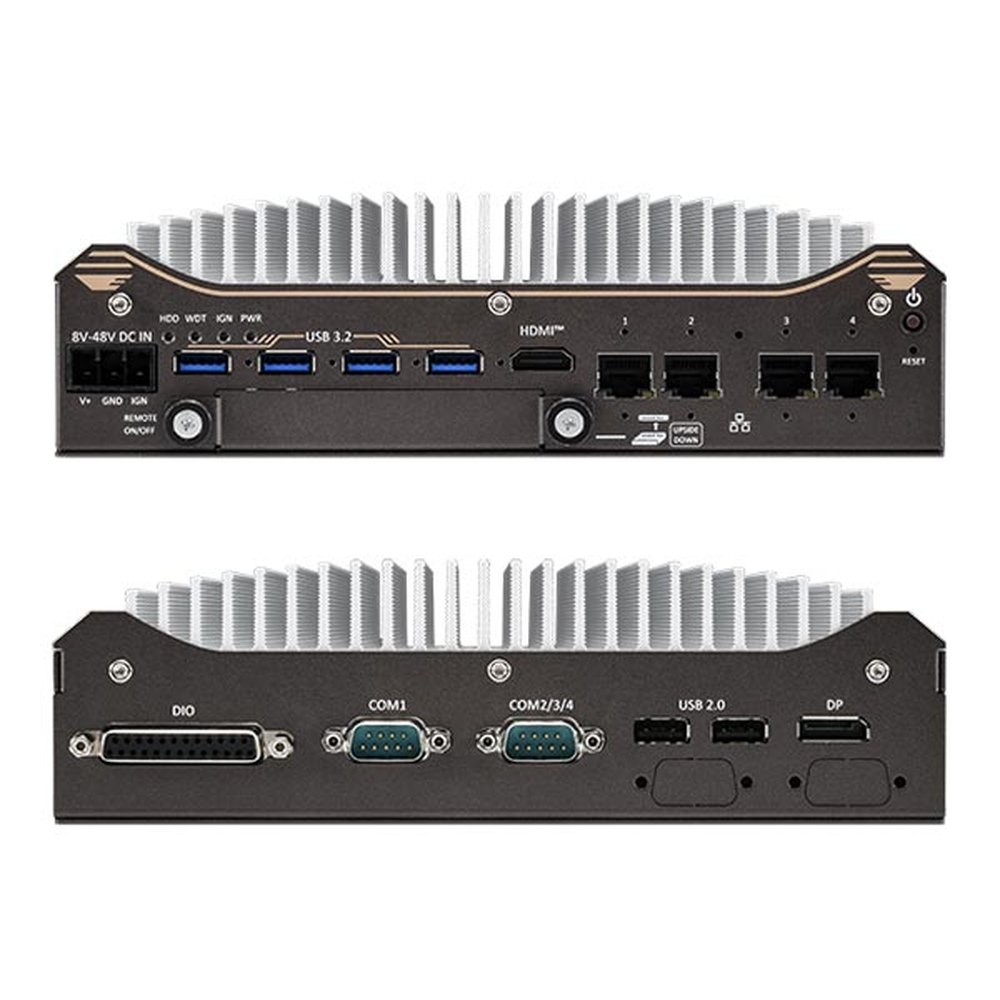
Intel Core Ultra 200S Fanless Industrial Mini PC with 4x PoE+
- AI
- 13 TOPS
- CPU
- Intel Core Ultra 2 Arrow Lake-S
- Ethernet
- 4× 2.5GbE (4× PoE)
Intel Core Ultra 200S Industrial Mini PC with PCIe Gen4 x8 SlimSAS
- AI
- 13 TOPS
- CPU
- Intel Core Ultra 2 Arrow Lake-S
- Ethernet
- 4× 2.5GbE (4× PoE)
What the Nuvo-11531 brings
- 01Core Ultra 200S AI
- Up to 36 TOPS from the integrated NPU and Xe GPU runs machine vision and lighter inference without a discrete card.
- 02Sensor-ready I/O
- Four 2.5GbE ports with optional PoE+ power and feed four cameras or LiDAR; USB 3.2, isolated DIO and four COM ports handle the rest.
- 03Wide DC and ignition
- An 8–48 V DC input with optional ignition control suits battery-powered robots and in-vehicle installation.
- 04Rugged, fanless build
- Fanless −25 to 60 °C operation with 35 W CPUs, MIL-STD-810H shock and vibration, and wall or DIN-rail mounting.
- 05Swappable storage
- An internal M.2 Gen4 x4 NVMe socket plus a front-access swappable 2.5" SSD tray.
Where the Nuvo-11531 fits
Platforms that need real compute and camera I/O in a small, fanless enclosure, often running on battery or vehicle power.
Machine vision
Multi-camera inspection and quality control on the line, with PoE+ cameras driven directly from the system.
Robots and AMRs
Compact, low-power compute for navigation and perception on robot arms and autonomous mobile robots.
Roadside and ITS
Wide-temperature operation for traffic, tolling and smart-city cabinets.

In-vehicle and autonomy
Wide DC input and ignition control for fleet, off-highway and autonomous vehicle platforms.
View rangeFrom compact box to deployed platform
A compact computer leaves little room for second guesses, so the configuration is settled before the system reaches the robot or vehicle.
-
Configure
RequirementWe match the Nuvo-11531 or Nuvo-11588 to the platform: CPU, memory, the PoE+ option and the 5G, 4G, CAN or Wi-Fi modules in the mini-PCIe and M.2 sockets.
-
Image
SoftwareThe software image is loaded and tested on the bench, with the cameras and I/O the application uses.
-
Deliver
InstallationEach system ships with its configuration and test record, ready to wall-mount or fit to a DIN rail.
Further reading
Our explainer on what defines a rugged computer and our guide to how fanless cooling works cover the two ideas behind this design. For multi-camera builds on the four PoE+ ports, our guide to PoE power budgeting shows how to plan the 100 W budget.
The choice between Nuvo-11531 and Nuvo-11588 comes down to one question: will the platform ever need a GPU, PCIe camera or external NVMe? Send us the camera count and power input, and we’ll confirm which build fits.
Nuvo-11531 FAQs
-
What Are the Advantages of Fanless Computers?
Fanless computers cool themselves passively, through a finned heatsink chassis and heat pipes, instead of a fan. With no moving parts and no airflow drawing in dirt, they are more reliable in dusty or vibrating places, completely silent, low maintenance and easy to seal, which is why they are the standard choice for industrial and embedded use.
-
Is 2.5GbE fast enough for edge AI?
Sufficient for lightweight workloads — single-camera inference, gateway aggregation — but usually insufficient for multi-camera analytics, multi-sensor fusion, or multi-node edge AI clusters.
-
PoE vs PoE+ vs PoE++: The 802.3af, 802.3at and 802.3bt Standards
802.3af (PoE), 802.3at (PoE+) and 802.3bt (PoE++) are the three IEEE Power over Ethernet standards. They differ mainly in power per port, roughly 15 W, 30 W, and up to 60 to 90 W, with the higher tiers using all four pairs of the cable.
-
How Much Power Does PoE Deliver?
PoE delivers up to about 15 W per port (802.3af), PoE+ up to about 30 W (802.3at), and PoE++ up to 60 W or 90 W (802.3bt), at around 48 V DC. Some power is lost in the cable, so the figure available at the device is a little lower than at the source.
-
MIL-STD-810G vs MIL-STD-810H: What Is the Difference?
MIL-STD-810G (2008) and MIL-STD-810H (2019) are successive revisions of the US military environmental test standard. 810H is the current version; it refined and reorganised test methods and tightened guidance, but both define test methods rather than a pass or fail certificate.
-
M.2 vs mSATA vs mPCIe — what’s the difference?
Three expansion formats sharing a similar look but with very different capabilities. M.2 has displaced both mSATA and mPCIe on new industrial designs — here's why, and what the trade-offs are.
-
What Is the Industrial Temperature Range?
The industrial temperature range is −40 to 85 °C: the grade an electronic component must operate across to be called industrial, compared with 0 to 70 °C for commercial parts. Rugged computers built from industrial-grade components typically run from −25 or −40 °C up to 70 °C as a complete system.
Specifying a compact rugged computer?
Tell us your camera count, power input and environment, and we'll recommend the right Nuvo model and configuration. We configure and test Neousys systems as part of edge AI and in-vehicle builds.