
 UK
UK 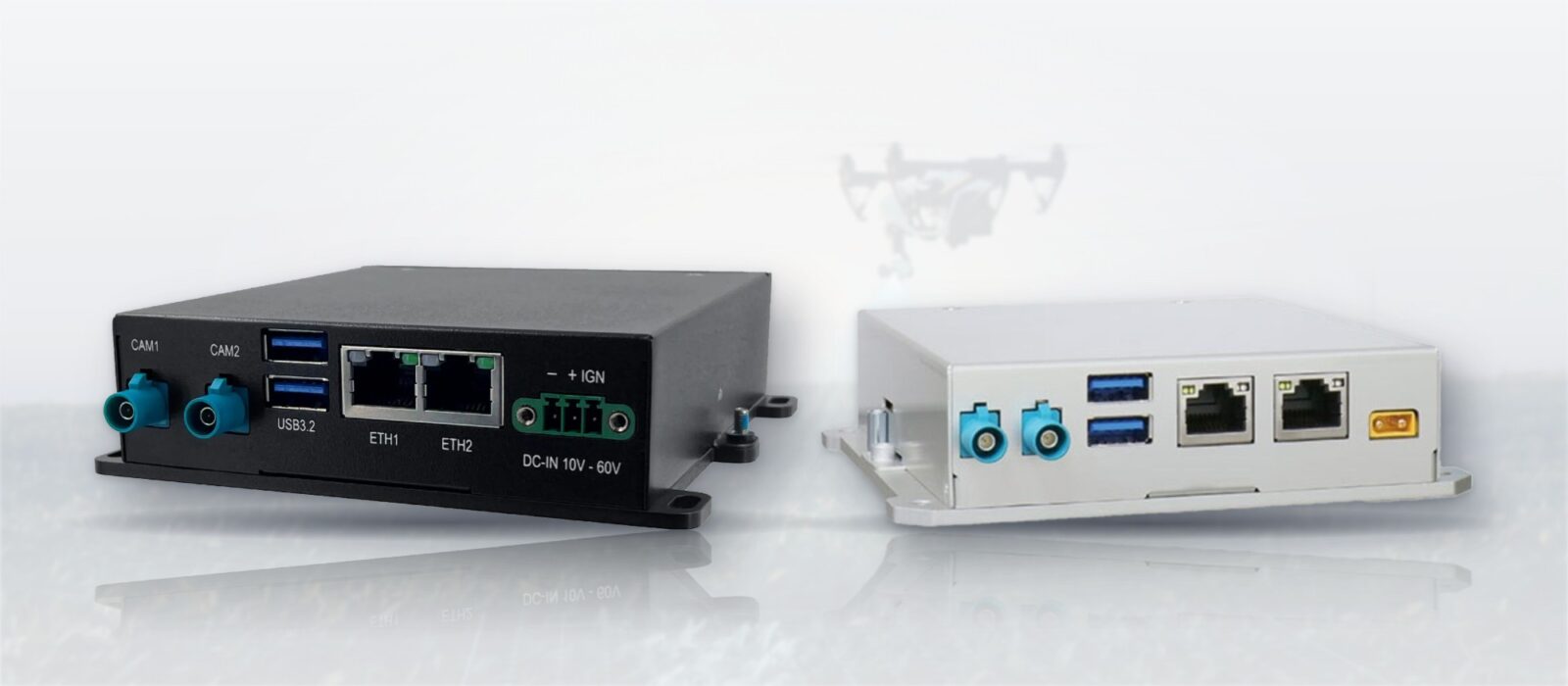
NVIDIA Jetson for Drones: Choosing an AI Companion Computer
A drone companion computer is the AI brain that rides alongside the flight controller, turning camera and sensor data into autonomy. NVIDIA Jetson Orin makes that practical in a package light enough to fly. Here is what a companion computer does, how it fits a drone, and how to choose one.
The Short Answer
A drone companion computer is a small, capable computer that runs alongside the flight controller on a UAV. The flight controller keeps the aircraft stable and flying; the companion computer does the thinking — running the AI that turns camera and sensor data into navigation, obstacle avoidance, and target detection. NVIDIA Jetson Orin is the usual choice because it delivers up to 100 TOPS of AI in a package light enough to fly. We supply two purpose-built options: the Neousys FLYC-300 and the Sintrones iBOX-604-G2.
Companion Computer vs Flight Controller
The two are often confused, but they do different jobs. The flight controller — running firmware such as ArduPilot or PX4 — handles stabilisation, motor control, and the real-time flight loop on a microcontroller. It is not built to run neural networks.
The companion computer is a full Linux computer, a Jetson, that runs the heavy AI: computer vision, path planning, object detection. The two talk to each other, usually over a serial UART or CAN link using the MAVLink protocol, so the AI can feed commands and waypoints to the flight controller and read telemetry back. Put simply: the flight controller flies the drone; the companion computer decides where it should go and what it is looking at.
Why NVIDIA Jetson for a Drone
- 01AI per gram
- Orin delivers up to 100 TOPS in a module light enough to fly, where a full GPU computer would be too heavy.
- 02One software stack
- JetPack and CUDA run the same vision and AI models used on the ground, on the aircraft.
- 03Camera and sensor I/O
- GMSL, USB, and Ethernet bring in many cameras and sensors at once.
- 04Flight-controller links
- Built-in CAN and UART connect directly to ArduPilot and PX4 controllers.
Size, Weight and Power: The SWaP Problem
On a drone, every gram and every watt is taken from flight time and payload. This is the SWaP constraint — size, weight, and power — and it is what separates a drone computer from an ordinary edge computer.
A companion computer has to be light: the FLYC-300 is 297 g, the iBOX-604-G2 under 339 g. It has to run directly from the drone battery, so both accept a wide 3S to 14S range (10 to 60 V) with no separate supply. And it has to shed heat in moving air without a heavy heatsink. Jetson Orin fits because it gives a high ratio of AI performance to weight and power; the integration work is making sure the module holds that performance thermally inside the airframe.
Cameras and Sensors
Autonomy is only as good as what the drone can sense. Both of our drone computers carry two GMSL2 camera inputs for long-cable, high-resolution, hardware-synchronised cameras — including stereo cameras such as the Stereolabs ZED X for depth and obstacle avoidance — alongside Ethernet and USB for RGB, infrared, hyperspectral, LiDAR, and radar.
That mix covers the common UAV workloads: mapping and survey, infrastructure and environmental monitoring, search and rescue, and detect-and-track. GNSS modules and 4G or 5G connectivity slot in over M.2 for positioning and a real-time downlink.
Connecting to the Flight Controller
The link between the companion computer and the flight controller is what turns sensing into action. Both computers expose CAN and UART specifically for this: the Jetson runs the autonomy software — often within the ArduPilot or PX4 flight stack via MAVLink — and sends velocity commands, waypoints, or a precise position estimate to the flight controller, which executes them.
The iBOX-604-G2 adds a built-in 3-axis accelerometer and ignition-aware power management; the FLYC-300 exposes UART, Ethernet, and CAN for flexible integration. Getting this interface right — protocol, timing, and failsafe behaviour — is central to a working autonomous drone.
FLYC-300 vs iBOX-604-G2
The two computers overlap heavily; the table below summarises where they differ.
| Specification | Neousys FLYC-300 | Sintrones iBOX-604-G2 |
|---|---|---|
| Jetson module | Orin NX 8 / 16 GB | Orin NX 8 / 16 GB, Orin Nano 8 GB |
| AI performance | Up to 100 TOPS | Up to 100 TOPS |
| Weight | 297 g | Under 339 g |
| GMSL2 cameras | 2x | 2x (ZED X supported) |
| Ethernet | 1x GbE + 1x 2.5GbE | 1x GbE + 1x 2.5GbE |
| Flight-controller I/O | UART, CAN 2.0 | CAN FD, UART, RS-232 |
| Extra sensing | — | 3-axis accelerometer |
| Battery input | 4S–14S (12–60 V) | 3S–14S (10–60 V) |
| Rugged | MIL-STD-810H, –25 to 70 °C | MIL-STD-810H, made in Taiwan |
Both run NVIDIA JetPack and integrate with standard flight stacks, so the choice comes down to the detail of the payload and the airframe.
Choosing and Integrating
The two computers overlap, so the choice comes down to specifics. The FLYC-300 leans into UAV mission use with its 297 g weight and an operating range to 70 °C with a heat spreader. The iBOX-604-G2 adds an onboard accelerometer, a CAN FD interface, RS-232, and a Taiwan country of origin that helps where TAA compliance matters.
As the system integrator, we recommend the module and the computer to fit the payload, the flight time, and the autonomy software, and we take on the integration — cameras, flight-controller link, power, and thermal — so what you mount on the airframe is a working platform, not a board to wire up. If you are still choosing a module, our guide to the Jetson lineup walks the options.
Frequently Asked Questions
-
What Is a Drone Companion Computer?
A drone companion computer is a small AI computer that runs alongside the flight controller on a UAV. The flight controller flies the aircraft; the companion computer does the thinking — running computer vision and AI to give the drone autonomy such as obstacle avoidance, navigation, and object detection. NVIDIA Jetson is the common choice because it delivers high AI performance at a weight light enough to fly.
-
Which NVIDIA Jetson Is Best for a Drone?
For most drones the NVIDIA Jetson Orin NX is the sweet spot: up to 100 TOPS of AI in a low-power, lightweight module, enough for multi-camera vision and autonomy. The lighter Orin Nano suits simpler payloads. The choice ultimately depends on the AI workload, the weight budget, and the flight time.
-
How Does a Jetson Connect to a Flight Controller?
An NVIDIA Jetson connects to a drone flight controller over a serial UART or a CAN bus, usually speaking the MAVLink protocol. The Jetson runs the autonomy software (often ArduPilot or PX4 companion software) and sends commands, waypoints, and position estimates to the flight controller, which executes them and returns telemetry.
Putting AI on a Drone?
Tell us the airframe, the payload, and the autonomy software. As your system integrator we will recommend the right Jetson companion computer and integrate it — cameras, flight-controller link, power, and thermal — into a flight-ready platform.