
 US
US 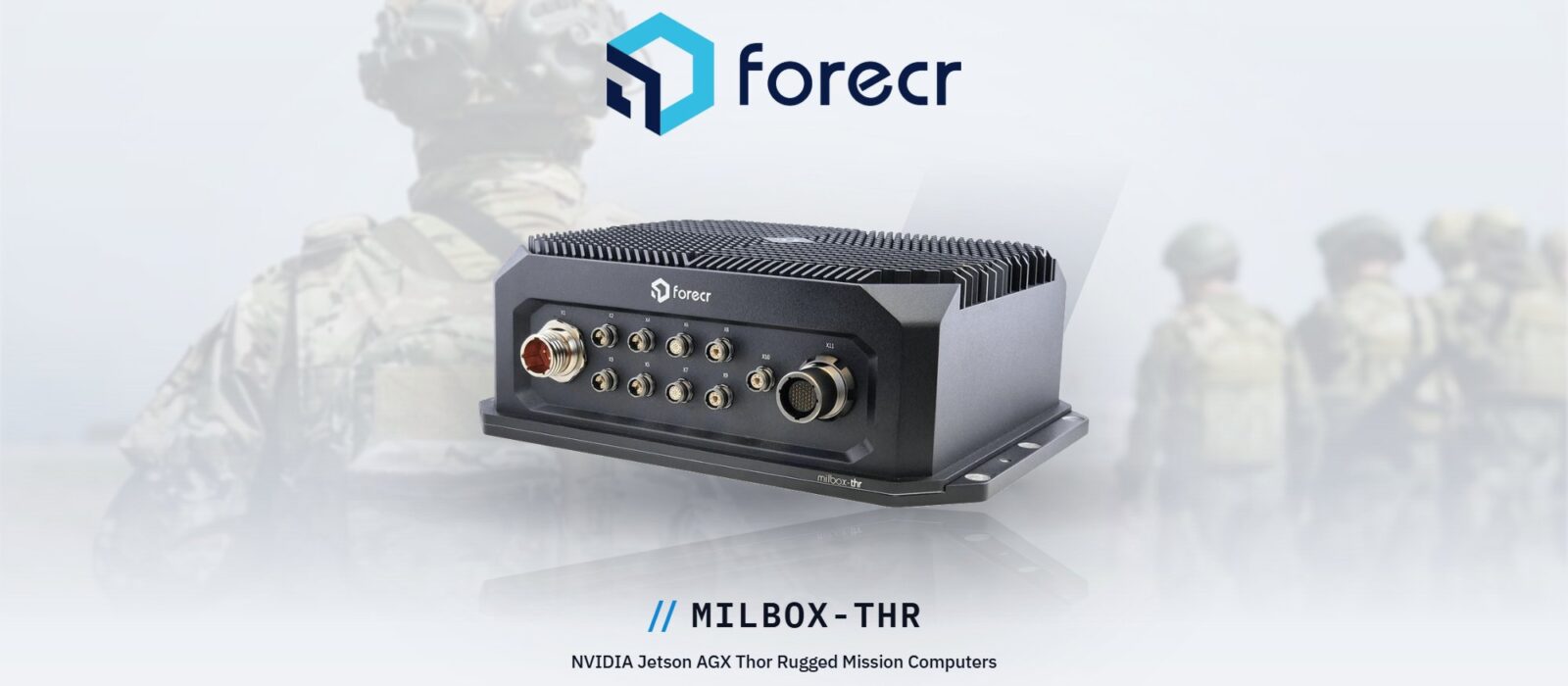
Forecr MILBOX‑THR: a military-grade Jetson AGX Thor computer
The ForeCR MILBOX-THR puts NVIDIA Jetson AGX Thor — 2,070 TFLOPS of AI — into a fully military-qualified enclosure, with 3G-SDI video, 10 Gigabit networking, and certification to a stack of MIL-STD standards.
The Forecr MILBOX‑THR is a military-grade edge AI computer built on the Jetson AGX Thor module, delivering 2,070 TFLOPS of AI in an enclosure sealed to IP67. We supply it for defense, aerospace, marine and transport programs that need Thor-class performance with full military qualification.
Where the Thor module brings the compute, the MILBOX‑THR brings the ruggedization, the professional video interfaces and the certification a mission platform demands. Forecr is an NVIDIA Elite Partner, and the system is engineered to a full stack of military standards rather than a single rating.
What the MILBOX‑THR brings
- 012,070 TFLOPS of AI
- NVIDIA Jetson AGX Thor T5000 or T4000, with up to 128 GB of LPDDR5X memory.
- 02Full military qualification
- Designed to meet MIL-STD-810G, MIL-STD-461G, MIL-STD-704F, MIL-STD-1275E and DO-160G, with IP67 sealing.
- 03Professional video I/O
- Two 3G-SDI inputs and outputs and two HDMI 2.0 outputs, alongside an optional GMSL2 camera slot.
- 0410 Gigabit and PCIe Gen5
- Four 10G Ethernet ports and three M.2 Key-M PCIe Gen5 slots for storage and AI accelerators.
- 05Secure and aware
- Integrated TPM 2.0, a 6-axis IMU and temperature sensing, on an 11 to 60 V DC input.
MILBOX‑THR variants
Two variants, matched to the Thor module: T5000 for the full 2,070 TFLOPS, T4000 where power and budget are tighter.
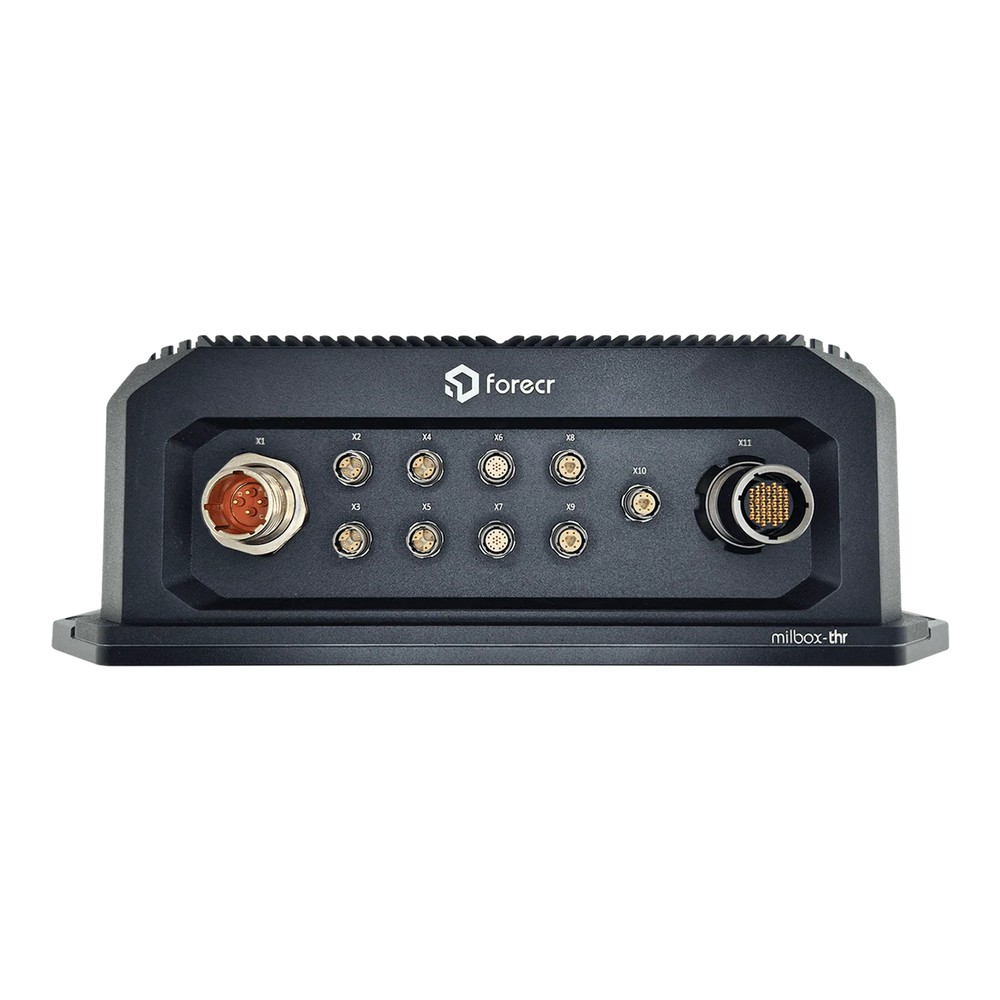
NVIDIA Jetson AGX Thor T5000 Rugged Mission Computer with IP67 Sealing
- AI
- 2,070 TOPS
- SOM
- NVIDIA Jetson T5000
- Ethernet
- 4× 10GbE
NVIDIA Jetson AGX Thor T4000 Rugged Mission Computer with IP67 Sealing
- AI
- 1,200 TOPS
- SOM
- NVIDIA Jetson T4000
- Ethernet
- 4× 10GbE
Specification highlights
| Specification | Forecr MILBOX‑THR |
|---|---|
| Module | NVIDIA Jetson AGX Thor T5000 / T4000 |
| AI performance | 2,070 TFLOPS |
| Memory | 128 GB LPDDR5X |
| Video | 2× 3G-SDI in, 2× 3G-SDI out, 2× HDMI 2.0 |
| Networking | 4× 10G Ethernet |
| I/O | 4× CAN FD, 4× RS-232/422/485, 8× isolated DIO |
| Expansion | 3× M.2 Key-M PCIe Gen5 |
| Security and sensing | TPM 2.0, 6-axis IMU, temperature sensors |
| Standards | MIL-STD-810G / 461G / 704F / 1275E, DO-160G, IP67 |
| Power and temperature | 11–60 V DC; −25 to 70 °C |
The 3G-SDI inputs are what set it apart for defence: they take feeds from existing surveillance and EO/IR sensors that use SDI, not just MIPI cameras.
A closer look
-
01
Ruggedized AGX Thor computer
The MILBOX-THR with its sealed circular military connectors and finned enclosure.
-
02
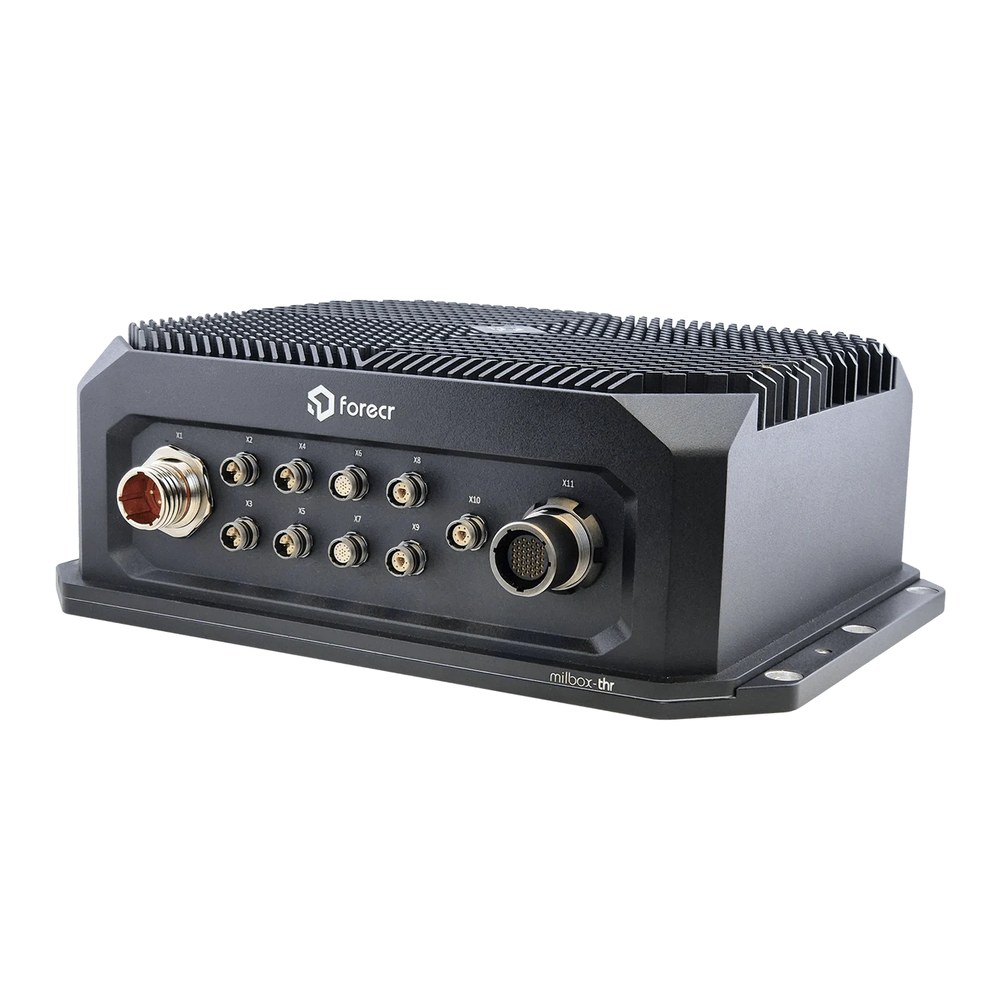
Military connector front panel
Sealed circular connectors carry the 10G Ethernet, SDI video and I/O out to the platform.
-
03
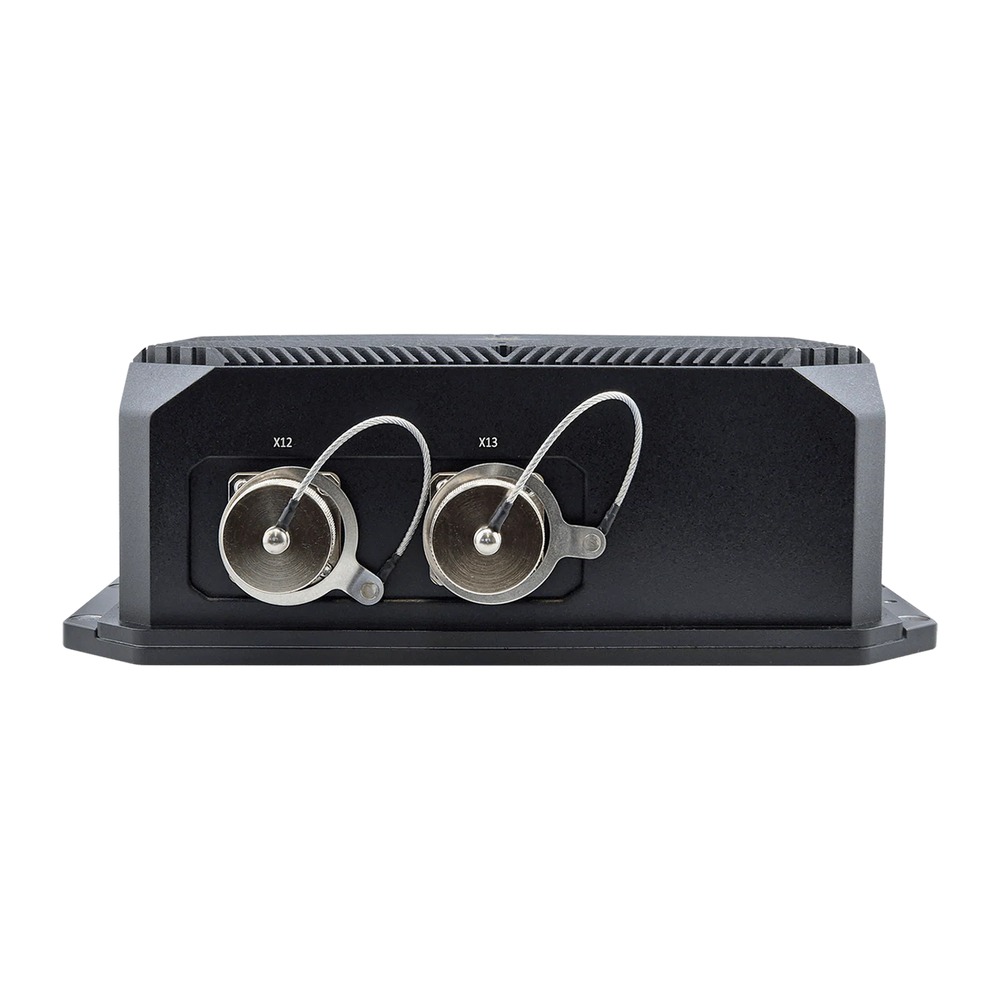
Sealed connector interface
Heavy-duty circular connectors with captive protective caps for the harshest field conditions.
Where the MILBOX‑THR fits
Platforms where the environment is as demanding as the workload: AI on live sensor feeds in vibration, temperature and EMI that would stop a commercial box.

Defense vehicles
Situational awareness and command systems on vehicles that see constant shock, vibration and dirty power.
Aerospace and unmanned
Onboard inference for aircraft and large unmanned platforms, where DO-160G and MIL-STD-704F power quality apply.
Surveillance and EO/IR
AI detection on 3G-SDI feeds from existing EO/IR gimbals and surveillance cameras.
Read answer
Marine systems
Sealed IP67 compute for deck and mast-mounted sensors in salt, spray and temperature swings.

Rail
Onboard AI for rolling stock, with wide DC input and the shock and vibration tolerance rail demands.
Why the full MIL-STD stack matters
MIL-STD-810G covers shock, vibration and climate; MIL-STD-461G covers electromagnetic interference; MIL-STD-704F and MIL-STD-1275E cover aircraft and vehicle power quality; DO-160G covers airborne equipment. A platform certified to one of these is not the same as one designed to meet them all, which is what the MILBOX‑THR sets out to do.
Our guide to the US DoD MIL-STDs explains what each of these tests covers.
From module to mission computer
A military program needs more than raw performance: it needs the right module sourcing, documented compliance and an integrator who can stand behind the platform.
-
Configure
RequirementWe match the MILBOX-THR to the programme: T5000 or T4000 module, storage, and the camera and I/O options the platform needs.
-
Source
ModulesWe source the Thor modules, including TAA-compliant options where the program calls for them.
-
Integrate
Video and softwareSDI and camera feeds are integrated, and the software image is loaded and tested on the bench before shipping.
-
Document
DeliveryEach system ships with its configuration, test record and compliance documentation, ready for the program file.
Choosing a Thor platform
Thor is a new module generation, so a Thor platform is a design step, not a refresh. Our guide to choosing a Jetson module sets it in context, and our overview of what Thor changes over AGX Orin covers the jump in performance. For programs that need their own enclosure, the MILBOARD‑THR open Jetson Thor carrier board brings the same Thor module to a custom design.
Thor changes what a mission platform can run at the edge. Tell us the sensors, the platform and the standards it must meet, and we’ll configure and document a MILBOX‑THR for the program.
MILBOX-THR FAQs
-
Jetson T5000 vs T4000: What Is the Difference?
The Jetson T5000 and T4000 are the two NVIDIA Jetson Thor modules. The T5000 is the top variant, with up to 2,070 FP4 TFLOPS, 128 GB, and up to 130 W; the T4000 is the lower-power variant, with up to 1,200 FP4 TFLOPS, 64 GB, and up to 70 W. Both use the Blackwell GPU.
-
What Is TAA Compliance?
TAA compliance means a product is wholly manufactured or substantially transformed in the United States or a TAA-designated country, as required by the Trade Agreements Act for many US federal and defense purchases. It is about country of origin, not US content levels, which is what the separate Buy American Act covers.
-
What Is MIL-STD-461?
MIL-STD-461 is the US military standard for the electromagnetic compatibility (EMC) of equipment. It sets limits and test methods for how much electromagnetic interference a device may emit, and how much it must tolerate, across both conducted and radiated paths.
-
What Is MIL-STD-1275?
MIL-STD-1275 defines the 28 V DC electrical power characteristics on military ground vehicles, including the voltage spikes, surges, ripple and starting dips that onboard equipment must tolerate to run reliably from the vehicle supply.
-
What Is MIL-STD-704?
MIL-STD-704 defines aircraft electrical power characteristics: the AC and DC voltages, frequencies, transients and abnormal conditions that airborne equipment must operate through on a military aircraft.
-
What Is an EO/IR Camera?
An EO/IR camera combines electro-optical (visible light) and infrared (thermal) imaging in one stabilized payload, so an operator can see by day and at night. EO/IR gimbals are standard on ISR drones, patrol aircraft, border security and maritime systems.
Need a Thor-class mission computer?
Tell us the program requirement and the environment. As your system integrator we configure the MILBOX-THR, source the modules, and deliver a documented, deployable mission computer.