
CASE STUDY · AGRICULTURE

Waterproof AI Edge Computer Controls Autonomous Tractors

The agricultural sector is adapting to advanced AI capabilities and embracing innovation which enables farmers to perform complex tasks with minimal human intervention. Let's explore how our waterproof edge AI computers empower autonomous tractors to operate with unparalleled efficiency and precision.

TypeCase study
Published12 Feb 2022
AuthorAndrew WhitehouseCEO
Reading time11 min

Rugged fanless computers have worked on farms since the late 1990s, handling data collection, machinery diagnostics and GPS-based precision farming in dust, moisture, heat and constant vibration. AI has changed what those computers are asked to do: an autonomous tractor now has to see, decide and steer on its own.

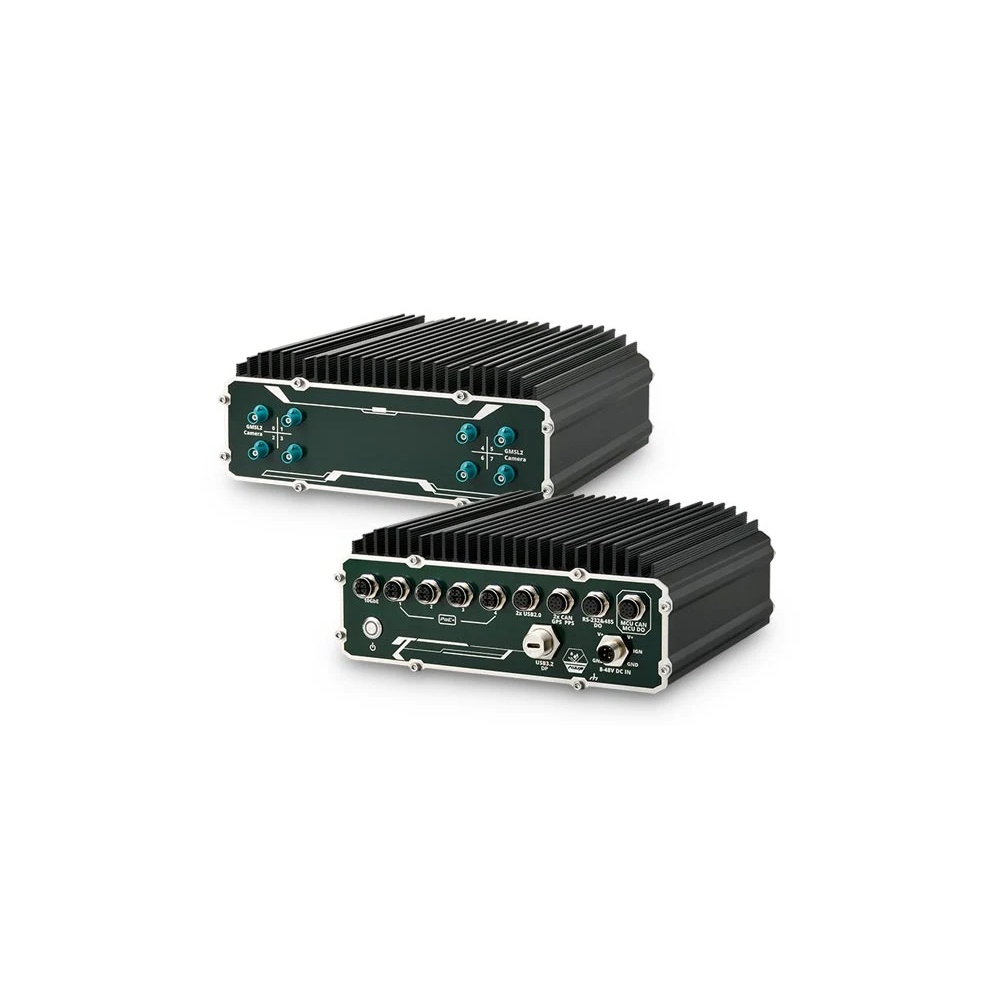
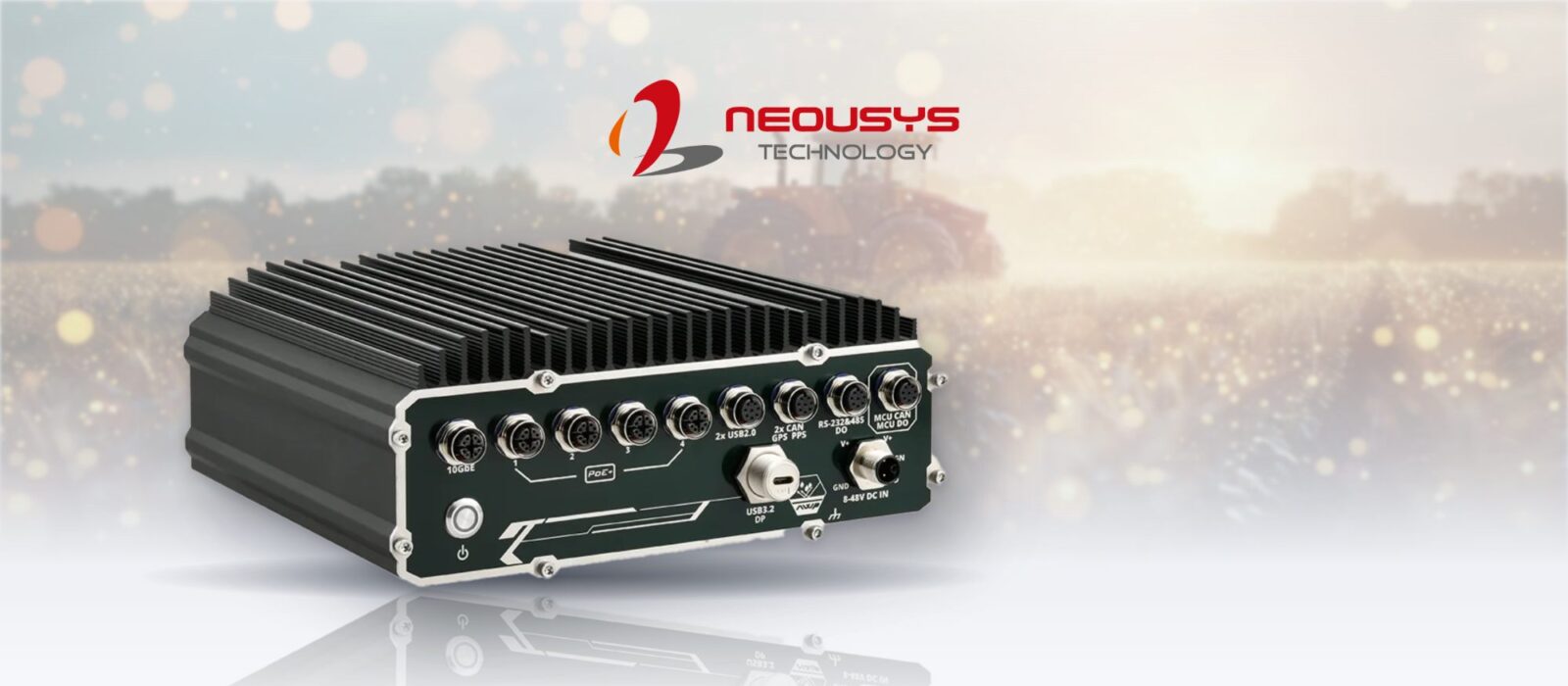
Supporting a world-leading OEM tractor manufacturer, we recommended the Neousys NRU-230V-AWP, a sealed Jetson AGX Orin edge AI computer, for its autonomous agricultural machinery. It is the kind of system we supply for agriculture and other autonomous platforms.

02Challenge

Why AI makes a sealed computer harder

Earlier rugged computers could be sealed in an enclosure without much thought for heat. Edge AI computers with powerful GPUs are different: they draw more power, and a waterproof enclosure that keeps out rain and dust also keeps the heat in, which risks throttling or failure in the middle of a field.

The NVIDIA Jetson AGX Orin answers this with performance per watt: up to 275 TOPS of AI at an adjustable 15 to 60 W. With proper thermal engineering, that makes continuous AI practical inside a compact, sealed waterproof enclosure. Heat is the main trade-off in a sealed system, and our guide to edge computers for sealed and waterproof enclosures looks at how efficient AI hardware makes these installs work.

Key technologies · 4Technology

What the tractor needed onboard

Four technologies decide whether an AI computer survives and performs on an autonomous tractor.

AI processing for perception

At the core is the Jetson AGX Orin system-on-module, whose GPU and CPU process camera images and sensor inputs so the tractor can navigate and work on its own. Its deep learning acceleration runs the object recognition and decision-making models that a changing field environment demands.

Sensor fusion from many sensors

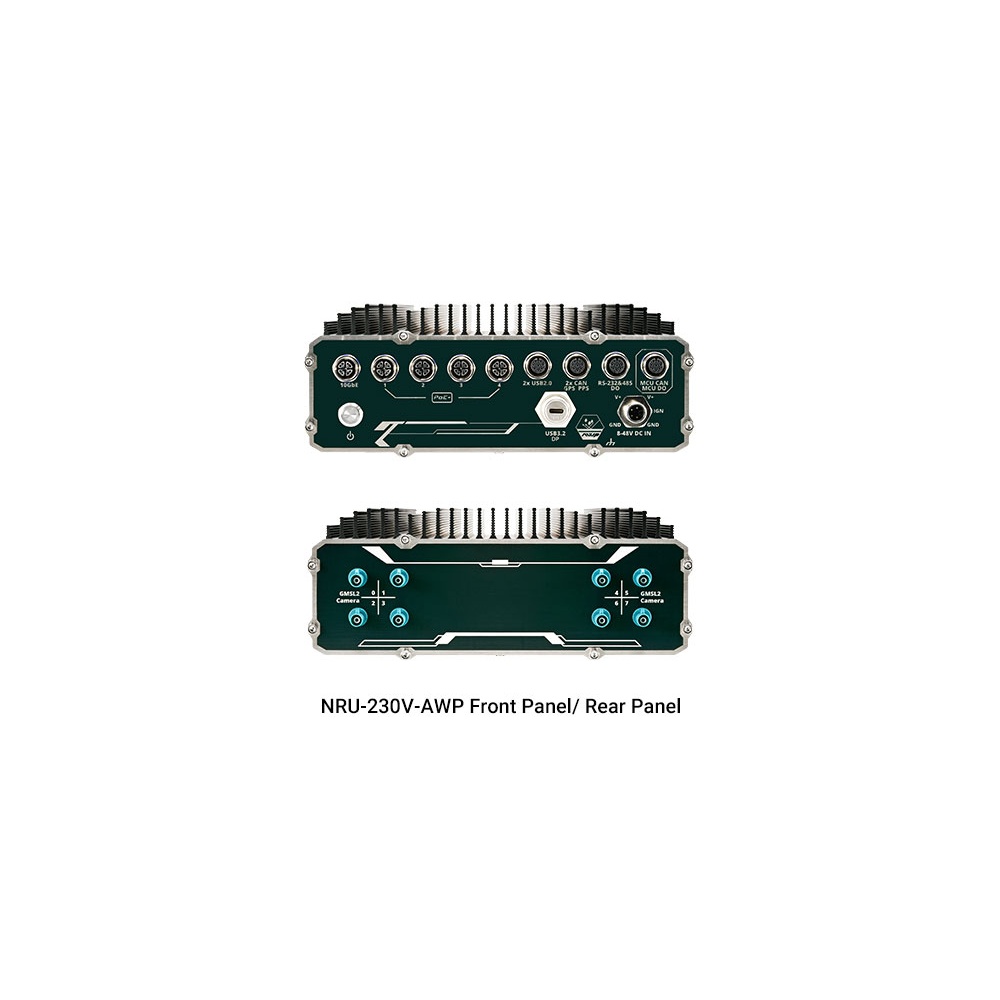
Eight GMSL2 camera inputs bring in high-bandwidth video over FAKRA Z connectors, while four PoE+ ports power and connect LiDAR and environmental sensors. Mini PCIe expansion adds LTE and RTK, for remote data transfer and centimetre-level GPS accuracy.

Sealed chassis with rugged I/O

The IP66 chassis keeps out dust, rain and strong water jets. M12 and Amphenol connectors hold their connection through the shock and vibration of field work, protecting the internals and keeping data processing uninterrupted.

Ignition sensing for battery management

An 8 to 48 V DC input suits the battery systems on different tractors. Ignition sensing powers the computer on and off with the tractor, saving energy when idle and making sure it shuts down safely.

Technology

A closer look

  1. 01

    NRU-230V-AWP

    The sealed IP66 Jetson AGX Orin computer with M12 and FAKRA Z connectors.

    View range
  2. 02

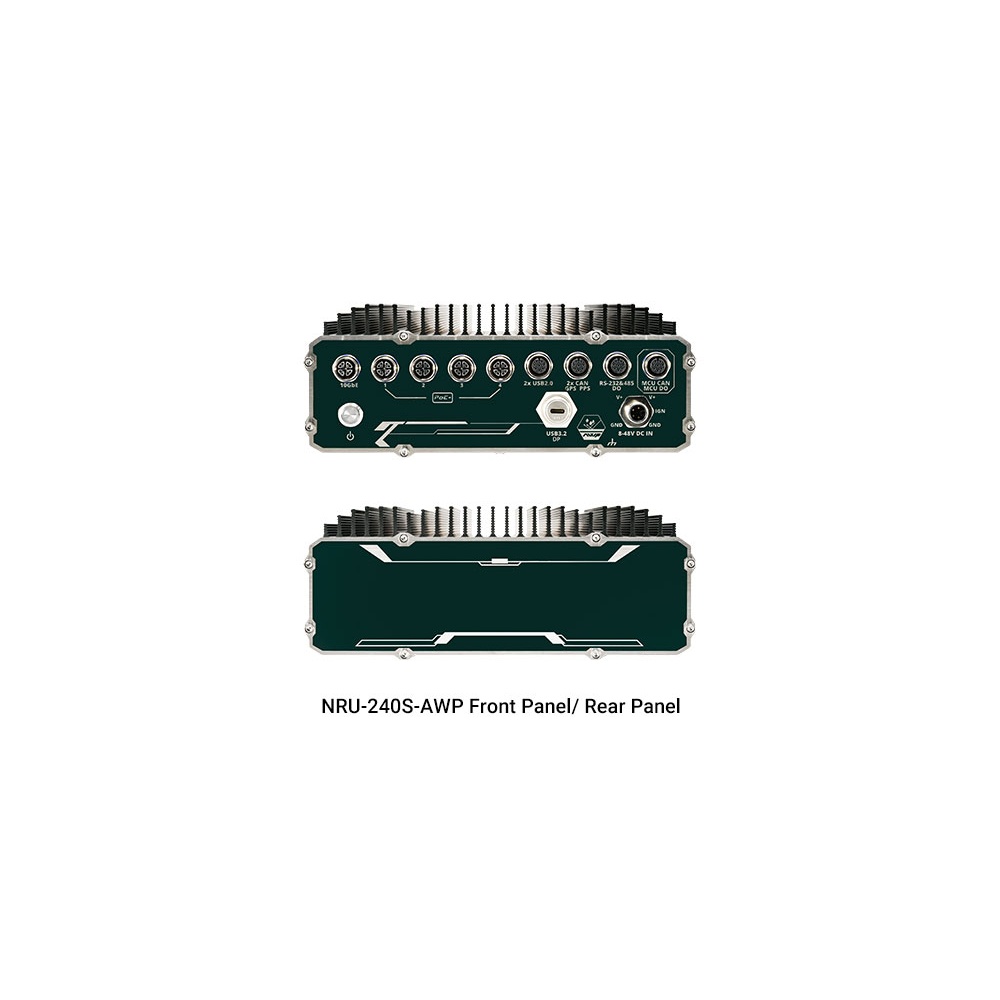
    Connector panel

    Rugged M12 and automotive camera connectors built for vibration.

  3. 03

    Finned enclosure

    Passive cooling that keeps AGX Orin running inside a sealed chassis.

Technology

Specification highlights

Specification Neousys NRU-230V-AWP
Module NVIDIA Jetson AGX Orin, JetPack 5.1.1 / 6.0
Cameras 8× GMSL2 via FAKRA Z
Networking 4× PoE+ GbE and 1× 10GBASE-T via M12 X-coded
Vehicle I/O 2× isolated CAN 2.0, 1× RS-232, 1× isolated RS-485 via M12 A-coded
Monitoring System monitoring port by automotive-grade MCU
Protection IP66 waterproof and dustproof
Temperature −40 to 75 °C; no throttling at 50/55 °C in MAXN mode
Power 8–48 V DC with ignition power control

IP66 means dust-tight and protected against powerful water jets; our IP rating chart shows how it compares with IP67, IP68 and IP69K.

Results · 4 outcomesAutonomous tractor

What changed in the field

With the NRU-230V-AWP onboard, the tractors took on precision tasks without a driver.

  1. Outcome 01

    Precision agriculture

    Soil analysis, crop health monitoring and resource distribution carried out with high accuracy, to raise yields and cut waste.

  2. Outcome 02

    Safer autonomy

    Real-time processing lets the tractors detect obstacles and take evasive action, lowering the risk of accidents.

  3. Outcome 03

    Adaptive in real time

    Data processed on board lets the machine adjust its strategy as field conditions change.

  4. Outcome 04

    Operators freed up

    Routine tasks run automatically, so people can focus on planning and decisions.

Powered by Jetson AGX Orin, this rugged AI edge computer has delivered powerful processing in extreme conditions with no performance throttling, sealed to IP66 against everything agriculture throws at it.

Andrew Whitehouse CEO, Things Embedded
05FAQs

Autonomous tractor FAQs

  1. What Is RTK GPS?

    RTK (Real-Time Kinematic) GPS is a satellite positioning technique that uses correction data from a nearby base station or correction network to improve accuracy from a few meters to around one to two centimeters. It is used to guide autonomous tractors, drones, construction machines and survey equipment.

  2. What Is Sensor Fusion?

    Sensor fusion is combining data from several sensors, such as cameras, LiDAR, radar, IMUs and GNSS, into one more accurate and reliable picture than any single sensor can give. Autonomous vehicles, robots and drones use it to understand their surroundings and their own position.

  3. What Is GMSL2?

    GMSL2 (Gigabit Multimedia Serial Link 2) is a high-speed serial link that carries uncompressed camera video, power and control data over one coaxial cable of up to around 15 meters. Developed for automotive cameras, it is now widely used on robots, autonomous machines and drones with NVIDIA Jetson computers.

  4. What does IP66 mean?

    IP66 is the rating above IP65 — dust-tight, and protected against powerful water jets. It is the standard specification for outdoor industrial computing in storm-exposed locations, marine deck equipment and light wash-down food handling, equivalent to NEMA 4 / 4X in North American markets.

  5. What Is an M12 X-Coded Connector?

    An M12 X-coded connector is the 8-pin M12 coding for Gigabit and 10 Gigabit Ethernet. Its four twisted pairs are separated by a cross-shaped shield that controls crosstalk at high speed, and it can carry Power over Ethernet with a suitable cable. It is defined in IEC 61076-2-109.

  6. What Is an M12 A-Coded Connector?

    An M12 A-coded connector is the most common M12 coding, used for sensors, actuators, low-voltage DC power and general signals. It has a single key and comes with 3, 4, 5, 8 or 12 pins, defined in IEC 61076-2-101. On industrial computers, A-coded connectors carry DC power input, serial ports, USB and digital I/O.

  7. What Is the Industrial Temperature Range?

    The industrial temperature range is −40 to 85 °C: the grade an electronic component must operate across to be called industrial, compared with 0 to 70 °C for commercial parts. Rugged computers built from industrial-grade components typically run from −25 or −40 °C up to 70 °C as a complete system.

// Next Step

Building autonomy into agricultural machinery?

Tell us about your application and a member of the team will get right back to you.

Phone · USA +1 407 214 9446