
 US
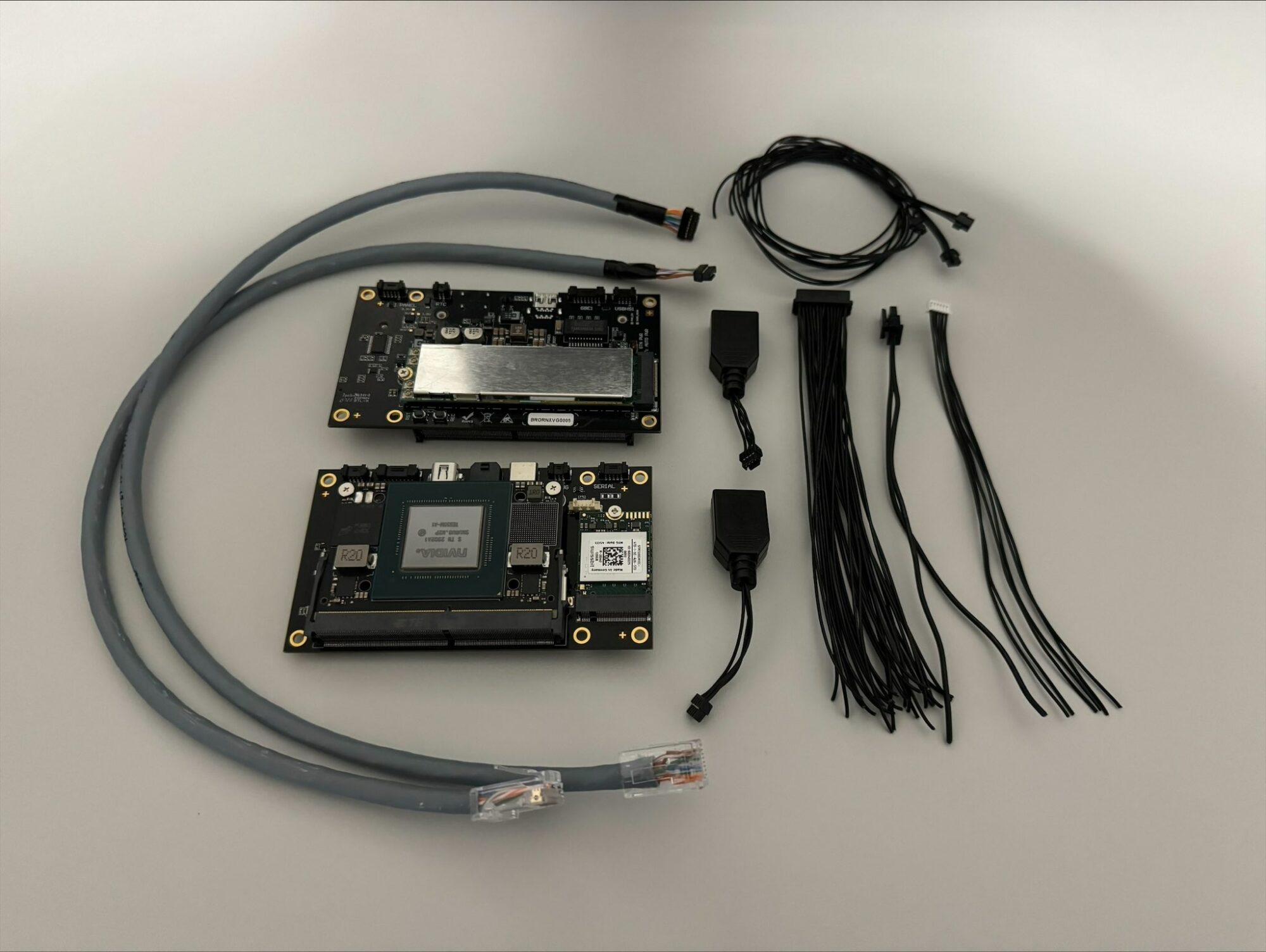
Fanless GPU Computer Built On A Custom Jetson Carrier Board
A customer needed a compact fanless GPU computer on a custom NVIDIA Orin carrier board, with serial control, 3G-SDI capture, and a tuned boot sequence.
Running AI at the edge in harsh conditions calls for a computer with GPU processing and nothing that can fail. A fanless GPU computer built on NVIDIA Jetson does exactly that: the module delivers the AI performance, and passive cooling removes the fan.
A customer building rugged GPU computers asked us for a compact Jetson Orin platform with specific I/O. We based it on Forecr’s DSBOARD‑ORNXS carrier and customized it to their requirements, with versions for both battery and DC power. The work drew on the same Jetson Orin carrier boards we supply off the shelf.
What the carrier board had to provide
The customer's applications needed every possible point of failure removed.
-
01
Fanless operation
Passive cooling, with extended temperature components and an optional heat spreader.
-
02
Serial control
RS-232/422/485 for PTZ cameras and other devices.
-
03
3G-SDI capture
Video input from SDI cameras for encoding, decoding and AI inference.
-
04
Soft sleep and shutdown
GPIO control to put the system to sleep or shut it down cleanly.
-
05
Compact footprint
A small board with high-density connectors to fit a compact rugged enclosure.
-
06
Battery or DC power
A low-power option for battery systems and a high-performance option on a DC supply.
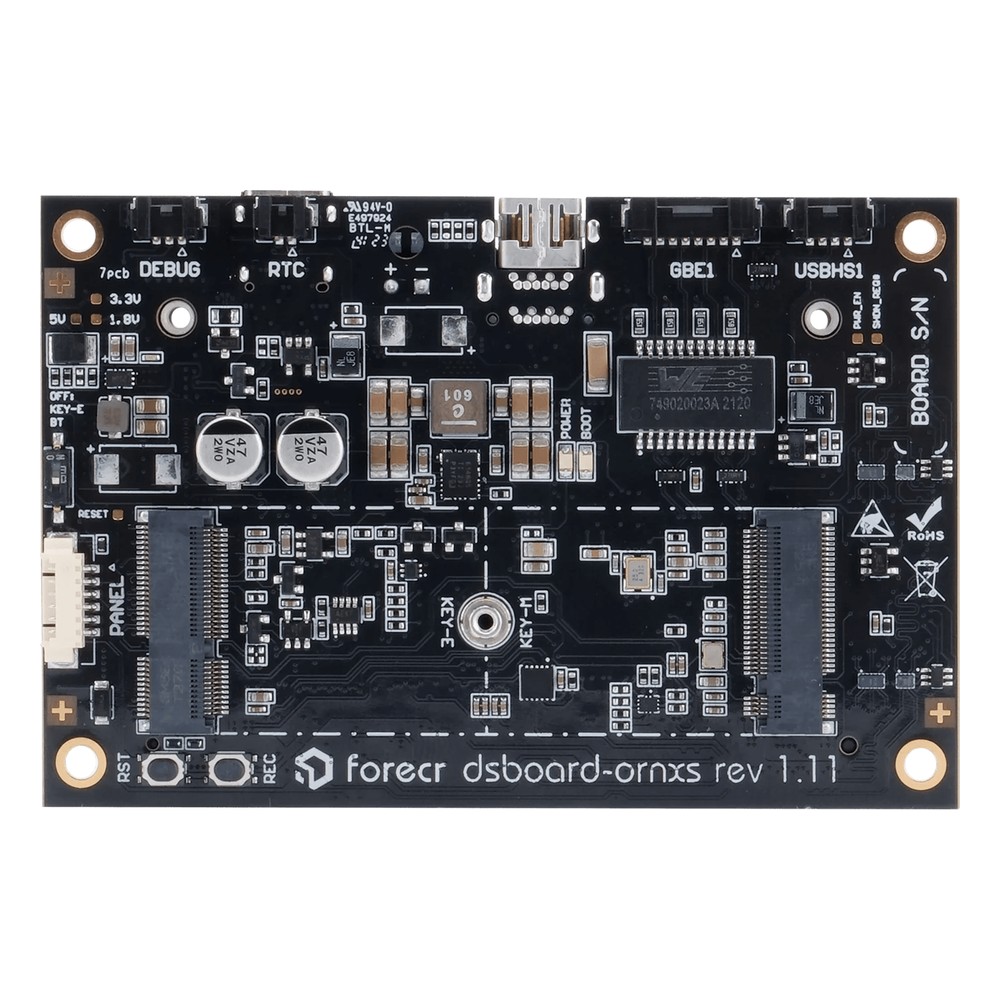
The Forecr DSBOARD‑ORNXS
The compact Jetson Orin carrier the platform was based on, here with Orin NX 16GB and Orin Nano 8GB modules fitted.
NVIDIA Jetson Orin NX 16GB Compact Carrier Board with Two 4-Lane MIPI CSI-2 Cameras
- AI
- 100 TOPS
- SOM
- NVIDIA Jetson Orin NX 16 GB
- Ethernet
- 2× GbE
NVIDIA Jetson Orin Nano 8GB Compact Carrier Board with Two CSI Cameras and CAN Bus
- AI
- 40 TOPS
- SOM
- NVIDIA Jetson Orin Nano 8 GB
- Ethernet
- 2× GbE
How we customized the DSBOARD‑ORNXS
- 01RS-232/422/485 serial
- Selectable serial for PTZ camera control and other connected devices; see our RS-232 vs RS-485 FAQ.
- 023G-SDI video capture
- SDI input for long cable runs and locking connectors; our SDI vs HDMI FAQ explains why.
- 03GPIO sleep and shutdown
- GPIO signals let the host put the system to sleep or shut it down softly.
- 04High-density Molex I/O
- Compact board connectors break out the I/O without growing the footprint.
- 05Extended temperature
- Extended temperature components and an optional heat spreader for passive cooling.
The finished platform handles multi-sensor data processing, PTZ camera control, video encoding and decoding, and AI inference in one fanless system. Carrier board choice decides which interfaces the module can reach; our Jetson carrier board guide explains how to match one to the I/O and power a product needs, and our SDI guide covers what 3G-SDI capture brings to edge AI.
We offer a wide range of NVIDIA Orin carrier boards for edge AI, ready to integrate with all kinds of sensors and cameras. With high-density I/O on a tiny footprint, the DSBOARD‑ORNXS suits defense and surveillance applications that demand perception, object detection and tracking, so we chose it as the base for a ruggedized fanless GPU computer.
Orin Nano for battery, Orin NX for power
AI performance is measured in TOPS, trillions of operations per second, and the Orin Nano and Orin NX modules span 20 to 100 TOPS, a big step up from the Xavier generation. Because both share the same carrier, the customer could build two versions of the same design.
| Specification | Jetson Orin Nano | Jetson Orin NX |
|---|---|---|
| AI performance | 20 to 40 TOPS | 70 to 100 TOPS |
| Power | From 7 W | From 10 W |
| Used for | The battery-powered rugged PC, where energy use matters most | DC-powered systems running more demanding AI |
Our Orin Nano vs Orin NX FAQ compares the two modules in more detail.
What the custom carrier delivered
One compact design covered both power options and every interface the customer needed.
-
Outcome 01
No points of failure
A fanless, solid-state platform for reliable AI in challenging applications.
-
Outcome 02
Exactly the right I/O
Serial, 3G-SDI and GPIO added to a compact off-the-shelf carrier.
-
Outcome 03
Two versions, one design
Orin Nano for battery power and Orin NX for maximum performance.
-
Outcome 04
Ready to roll out
A defined build for reliable, repeatable deployment.
Carrier boards built to your requirements
We can configure our Jetson Orin carrier boards to exact requirements for a reliable, repeatable roll-out, or design and manufacture a custom Jetson carrier board from the ground up through our engineering services, as we did for the drone detection camera.
Jetson carrier board FAQs
-
What Does TOPS Mean in AI?
TOPS stands for tera operations per second: the number of trillion simple operations an AI processor can perform each second. It is the headline figure used to compare AI accelerators such as NVIDIA Jetson modules and the NPUs in Intel and AMD processors. It is usually quoted for 8-bit integer (INT8) maths, and sometimes with sparsity, which doubles the figure.
-
What Is GPIO?
GPIO (general-purpose input/output) pins are digital signal lines that software can set as inputs or outputs. As inputs they read on/off signals such as buttons, switches or sensors; as outputs they can drive LEDs, trigger cameras or switch relays through a driver. Embedded boards use them to connect simple signals without a dedicated interface.
-
SDI vs HDMI: What Is the Difference?
SDI and HDMI both carry uncompressed digital video, but for different settings. SDI runs over coaxial cable with locking BNC connectors and covers long distances, around 100 m for 3G-SDI, making it the standard in broadcast, defense and industry. HDMI is a consumer interface with short cables and push-fit connectors, common on monitors, PCs and cameras.
-
What Is Jetson Super Mode?
Jetson Super Mode is a set of higher-power operating modes NVIDIA added for Jetson Orin Nano and Orin NX modules with JetPack 6.2. Raising clock speeds and power limits lifts AI performance substantially, for example to up to 67 TOPS on Orin Nano 8GB and up to 157 TOPS on Orin NX 16GB, on the same hardware.
-
Jetson Orin Nano vs Orin NX: What Is the Difference?
The Jetson Orin Nano delivers up to 67 TOPS in 7 to 25 W with 4 to 8 GB of memory, suited to entry-level, low-power vision. The Orin NX steps up to 157 TOPS in 10 to 40 W with 8 to 16 GB, adds deep learning accelerators and a hardware video encoder, and handles multi-camera, heavier inference.
-
RS-232 vs RS-485: What Is the Difference?
RS-232 is a single-ended serial link between two devices over a short cable, typically up to about 15 m. RS-485 sends a differential signal over a twisted pair, so it resists electrical noise, runs up to about 1,200 m and lets many devices share one bus. RS-422 sits between them: differential, long distance, one sender to several receivers.
Need a carrier board built around your I/O?
Tell us your I/O, video, and form-factor requirements and we will adapt a Jetson carrier board and configure the platform around them.