NETWORKING · DETERMINISM

Time-Sensitive Networking (TSN): A Guide to Deterministic Ethernet

Time sensitive networking is a set of IEEE 802.1 standards that give standard Ethernet bounded, guaranteed latency. This guide covers the standards, how the time-aware shaper works, TSN vs PTP and fieldbus, and the hardware every hop needs.

TypeWhite paper
Published11 Jun 2026
AuthorAndrew WhitehouseCEO
Reading time24 min

Time sensitive networking (TSN) is a set of IEEE 802.1 standards that add determinism to standard Ethernet: bounded, guaranteed latency and tightly controlled jitter for the traffic that needs it, on the same network and hardware that carries everything else. It exists because control, motion, sensor and safety traffic increasingly share a network with ordinary data, and that critical traffic cannot tolerate the variable delay of best-effort Ethernet.

TSN lets time-critical and best-effort traffic coexist on one converged network while still guaranteeing that the critical streams arrive on time. It does this with four ingredients: a shared clock in every device, a schedule that reserves transmission windows, a way to stop long frames getting in the way, and redundancy that survives a broken link without a recovery pause.

This guide sets out the TSN standards with their numbers and what each one does, explains how the time-aware shaper works with a worked timing example, compares TSN with PTP, a standard managed switch and fieldbus, and covers the configuration models, the industrial protocols that run over TSN, and the hardware you need at every hop. It ends with a checklist, examples from our range and answers to the questions engineers ask most.

Key points · 5 points

Key takeaways

01Determinism, not just speed
TSN guarantees when a frame arrives, within a known bound, rather than making Ethernet faster on average.
02Time comes first
IEEE 802.1AS gives every device a shared clock; scheduling, shaping and redundancy all build on it.
03Scheduling is the core
The 802.1Qbv time-aware shaper opens and closes queue gates on a cyclic timetable at every hop.
04End to end or not at all
Every switch and end device in a critical path must support the TSN features that path uses.
05Profiles pick the subset
IEC/IEEE 60802 for industrial automation and IEEE 802.1DG for vehicles select which standards a device must support.
02Standards

What are the TSN standards?

TSN is not one standard but a toolbox maintained by the IEEE 802.1 Time-Sensitive Networking task group. Most of the individual amendments have since been rolled into the base bridging standard, IEEE 802.1Q, so a datasheet may list either the amendment name or simply 802.1Q. The table lists the parts industrial buyers meet most often, with the year each amendment was first published.

Standard Name What it does Why it matters
IEEE 802.1AS (2011, revised 2020) Timing and synchronization (gPTP) A profile of IEEE 1588 that aligns every device’s clock, typically to sub-microsecond accuracy Every scheduled feature depends on a shared sense of time
IEEE 802.1Qbv (2015) Time-aware shaper Opens and closes transmission gates per queue on a repeating schedule Gives critical traffic a protected window at every hop
IEEE 802.1Qbu (2016) and IEEE 802.3br (2016) Frame preemption Lets an express frame interrupt a lower-priority frame and resume it afterwards Cuts the delay a long frame adds and shrinks guard bands
IEEE 802.1CB (2017) Frame replication and elimination (FRER) Sends a stream over two disjoint paths and drops the duplicate at the far end A single link or switch failure loses no frames
IEEE 802.1Qcc (2018) Stream reservation and central configuration Adds the user and network configuration models and the interfaces to a central controller Lets a network be configured for streams automatically
IEEE 802.1Qci (2017) Per-stream filtering and policing Checks each stream against its reservation at the switch ingress Stops a faulty or rogue device from flooding a schedule
IEEE 802.1Qav (2009) Credit-based shaper Reserves and smooths bandwidth for a traffic class Used for audio and video streams that need bandwidth more than an exact slot
IEEE 802.1Qch and 802.1Qcr Cyclic queuing and asynchronous traffic shaping Alternative ways to bound latency without a full per-hop schedule Options where precise scheduling is not needed
IEC/IEEE 60802 TSN profile for industrial automation Selects the features, defaults and configuration for factory networks The reference for interoperable industrial TSN devices
IEEE 802.1DG TSN profile for automotive in-vehicle Ethernet Selects features for vehicle networks The automotive counterpart to 60802

TSN grew out of Audio Video Bridging (AVB), which used 802.1AS and the credit-based shaper to carry synchronized audio and video. Industrial and automotive users added the scheduling, preemption and redundancy needed for control traffic. If you want the background on clock synchronization itself, our white paper on IEEE 1588 for machine vision covers the protocol that 802.1AS is built on.

Standards

The problem TSN solves

Standard Ethernet is best-effort: it forwards frames as quickly as it can, but under load a critical frame can sit behind a long bulk-data frame, and the delay varies from one moment to the next. For email or file transfer that is invisible; for a motion controller, a safety interlock or a sensor-fusion loop it is unacceptable, because those systems need to know that a packet will arrive within a fixed, repeatable window.

Historically that meant separate, purpose-built networks: a fieldbus or a proprietary real-time Ethernet for control, and an ordinary network for everything else. TSN brings the guarantee onto standard Ethernet, so one network can carry both the deterministic control traffic and everything else, with standard silicon and standard tools.

Why priority alone is not enough

A managed switch with quality of service already puts urgent traffic in a higher-priority queue. That helps, but it is still best-effort under contention. A switch cannot stop sending a frame once it has started, so a critical frame that arrives just after a maximum-size best-effort frame has begun must wait for it to finish. On a Gigabit link that wait is about 12 µs per hop; on a 100 Mbit/s link it is about 123 µs. Across several hops, with queues of variable depth, the worst case adds up and is hard to predict. TSN removes that uncertainty by scheduling when each class may transmit.

The mechanisms · 5How it works

How TSN delivers determinism

Shared time with 802.1AS

Every switch and end station synchronizes to a grandmaster clock using generalised PTP. Each hop measures its link delay and corrects for its own residence time, so the whole network agrees on the time to well under a microsecond in practice.

Scheduled gates with 802.1Qbv

Each egress port has up to eight queues, each behind a gate. A gate control list opens and closes the gates on a repeating cycle, so the critical queue gets the port to itself during its window, at exactly the right instant at every hop.

Frame preemption with 802.1Qbu and 802.3br

An express frame can interrupt a preemptable frame mid-transmission; the interrupted frame resumes afterwards. This shortens the guard band needed before each protected window and recovers bandwidth.

Zero-loss redundancy with 802.1CB

FRER replicates a critical stream across two disjoint paths and eliminates the duplicate at the far end, so a single link or switch failure loses nothing and there is no recovery time.

Policing with 802.1Qci

Per-stream filtering checks each stream against its reservation at the ingress port and drops what exceeds it, so a misbehaving device cannot disturb the schedule for everyone else.

How it works

How the time-aware shaper works

The time-aware shaper divides time on each port into a repeating cycle. A gate control list says, for each slice of the cycle, which queue gates are open. In the simplest industrial schedule there are two windows: a protected window in which only the critical queue may transmit, and an open window for everything else. Because every device shares the same clock, the protected windows line up hop by hop, and a critical frame forwarded inside its window never waits behind other traffic.

Just before each protected window sits a guard band, during which no new best-effort frame may start. Without preemption, the guard band has to be as long as the largest frame that could be in flight. With preemption it shrinks to the smallest piece of a frame that cannot be split, which returns most of that time to best-effort traffic.

Worked example: a 500 µs control cycle on Gigabit Ethernet

Take a machine with a 500 µs control cycle on a Gigabit network, where the controller sends a cyclic frame to each drive and every drive replies within the cycle. The figures are illustrative; real schedules come from the configuration tool.

Item Without preemption With preemption Notes
Cycle time 500 µs 500 µs Set by the application
Protected window for control frames 50 µs 50 µs Room for the control frames on this port
Guard band before the window About 12.3 µs About 1 µs Maximum 1,522-byte frame vs the shortest non-preemptable fragment
Time left for best-effort traffic About 438 µs per cycle About 449 µs per cycle Available to video, file transfer and IT traffic
Worst-case wait for a control frame per hop Bounded by the schedule Bounded by the schedule Plus fixed forwarding and cable delay
Effect of a large file transfer None on control frames None on control frames Best-effort traffic queues in its own window

The point of the example is the bound. However busy the best-effort side becomes, the control frames see the same delay every cycle. The overall latency is the sum of known parts: forwarding delay in each switch, the cable, and the position of the window in the cycle. Published industrial demonstrations show cycle times well under a millisecond on Gigabit links, but the achievable figure depends on the number of hops, the traffic mix and the devices.

How it works

TSN configuration models

A TSN network has to be told which streams exist, what bandwidth and latency each needs, and which path it takes. IEEE 802.1Qcc defines three ways to do that, and which one a product supports affects how the system is engineered and commissioned.

Model How streams are configured Where it fits
Fully distributed End stations announce their needs and each switch reserves resources hop by hop Small or ad hoc networks; similar to how AVB works
Centralized network, distributed user A Centralized Network Configuration (CNC) function computes paths and schedules; end stations still announce their streams Plant networks where switches are configured centrally
Fully centralized A Centralized User Configuration (CUC) collects application requirements and passes them to the CNC, which configures every switch Large automation systems and engineering-tool driven projects

In practice, many industrial projects today configure schedules with the switch or controller vendor’s engineering tool, which plays the CNC role. Network design still matters: VLANs separate traffic types, and the priority code point in the VLAN tag is how frames are mapped to TSN queues.

04Compared

TSN vs PTP vs a standard managed switch

It is easy to conflate these. IEEE 1588 PTP, and its TSN profile 802.1AS, provides timing: synchronized clocks. Timing alone does not guarantee delivery. A standard managed switch can prioritize traffic with QoS, but prioritization is still best-effort under contention. TSN adds the scheduling, preemption and redundancy that turn high priority into guaranteed within a bound. For how PTP itself works, including grandmaster, boundary and transparent clocks and the delay measurement behind sub-microsecond accuracy, see our explainer on Precision Time Protocol.

Capability Standard managed switch Managed switch with PTP TSN switch
Time synchronization No, or NTP only Yes, IEEE 1588 boundary or transparent clock Yes, IEEE 802.1AS, often 1588 as well
Traffic priority Yes, 802.1p and DSCP queues Yes Yes, mapped to scheduled queues
Bounded latency under load No No Yes, with 802.1Qbv scheduling
Frame preemption No No Where 802.1Qbu and 802.3br are supported
Redundancy RSTP or ring protocols, with a recovery time As managed FRER with zero recovery time, plus ring protocols
Typical use IT, video, general plant traffic Synchronized sensors and cameras, substations, telecom Motion control, converged plant and vehicle networks

Ring protocols and spanning tree still have a place on TSN networks for the best-effort side; our FAQs on network redundancy and RSTP explain the recovery times involved. Crucially, TSN has to be supported end to end: every switch in the critical path must be TSN-capable, which is why the switch hardware matters. Our guides to managed vs unmanaged switches and Layer 2 vs Layer 3 switches cover the rest of the switching decision.

Compared

Is TSN replacing fieldbus?

Gradually, and mostly by carrying the same protocols over a converged network rather than replacing them outright. TSN is a set of Layer 2 mechanisms; it does not define the application protocol. The automation protocols are being adapted to run over it, so the device behavior engineers know stays the same while the network underneath becomes standard Ethernet with guarantees.

Protocol TSN status Notes
PROFINET PROFINET over TSN specified by PI Uses TSN scheduling in place of PROFINET IRT hardware for isochronous traffic
OPC UA FX (Field eXchange) Designed to run over TSN for controller-to-controller and field traffic Builds on OPC UA PubSub; see our OPC UA FAQ
CC-Link IE TSN Released by the CC-Link Partner Association One of the first industrial protocols built around TSN
EtherNet/IP ODVA work on TSN is in progress Today usually runs on standard managed switches with QoS
EtherCAT Can be tunnelled across TSN segments EtherCAT itself keeps its own on-the-fly processing

Our FAQs on OPC UA and EtherNet/IP cover those protocols, and the white paper on OPC UA vs MQTT explains where each sits in an IIoT architecture. For new plants, TSN means one cable and one switch family for control, vision and IT traffic. For existing plants, the fieldbus stays in place until the next major refit, and gateways bridge the two.

05Applications

Where TSN is used

TSN started in professional audio and video and in industrial automation, and has spread to any domain that wants to converge real-time control onto Ethernet. The common thread is convergence: replacing several single-purpose networks with one deterministic Ethernet backbone.

Sector What TSN carries Typical requirement
Industrial automation Motion control, drive synchronization, machine vision triggers, controller-to-controller traffic Cycle times from hundreds of microseconds to a few milliseconds
Automotive and mobile machines Zonal in-vehicle networks feeding ADAS, sensor fusion and actuators Bounded latency between sensors, compute and actuators
Aerospace and defense Deterministic onboard networks where sensors, mission compute and effectors share one network Timing and redundancy for mission-critical traffic
Energy and utilities Substation process bus and protection traffic alongside monitoring Time synchronization and fast, predictable delivery
Professional audio and video Synchronized streams across a venue or studio Shared clock and reserved bandwidth (the original AVB use)

In vehicles, many of those links run over single-pair Ethernet, and how automotive-grade single-pair Ethernet is moving into industrial and edge AI computers covers that physical layer. In machine vision, scheduled traffic keeps GigE Vision camera triggers and image transfers from interfering with control. In substations, TSN sits alongside IEC 61850 process bus traffic, where the timing requirements are already strict.

06Hardware

What hardware supports TSN?

Three things must line up: the switches, the network interfaces in the end devices, and the software stack. A TSN-capable switch in the middle cannot help a computer that timestamps in software and transmits whenever its driver decides to.

Part of the system What to look for Examples
Switches 802.1AS, 802.1Qbv, ideally 802.1Qbu/802.3br, 802.1CB and 802.1Qci; a configuration tool or CNC support Board-level TSN switches such as the Diamond Systems EPS-9610-L3-TSN
Network controllers in computers Hardware timestamping, 802.1AS, 802.1Qbv and launch-time support in the controller Intel I225-IT and I226-IT 2.5GbE controllers, which several of our computers use
Processor and platform Real-time tuning so the application meets its own cycle Intel Time Coordinated Computing (TCC) on Atom x6000E and 11th Gen Core and later embedded processors
Operating system A TSN-aware network stack Linux taprio (Qbv), etf (launch time) and cbs (Qav) queuing disciplines, with linuxptp for 802.1AS
Profile and certification Conformance to the relevant TSN profile IEC/IEEE 60802 for industrial automation; industry test events and certification programs

A network interface card with TSN support can add the capability to an existing computer, provided the operating system and drivers support it. In our range, the Vecow PE-6004 card uses four Intel I226-IT controllers with IEEE 1588, 802.1AS, 802.1Qav and 802.1Qbv support. Computers such as the Vecow SPC-7100 and the EMBC-5000 3.5 inch SBC carry an Intel I225-IT 2.5GbE port with TSN support, and many of our Intel industrial PCs list TSN and TCC on their Intel I225 or I226 ports.

Where this fits in our range

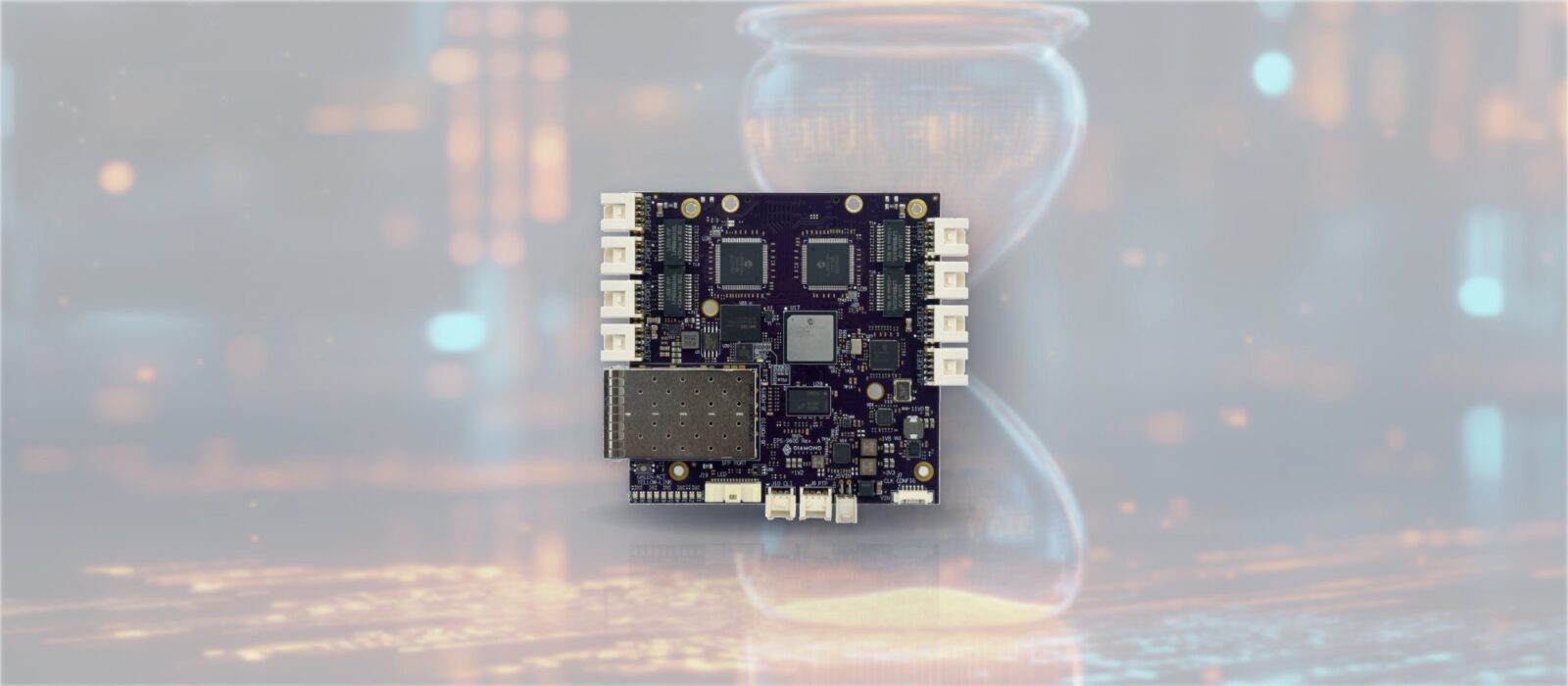
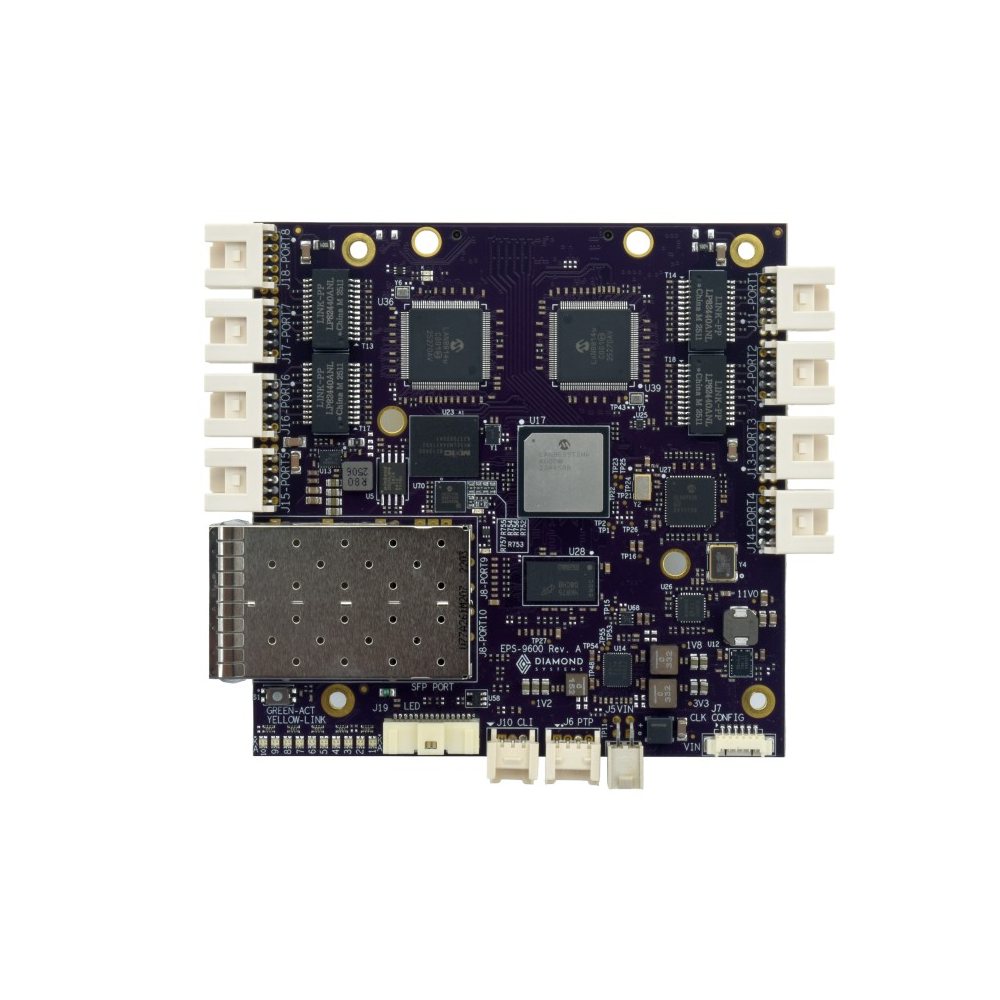
Deterministic networks need TSN-capable switches throughout, and for rugged and defense systems those switches also have to survive the environment. The Diamond Systems EPS-9600 family brings TSN and IEEE 1588 PTP to a board-level, −40 to +85 °C switch with eight Gigabit copper ports and two 10G SFP+ sockets. Its TSN builds fit a ZL30732B TSN clock and bring out a PTP/PPS signal. Diamond Systems designs and builds the board; we supply it. The same switching technology is used inside Diamond’s fully built rugged Ethernet switches, and our article on how a military Ethernet switch is built shows how a board-level core becomes a sealed system. For OEM designs that need the switching core on their own carrier, see our guide to embedded Ethernet switch modules. Browse our industrial Ethernet switches for the wider range.

Hardware

TSN products compared

Four products from our catalog with TSN support, from a switch board to the computers and the card at the end of the link. Figures are from each product’s page.

Product Type TSN-related features Ports Rating
Diamond Systems EPS-9610-L3-TSN-HSK Layer 3 switch board on the PC/104 hole pattern ZL30732B TSN clock, IEEE 1588 PTP, PTP/PPS signal 8× 1G copper, 2× 10G SFP+ −40 to 85 °C, 12–34 V DC
Vecow SPC-7100-1185G7E Fanless embedded computer, Core i7-1185G7E Intel I225-IT 2.5GbE with TSN support 1× 2.5GbE, 1× GbE −40 to 75 °C at 15 W, 9–55 V DC
Vecow EMBC-5000-1185G7E 3.5 inch SBC, Core i7-1185G7E Intel I225-IT 2.5GbE with TSN 1× 2.5GbE, 1× GbE −40 to 75 °C at 15 W TDP, 9–55 V DC
Vecow PE-6004 PCIe x4 PoE+ card IEEE 1588, 802.1AS, 802.1Qav, 802.1Qbv on Intel I226-IT 4× 2.5GbE PoE+ −25 to 60 °C with airflow
Our process · 4 steps TSN

How we help with a TSN network

We configure, image and test the computers; Diamond Systems builds its switches, and we specify and supply them.

  1. Scope

    Traffic and timing

    We list the streams that need a guarantee, their cycle times and the hops between them.

  2. Select

    Hops and profile

    We match switches, network controllers and computers so every hop in the critical path supports the same TSN features.

  3. Configure

    Image and settings

    We build the computer image with the TSN-aware network stack, linuxptp or the vendor tools, and the drivers the controllers need.

  4. Test

    Before shipping

    We check time synchronization and the network ports on each computer before it ships, and document the settings.

Specify · 7 checksTSN

Specifying a TSN network

Questions that decide which TSN features, and which hardware, a network needs.

  1. 01

    Streams

    List the time-critical streams, their size, cycle time and the latency each can tolerate.

  2. 02

    Features

    Decide which standards you need: 802.1AS always, 802.1Qbv for scheduling, 802.1Qbu for preemption, 802.1CB for zero-loss redundancy.

  3. 03

    Every hop

    Check that every switch and end device in each critical path supports those features, not just the core switch.

  4. 04

    Profile

    Ask suppliers which TSN profile they follow, such as IEC/IEEE 60802 or IEEE 802.1DG, and how they are tested.

  5. 05

    Configuration

    Choose how schedules will be set: a vendor tool, a central controller or distributed reservation.

  6. 06

    Protocol

    Confirm the automation protocol’s TSN status: PROFINET, OPC UA FX, CC-Link IE TSN or EtherNet/IP.

  7. 07

    Environment

    Match temperature range, power input, connectors and certifications, such as EN 50155 for rail, to the installation.

07FAQs

Time sensitive networking: common questions

Quick answers

What is time sensitive networking?

A set of IEEE 802.1 standards for deterministic Ethernet. TSN gives selected traffic bounded latency and low jitter on a standard Ethernet network shared with ordinary traffic.

What are the TSN standards?

802.1AS, 802.1Qbv, 802.1Qbu with 802.3br, 802.1CB, 802.1Qcc and 802.1Qci are the core. Profiles such as IEC/IEEE 60802 choose which of them a device must support.

How is TSN different from IEEE 1588?

IEEE 1588 provides time; TSN uses that time to schedule delivery. 802.1AS is the IEEE 1588 profile that TSN relies on, and TSN adds shaping, preemption and redundancy on top.

What is 802.1Qbv?

The time-aware shaper. It opens and closes per-queue transmission gates on a repeating schedule, so critical traffic gets a protected window at every hop.

What latency can TSN achieve?

It depends on hops, link speed and schedule. Gigabit networks can support cycle times well under a millisecond; the key benefit is that the worst case is known and repeatable.

Do I need TSN switches everywhere?

Only on the critical paths. Every hop a time-critical stream crosses must support the features it uses; other parts of the network can stay standard.

Is TSN the same as real-time Ethernet?

It is one way to make Ethernet real-time. Older real-time Ethernet systems use their own hardware or protocols; TSN does it with IEEE standards that any vendor can implement.

FAQs

TSN and timing FAQs

  1. What Is Precision Time Protocol (PTP)?

    Precision Time Protocol (PTP), defined in IEEE 1588, synchronizes the clocks of devices on a network to a single reference clock, called the grandmaster. With hardware timestamping in the network interfaces and switches, PTP typically aligns clocks to within a microsecond or better, far tighter than NTP, which is why it is used in industrial automation, substations, broadcast and telecoms.

  2. What Is a Managed Switch?

    A managed switch is an Ethernet switch you can configure, through a web interface, command line or SNMP, to set up VLANs, quality of service, redundancy and monitoring. An unmanaged switch is plug-and-play with no settings at all. Managed switches suit networks that are segmented, critical or monitored remotely.

  3. What Is QoS?

    QoS (quality of service) is a set of network techniques that give some traffic priority over the rest. Switches and routers classify packets, mark them with a priority such as an IEEE 802.1p or DSCP value, and serve the higher-priority queues first. That keeps delay, jitter and packet loss low for voice, video and control traffic when links are busy.

  4. What Is Network Redundancy?

    Network redundancy means building a network with spare paths, devices and power feeds, so traffic keeps flowing when a cable, switch, gateway or supply fails. A protocol such as RSTP, ERPS, PRP or VRRP decides which path is used and how quickly the backup takes over, from tens of seconds down to zero frame loss.

  5. What Is Fieldbus?

    Fieldbus is the family of industrial digital networks that connect controllers such as PLCs to field devices: sensors, actuators, drives and valves. One shared cable replaces a separate wire pair per signal. PROFIBUS, Foundation Fieldbus, Modbus RTU, CANopen and DeviceNet are fieldbuses, standardized internationally in IEC 61158 and IEC 61784.

  6. What Is OPC UA?

    OPC UA (OPC Unified Architecture) is an open standard, IEC 62541, for exchanging data securely between industrial machines, controllers and software on any operating system. Servers publish a browsable information model that describes what each value means, and clients read, write or subscribe to it, with certificates and encryption built in.

// NEXT STEP

Building a deterministic network?

Tell us the system and the traffic that has to be guaranteed. We will help you specify TSN-capable switches, board-level or rugged, and configure the computers at each end of the link.

Phone · USA +1 407 214 9446