
 US
How a Military Ethernet Switch Is Built
A military Ethernet switch is a managed switch built to MIL-STD-810, MIL-STD-461 and MIL-STD-1275 or MIL-STD-704. This guide covers the standards, power, connectors and features. Diamond Systems builds them from board-level switching; Things Embedded supplies them and helps you specify the right one.
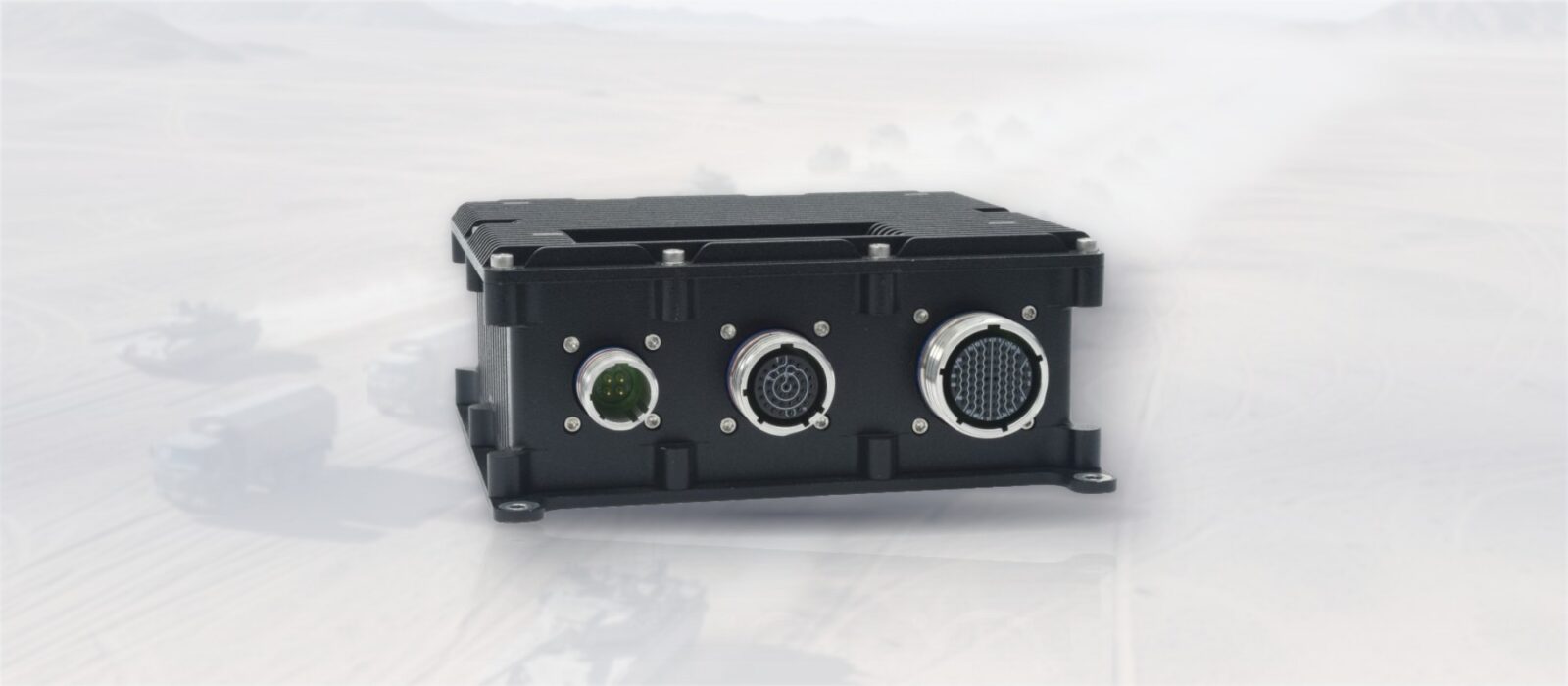
A military Ethernet switch is a managed network switch built to survive a military vehicle, aircraft or shelter and to meet the standards its program is written against: MIL-STD-810 for environment, MIL-STD-461 for electromagnetic compatibility, MIL-STD-1275 or MIL-STD-704 for platform power, with sealed MIL-DTL-38999 circular connectors in place of RJ45 sockets. The switching inside is the same Ethernet as any managed switch; the build around it is what makes it military.
A military Ethernet switch is rarely something you buy off a shelf. The network has to survive the platform, with its shock, vibration, temperature extremes, dirty power and electromagnetic noise, while the port count, speeds and connectors have to match the system it goes into. These switches are built by integrating proven board-level switching into a rugged, MIL-rated system, rather than adapting a fixed product. Diamond Systems builds them around its own board-level switch modules; Things Embedded supplies them and helps you specify the right configuration for the platform.
This guide sets out what makes a switch military grade, standard by standard, then follows the build from switching core to power, enclosure and configuration. It covers connectors, the managed features defense networks rely on, the platforms that use them and the switches in our range, and ends with a specification checklist and answers to common questions.
Key takeaways
- 01Four standards define it
- MIL-STD-810 for environment, MIL-STD-461 for EMC, MIL-STD-1275 or MIL-STD-704 for power, and MIL-DTL-38999 for connectors.
- 02Power is the hard part
- A military switch needs a front end that rides through spikes, surges and cranking dips on a 28 V DC bus.
- 03Board-level core, rugged case
- Most are built from a proven switch board inside a sealed, conduction-cooled aluminum enclosure.
- 04Managed and often Layer 3
- VLANs, multicast control, fast ring recovery, routing and precise time are standard requirements.
- 05Compliant is not certified
- Switches are designed and tested to the requirements of the standards; qualification evidence is per build and per program.
What makes an Ethernet switch military grade?
No single standard makes a switch military. A program calls up a set of standards, and the switch is designed and tested to meet the parts that apply. The table lists those met most often, with what each one means for a switch.
| Requirement | Standard | What it covers | What it means for a switch |
|---|---|---|---|
| Environment | MIL-STD-810H | Test methods for temperature, altitude, humidity, salt fog, sand and dust, immersion, vibration and shock | Sealed, conduction-cooled case; components rated for −40 to 85 °C; secured connectors and boards |
| Electromagnetic compatibility | MIL-STD-461G | Conducted and radiated emissions and susceptibility | Filtered power input, shielded case, careful cable screening |
| Ground vehicle power | MIL-STD-1275E | 28 V DC vehicle bus: steady state, surges, spikes, ripple and starting | Power front end that rides through disturbances without resetting |
| Aircraft power | MIL-STD-704F | Aircraft electrical power characteristics, including 28 V DC and 270 V DC | Power supply designed to the aircraft’s normal and abnormal limits |
| Connectors | MIL-DTL-38999 | Circular connectors with threaded coupling, sealing and many insert layouts | Ports grouped on a few sealed circular connectors instead of RJ45 |
| Ingress | IEC 60529 | IP code for dust and water | Typically IP65 to IP67 for exposed installations |
| Shock and vibration, component level | MIL-STD-202 | Test methods for electronic components | Sometimes quoted for smaller switches |
| USA defense | DEF STAN 00-35, DEF STAN 59-411, DEF STAN 61-5 Part 6 | Environment, EMC and vehicle power for USA programs | Often called up alongside or instead of the US standards |
Our FAQs explain each one: MIL-STD-810H, MIL-STD-461, MIL-STD-1275, MIL-STD-704 and MIL-DTL-38999. Our overview of the US military standards that defense equipment is tested against puts them in context. One word of care: a manufacturer may say a switch is designed to, compliant with or tested to a standard, and the test reports behind that statement are what a program asks for.
MIL-STD-810H tests that matter for a switch
MIL-STD-810H is a set of test methods, not a pass mark. The program chooses the methods and the levels from the platform’s life cycle profile, so two switches can both be tested to MIL-STD-810H and still have been tested to very different levels.
| Method | Test | Why it matters for a switch |
|---|---|---|
| 500 | Low pressure (altitude) | Airborne and air-transported equipment; affects sealing and cooling |
| 501 and 502 | High and low temperature | Operating and storage extremes, typically −40 to 85 °C for the electronics |
| 503 | Temperature shock | Moving between a heated shelter and the outside air |
| 507 | Humidity | Condensation inside the case, helped by sealing and conformal coating |
| 509 | Salt fog | Corrosion on naval and coastal platforms |
| 510 | Sand and dust | Seals and connectors on ground vehicles |
| 512 | Immersion | Fording vehicles and exposed masts |
| 514 | Vibration | Tracked and wheeled vehicles, aircraft and rotorcraft profiles |
| 516 | Shock | Gunfire, rough terrain, crash safety and transit drops |
Moisture is the slow failure. A sealed case limits it, and conformal coating on the boards protects against the condensation that sealing cannot prevent when a cold switch meets warm air.
MIL-STD-461G tests for a switch
MIL-STD-461G sets limits on what equipment emits and what it must tolerate. The requirements that apply depend on the platform, ground vehicle, aircraft, ship or fixed installation, but a switch is usually tested against the following.
| Requirement | Type | What it checks | Design response in a switch |
|---|---|---|---|
| CE102 | Conducted emissions, power leads | Noise the switch puts back onto the platform’s power bus | Input filter on the power supply |
| CS101 | Conducted susceptibility, power leads | Tolerance of low-frequency ripple on the supply | Filtering and regulation margin |
| CS114 | Conducted susceptibility, bulk cable injection | Tolerance of RF currents induced on cables | Cable screening, connector bonding, filtered I/O |
| CS116 | Conducted susceptibility, damped sinusoids | Tolerance of transients on cables and power leads | Transient suppression at every entry |
| RE102 | Radiated emissions, electric field | What the switch radiates | Shielded metal case, bonded connectors |
| RS103 | Radiated susceptibility, electric field | Tolerance of nearby transmitters and radar | Shielded case and filtered entries |
Ethernet itself is reasonably robust, but a switch on a vehicle sits beside radios, motors and jammers, and its cables run past them. The related standard MIL-STD-464 covers electromagnetic effects at the level of the whole platform.
MIL-STD-1275 and MIL-STD-704: platform power
Platform power is hostile: spikes, surges, ripple and electromagnetic noise that a commercial switch is not built to tolerate. A ground vehicle’s 28 V DC bus is the classic case. The figures below are the commonly quoted MIL-STD-1275E limits for 28 V DC systems; the standard itself defines the exact waveforms and durations.
| Disturbance | Typical MIL-STD-1275E figure | What happens on the vehicle | What the switch needs |
|---|---|---|---|
| Steady state | 20–33 V DC | Normal running, generator and batteries | Wide input range |
| Surges | Up to about 100 V for up to 50 ms | Load dump when a large load disconnects | Surge clamping and a tolerant converter |
| Spikes | Up to about ±250 V, very short | Switching of inductive loads | Transient suppression |
| Starting disturbance | Dips to about 6 V during engine cranking | Starter motor pulls the bus down | Hold-up or ride-through so the network does not drop |
| Ripple | A few volts peak to peak | Alternator and power electronics | Filtering |
Aircraft use MIL-STD-704 instead, which defines normal, abnormal and emergency limits for 28 V DC and 270 V DC systems, among others. The answer in both cases is a dedicated power front end. Diamond Systems pairs its switches with board-level military power supplies that add galvanic isolation and input filtering to the requirements of MIL-STD-461, MIL-STD-704 and MIL-STD-1275, so the switch runs cleanly from the platform’s 28 V DC supply without polluting the network or the vehicle’s electrical system. The same family of supplies powers PC/104 stacks; see our PC/104 power supplies.
Step 1: start with proven board-level switching
The network core is a board-level managed switch from the Diamond Systems range, up to the EPS-9600 with its Time-Sensitive Networking capability and IEEE 1588 PTP. Building on a proven board rather than custom silicon takes the risk out of the design: you get managed Layer 2+ switching and Layer 3 routing, 1G and 10G ports (copper or SFP, broken out with transceivers), and determinism features, on a board already sized for integration. Our guide to OEM Ethernet switch modules and board-level switching covers how that core is chosen and what a carrier board needs.
Step 2: add isolation and filtering with MIL power
The board is paired with the military power front end described above: isolation between the platform supply and the switch, filtering in both directions, and enough hold-up to ride through a cranking dip. On Diamond’s complete switches this is a build option. The SabreNet-12000-200 and -220, for example, use a power supply based on Diamond’s JMM-7500 that provides compliance with MIL-STD-461, MIL-STD-704 and MIL-STD-1275 with 500 V isolation between input and output, while the -100 and -120 builds use a MIL-STD-461 filter in a lower-profile case.
Step 3: build it rugged
The electronics go into a rugged build: a solid-body aluminum enclosure, MIL-DTL-38999 circular connectors in place of RJ45, conformal coating against moisture and contaminants, and fanless conduction cooling for −40 to 85 °C operation. The assembly is built and tested to the requirements of MIL-STD-810 for shock and vibration and sealed to an IP rating suited to where it is deployed. Our guide to the types of Ethernet switches compares the connector and management options across rugged switch types.
Step 4: configure for the network
The switch is configured for the network it will run: VLANs, QoS, redundancy and, where the application is time-critical, TSN scheduling and PTP timing, which our TSN guide explains. It is integrated with the rest of the system, including the mission computer it connects to, and delivered tested and ready to deploy rather than as a box to be wired up and configured on site.
Connectors and sealing
Connectors decide how a switch is cabled, sealed and serviced. On a military switch the ports are usually grouped onto a few circular connectors, each carrying four to eight Ethernet links, with breakout cables to the devices.
| Connector | Ports per connector | Sealing | Where it is used |
|---|---|---|---|
| RJ45 with latching or sealed housing | 1 | Limited | Shelters and control rooms |
| M12 X-coded | 1 Gigabit or 10G port | IP67 when mated | Industrial vehicles, rail and machines |
| MIL-DTL-38999 Series III | Several Gigabit ports per connector | IP67 class, threaded coupling | Military vehicles, aircraft and masts |
| 38999 with fiber termini or expanded-beam fiber | Two fiber ports per connector, typically | IP67 class | Long runs and EMC-sensitive links |
| SFP and SFP+ sockets inside the case | 1 per cage | Behind a sealed connector | 10G uplinks via copper or fiber transceivers |
Our FAQs on X-coded M12 and single-mode vs multimode fiber help with the choice between copper and fiber uplinks. Fiber is immune to the electromagnetic noise around a vehicle and carries 10G over long runs, which is why some military switches offer it on their fast ports.
Managed features for defense networks
A vehicle or shelter network carries video, sensor data, voice, command and control and maintenance traffic on the same cables. The managed features below keep them apart, keep them moving and keep them secure.
| Feature | What it does | Why defense networks need it |
|---|---|---|
| VLANs (802.1Q) | Splits one switch into separate logical networks | Keeps mission, video and maintenance traffic apart |
| QoS and priority queues | Forwards critical traffic first | Command traffic is not delayed by video |
| IGMP snooping | Sends multicast only to ports that asked for it | Video streams do not flood every device |
| RSTP, MSTP or ring protocols | Recovers from a broken link | Network stays up after cable damage |
| Link aggregation | Combines ports for bandwidth or redundancy | Resilient uplinks to the mission computer |
| Layer 3 routing | Routes between subnets on the switch | Segmented networks without a separate router |
| IEEE 1588 PTP | Distributes precise time | Sensor fusion and time-stamped recording |
| TSN | Schedules traffic with bounded latency | Control loops and deterministic data |
| Secure management | Web, SSH and SNMPv3 access, 802.1X and RADIUS | Controls who can change the network |
| Out-of-band console | RS-232 management port | Recovery without network access |
Our FAQs on VLANs, IGMP snooping, RSTP and Precision Time Protocol explain these features, and our article on IEEE 1588 for machine vision shows why shared time matters when several cameras and sensors feed one computer.
Where are military Ethernet switches used?
The platforms differ in power, space and environment, which changes the switch they need. The rows below are typical, not fixed rules. Size, weight and power, often written SWaP-C with cost added, drives most of the choices.
| Platform | Typical network | Ports and speeds | Features that matter |
|---|---|---|---|
| Ground vehicles | Cameras, displays, mission computer, radios; vehicle architectures such as VICTORY or the USA Generic Vehicle Architecture | 8–24 Gigabit ports, 10G uplinks | MIL-STD-1275 power, VLANs, multicast, PTP |
| Unmanned ground and air vehicles | Sensors and payload computer in a small airframe or chassis | 5–12 ports, sometimes 2.5G | Low weight and power, board-level switch |
| Airborne | Mission systems and sensors | 8–16 ports | MIL-STD-704 power, altitude, vibration |
| Naval | Ship systems and sensors | Larger port counts, fiber | Salt fog, shock, ship vibration |
| Shelters and command posts | Servers, workstations, radios | 24 ports, 10G uplinks | Layer 3, redundancy, quick deployment |
| Masts and remote sensors | Cameras and radar on exposed structures | Small port counts, fiber uplinks | Sealing, temperature range, lightning protection |
Military switches usually sit beside military computers and military monitors on the same platform, all built to the same standards. Ship systems also call up MIL-STD-167-1 for shipboard vibration.
Military and rugged switches from our range
Diamond Systems builds the switches below; we supply them and help you specify the build. All figures are from Diamond’s published information in our catalog. The Diamond range does not supply PoE; where a rugged network has to power cameras, the M12 PoE switches in our military and rugged Ethernet switches range are designed to railway and industrial standards rather than MIL-STD.
| Switch | Ports | Switching | Power and standards | Environment |
|---|---|---|---|---|
| Diamond Systems SabreNet-12000 | 12× Gigabit copper on two MIL-DTL-38999 connectors | Layer 3 software; IEEE 1588 PTP on -120 and -220 | MIL-STD-461 filter, or isolated supply with MIL-STD-461, 704 and 1275 compliance | IP67 design, −40 to 85 °C |
| Diamond Systems SABRENET-24000 | 24× Gigabit on MIL-DTL-38999 Series III, up to 4× 10G via SFP+ | Layer 3 with OSPFv2, IEEE 1588 PTP | MIL-STD-461 filter, or isolated supply compatible with MIL-STD-461, 1275 and 704 | IP67, MIL-STD-810 shock and vibration, −40 to 85 °C |
| Diamond Systems RAPTOR-EPSILON | 8× Gigabit on two MIL D38999 connectors | Layer 2+ | 5–32 V DC with MIL-STD-461 filter | IP65 aluminum case, MIL-STD-202G shock and vibration, −40 to 85 °C |
| Diamond Systems EPS-9600 | 8× Gigabit plus 2× 10G SFP+, up to 28 ports with a daughterboard | Layer 3; TSN and IEEE 1588 PTP on two builds | 12–34 V DC; pairs with MIL power boards | Board-level, −40 to 85 °C |
The EPS-9600 is a switch board rather than a sealed switch: it uses the PC/104 mounting hole pattern and goes inside a mission computer or a rugged enclosure. The wider family of Ethernet switch boards gives other port counts on the same principle.
Military Ethernet switches to start from
Three sealed Diamond Systems switches with MIL-DTL-38999 connectors, and the EPS-9600 TSN switch board for building into a system.
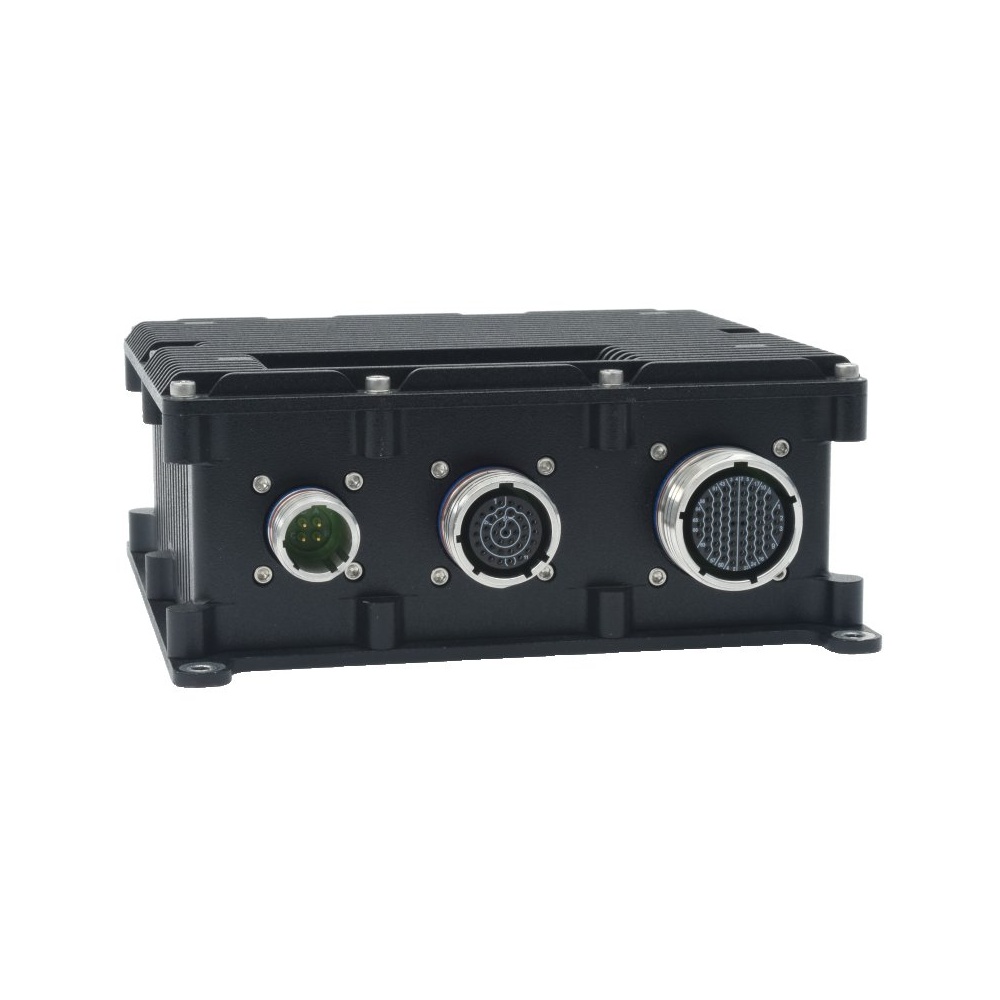
12 Port Gigabit Managed Rugged Switch With Layer 3 Software, MIL-Grade Power Supply, IEEE-1588 PTP and High-Profile Case
- IP Rating
- IP67
- Temp
- −40 to +85 °C
- Power
- 9–60 V DC Input [MIL-STD]
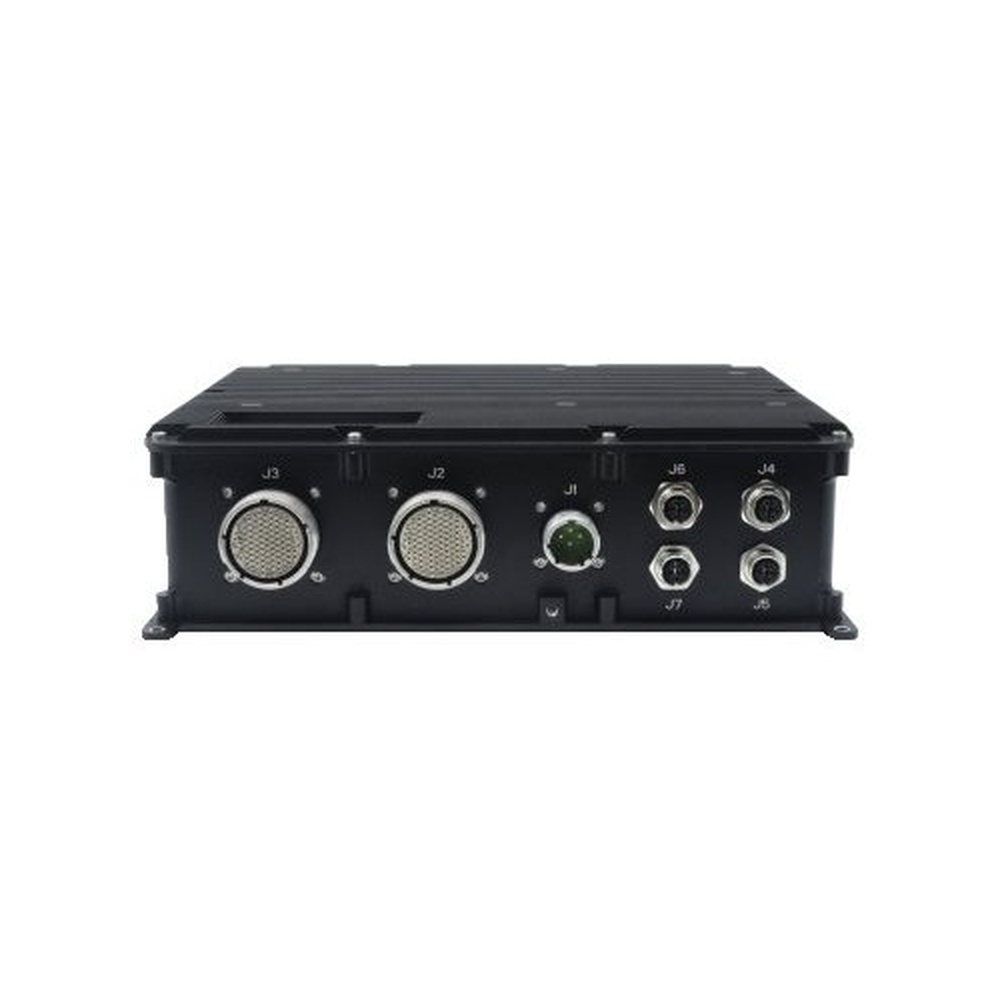
Rugged 24-Port Gigabit Ethernet Switch With 4x 10GbE
- IP Rating
- IP67
- Temp
- −40 to +85 °C
- Power
- 7–40 V DC [MIL-STD]
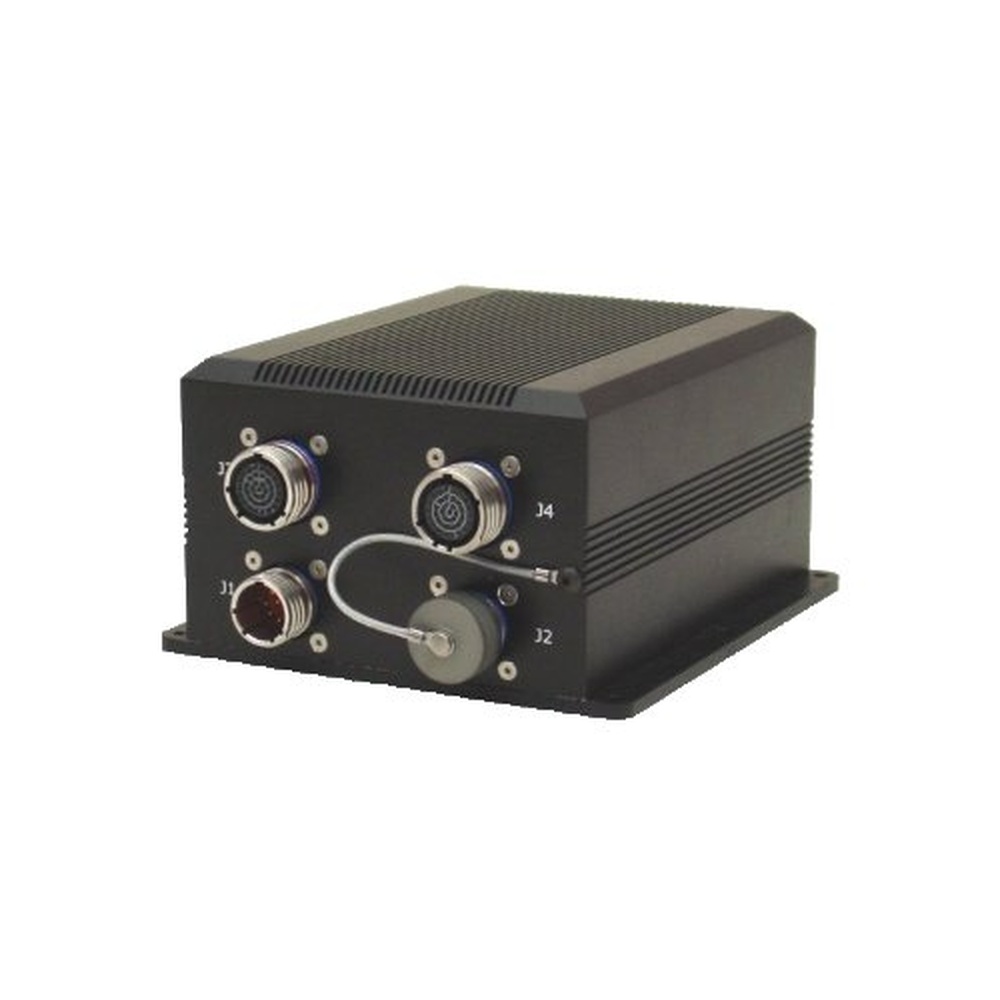
Rugged 8 Port Gigabit Ethernet Switch With Wide Voltage Input and Serial Management Port
- IP Rating
- IP65
- Temp
- −40 to +85 °C
- Power
- 5–32 V DC [MIL-STD]
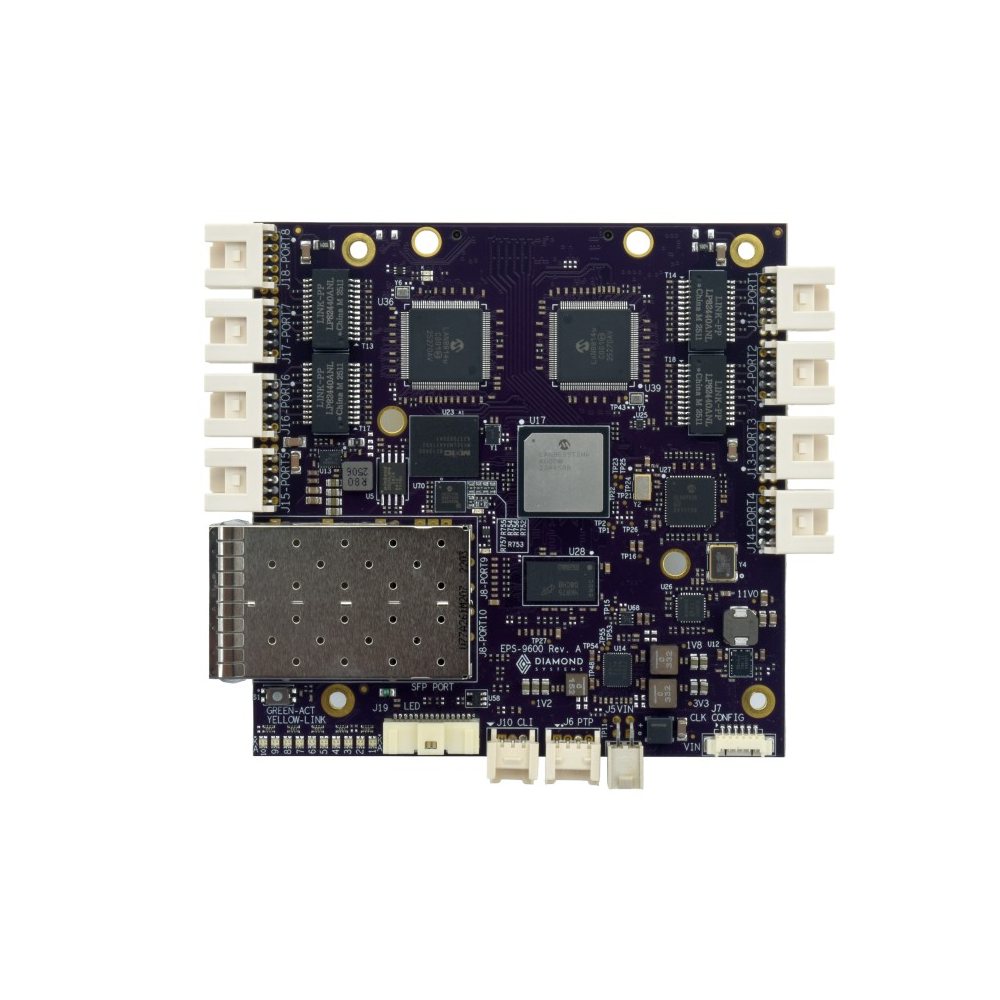
Rugged 8-Port Gigabit + 2-Port 10G SFP+ Managed Layer 3 TSN Switch with Heat Sink
- Temp
- −40 to +85 °C
- Power
- 5–36 V DC [Latching]
Why integrate rather than buy off the shelf?
An integrated build gives an exact fit: the right ports, connectors and power for the platform, rather than the closest catalog match. It brings a single point of accountability for the switch, its power and its enclosure, a build qualified against the standards the program needs, and a supported lifecycle for the years a defense platform stays in service. It is the difference between a switch that happens to fit and one built to belong on the vehicle.
Diamond can also change the connector arrangement, cabling, coatings and software branding on its complete switches, which narrows the gap between a catalog product and a custom design. Where nothing in the range fits, the same board-level switching is the starting point for a custom build.
Defense networking across our range
Switches, computers and displays for military platforms, built to the same family of standards.

Rugged Ethernet switches
Sealed switches with MIL-DTL-38999 or M12 connectors for vehicles and exposed sites.
View range
Ethernet switch modules
Board-level switching for building into a mission system.
View range
Rugged mission computers
Computers built to MIL-STD standards for vehicles and aircraft.
View range
Military monitors
Displays with MIL-STD testing and night vision options.
View range
PC/104 power supplies
MIL-STD power front ends for stacks and switches.
View range
M12 Ethernet switches
IP67 switches with M12 connectors, including PoE builds.
View rangeSpecifying a military Ethernet switch
Agree these with the platform team before choosing a build.
-
01
Ports and speed
How many ports at 1G or 10G, copper or fiber, matched to the cameras, sensors and compute on the platform.
-
02
Switching layer
Layer 2+ or Layer 3, and whether the network needs TSN or IEEE 1588 PTP.
-
03
Platform power
Input voltage and the power standard the supply must meet: MIL-STD-1275, MIL-STD-704 or a DEF STAN.
-
04
EMC
The MIL-STD-461 requirements and limits the program calls up for this platform.
-
05
Environment
Temperature range, IP rating and the MIL-STD-810 methods and levels for shock, vibration and altitude.
-
06
Connectors
MIL-DTL-38999, M12 or another circular standard to suit the harness, and the cable kits needed.
-
07
Form factor
Board-level for integration into an existing chassis, or a complete sealed switch.
-
08
Evidence
Which test reports, certificates of conformity and lifecycle commitments the program needs.
Military Ethernet switches: common questions
Quick answers
What is a military Ethernet switch?
A managed switch built to military environmental, EMC and power standards. It has a sealed, conduction-cooled case, a filtered power front end and MIL-DTL-38999 connectors.
What makes an Ethernet switch military grade?
The standards it is designed and tested to. Usually MIL-STD-810 for environment, MIL-STD-461 for EMC and MIL-STD-1275 or MIL-STD-704 for power.
What MIL-STD standards apply to rugged Ethernet switches?
MIL-STD-810, MIL-STD-461, MIL-STD-1275 and MIL-STD-704 most often. USA programs may call up DEF STAN 00-35, DEF STAN 59-411 and DEF STAN 61-5 Part 6 as well.
What is MIL-STD-1275?
The US standard for 28 V DC power in military ground vehicles. It defines steady-state limits, surges, spikes, ripple and starting disturbances that equipment must tolerate.
What connectors do military switches use?
MIL-DTL-38999 circular connectors. Each carries several Ethernet ports; M12 X-coded and fiber are used for some links.
Do military Ethernet switches support PoE?
Some do, but many do not. The Diamond Systems range does not; rugged M12 PoE switches cover vehicle networks that need it.
Military networking FAQs
-
What Is a Managed Switch?
A managed switch is an Ethernet switch you can configure, through a web interface, command line or SNMP, to set up VLANs, quality of service, redundancy and monitoring. An unmanaged switch is plug-and-play with no settings at all. Managed switches suit networks that are segmented, critical or monitored remotely.
-
What Is MIL-STD-1275?
MIL-STD-1275 defines the 28 V DC electrical power characteristics on military ground vehicles, including the voltage spikes, surges, ripple and starting dips that onboard equipment must tolerate to run reliably from the vehicle supply.
-
What Is MIL-STD-461?
MIL-STD-461 is the US military standard for the electromagnetic compatibility (EMC) of equipment. It sets limits and test methods for how much electromagnetic interference a device may emit, and how much it must tolerate, across both conducted and radiated paths. The current revision is MIL-STD-461G.
-
What Is MIL-STD-704?
MIL-STD-704 defines aircraft electrical power characteristics: the AC and DC voltages, frequencies, transients and abnormal conditions that airborne equipment must operate through on a military aircraft. The current revision is MIL-STD-704F, with test methods in MIL-HDBK-704.
-
What Is MIL-DTL-38999?
MIL-DTL-38999 is the US military specification for high-density, environmentally sealed circular connectors. It defines four series of connector, with bayonet, threaded and breech-lock coupling, used for power, signal and data on aircraft, military vehicles and rugged computers.
-
What Is MIL-STD-810H?
MIL-STD-810H is the current revision of the US Department of Defense standard for environmental engineering and laboratory testing. It describes test methods for temperature, shock, vibration, humidity, altitude, sand, rain and more, and explains how to tailor them to the conditions equipment will meet. It is a test method standard, not a certification, so claims should name the methods used.
-
MIL-STD-810G vs MIL-STD-810H: What Is the Difference?
MIL-STD-810G (2008) and MIL-STD-810H (2019) are successive revisions of the US military environmental test standard. 810H is the current version; it refined and reorganised test methods and tightened guidance, but both define test methods rather than a pass or fail certificate.
Need a military Ethernet switch built to spec?
Tell us the network, the platform and the standards it must meet, and we will help you specify and supply a rugged or military Ethernet switch built to suit, with board-level switching, MIL power and a sealed enclosure.