
 US
US 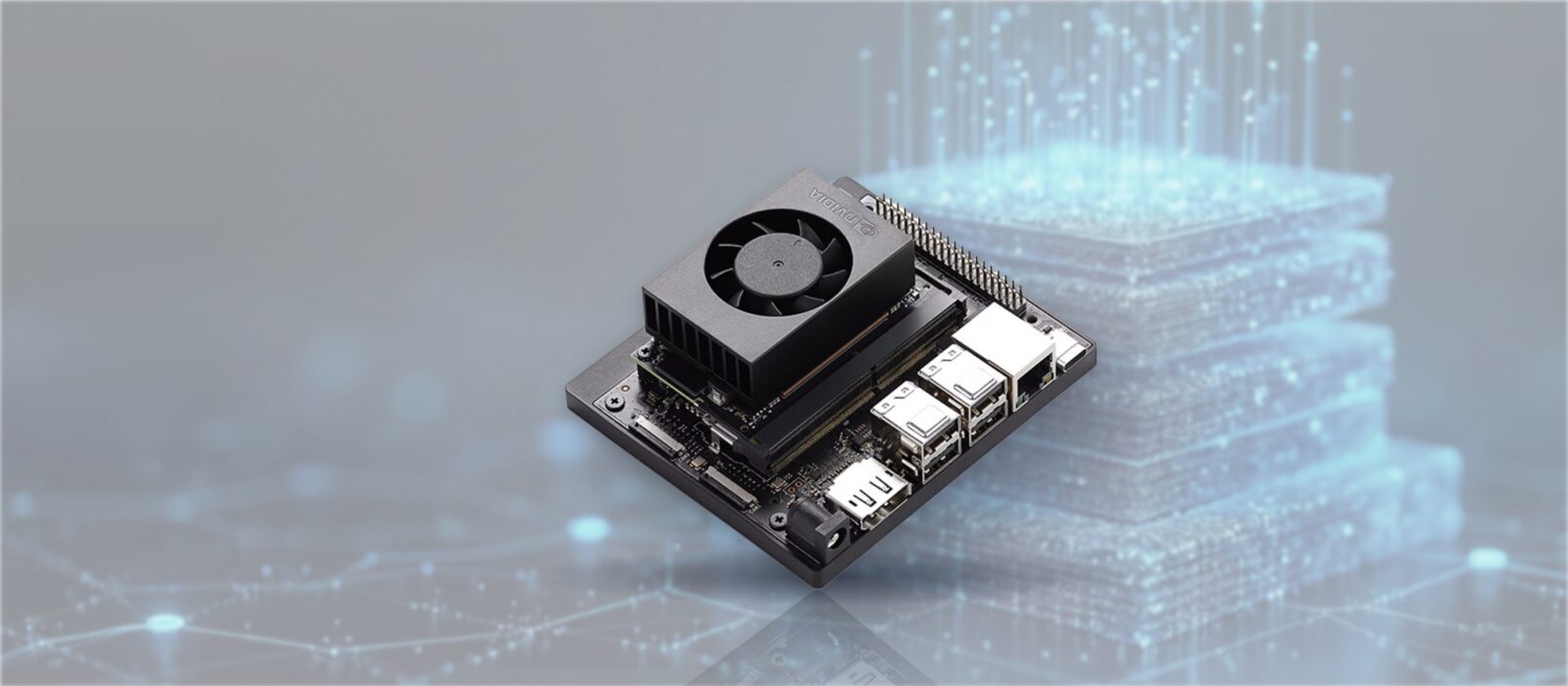
What Is NVIDIA JetPack? The Jetson Software Stack Explained
NVIDIA JetPack is the software development kit that turns Jetson hardware into a working edge AI computer. It bundles the operating system and the GPU-accelerated libraries every Jetson application needs. Here is what is in JetPack, how versioning works, and why it matters for a deployed product.
The Short Answer
NVIDIA JetPack is the software stack for the Jetson platform. It bundles the operating system and the AI, vision, and multimedia libraries an edge application needs, so a Jetson module arrives able to run GPU-accelerated inference rather than as a bare board. JetPack is what turns Jetson silicon into a usable AI computer on the software side, and the same stack runs across the whole Jetson range.
What JetPack Is
A Jetson module is a piece of hardware; JetPack is the software that makes it do anything useful. It is NVIDIA’s development kit for Jetson, combining a Jetson-tuned Linux with the GPU-accelerated libraries that AI and computer-vision applications are built on.
Without JetPack, a Jetson is a board with an unconfigured processor. With it, the GPU, the deep-learning accelerators, and the camera and video hardware are all driven by a supported software stack — the same one NVIDIA uses across its AI platforms, scaled down to the edge.
What Is Inside JetPack
| Component | What it does |
|---|---|
| Linux for Tegra (L4T) | An Ubuntu-based OS and board support package tuned for Jetson |
| CUDA | The GPU parallel-computing platform that everything else builds on |
| cuDNN | GPU-accelerated primitives for deep-learning models |
| TensorRT | An inference engine that optimizes trained models to run fast on the device |
| VPI and multimedia | Accelerated vision, camera, and video processing |
| Developer tools | Profiling, samples, and the SDK Manager for flashing |
The OS and the libraries ship together as one versioned release, which is why JetPack is treated as a single stack rather than a set of parts to assemble.
How JetPack Versioning Works
Each JetPack release bundles a specific Linux for Tegra version, and that pairing matters. A JetPack release supports a particular set of modules and a particular CUDA and TensorRT version, so the JetPack a module is flashed with determines which drivers, libraries, and model formats work on it.
In practice that means two things. A newer module generation needs a JetPack new enough to support it — Orin and Thor are on newer JetPack lines than Xavier ever reached. And an application built against one JetPack does not automatically move to another without revalidation, because the underlying CUDA and TensorRT versions change. A new release can change performance as well as compatibility: the Orin Nano Super update raised the same module from 40 to 67 TOPS through software alone.
Why the GPU Stack Matters
- 01CUDA is the foundation
- Every accelerated library on Jetson runs on CUDA; it is what lets code use the GPU at all.
- 02TensorRT is the speed
- It compiles and optimizes a trained model for the specific Jetson, which is where much of the real-time performance comes from.
- 03One stack, whole range
- The same JetPack libraries run from Orin Nano to Thor, so an application moves across modules without a rewrite.
- 04Maturity
- It is the same CUDA platform used on NVIDIA data-centre GPUs, so tools and models carry over to the edge.
JetPack and Production Deployment
JetPack is built around the developer experience — flash a module, install the SDK, and start building. A product that ships in volume usually needs more than that: a minimal, reproducible, and securable software image rather than a full developer install, often built with a framework such as Yocto on top of the Jetson board support package.
That production step is where deployments stall if it is left late. We take the application validated on JetPack through to a production software build for the module, so what ships is a controlled image rather than a developer kit configuration. Our guide to JetPack and Yocto for production covers that path in detail.
Frequently Asked Questions
-
What Is NVIDIA JetPack?
NVIDIA JetPack is the software development kit for the Jetson platform. It provides the operating system (Linux for Tegra, based on Ubuntu) plus the AI, computer-vision, and multimedia libraries — CUDA, cuDNN, and TensorRT — that let a Jetson run GPU-accelerated AI. The same JetPack runs across the Jetson range.
-
What Is the Difference Between a Jetson Module and a Developer Kit?
A developer kit is a reference carrier board with a module fitted, meant for evaluation and prototyping. A production system uses the bare module on a carrier board designed for your I/O, environment, and lifecycle. The module is the same; the kit is not what you deploy.
-
What Is CUDA?
CUDA is the NVIDIA platform for running general-purpose code on a GPU. It lets software use the thousands of cores in a GPU for parallel work, and it is the foundation that every other NVIDIA accelerated library, including the AI libraries, is built on. CUDA is what allows an application to use the GPU at all.
-
What Is TensorRT?
TensorRT is the NVIDIA inference engine. It takes a trained AI model and optimizes it to run as fast as possible on a specific NVIDIA GPU. Much of the real-time performance of a deployed edge AI application comes from running the model through TensorRT rather than a generic framework.
-
What Is cuDNN?
cuDNN is the NVIDIA library of GPU-accelerated building blocks for deep learning — optimized implementations of operations such as convolutions that neural networks are made of. It sits between CUDA and the AI frameworks.
-
What Is Linux for Tegra (L4T)?
Linux for Tegra, or L4T, is the NVIDIA operating system for the Jetson edge AI platform: an Ubuntu-based Linux plus the board support package — kernel, bootloader, and drivers — that makes Linux run on Jetson hardware. It is the base layer of JetPack.
-
What Is NVIDIA VPI?
VPI, the Vision Programming Interface, is the NVIDIA library for computer-vision and image-processing algorithms. It lets the same vision operations run across different processors — GPU, CPU, and dedicated vision hardware — on NVIDIA platforms.
Need a Configured Jetson Software Image?
Tell us your module and application. As your system integrator we flash and configure the right JetPack image, and take it through to a production software build, so the platform ships ready to run.