
 US
US 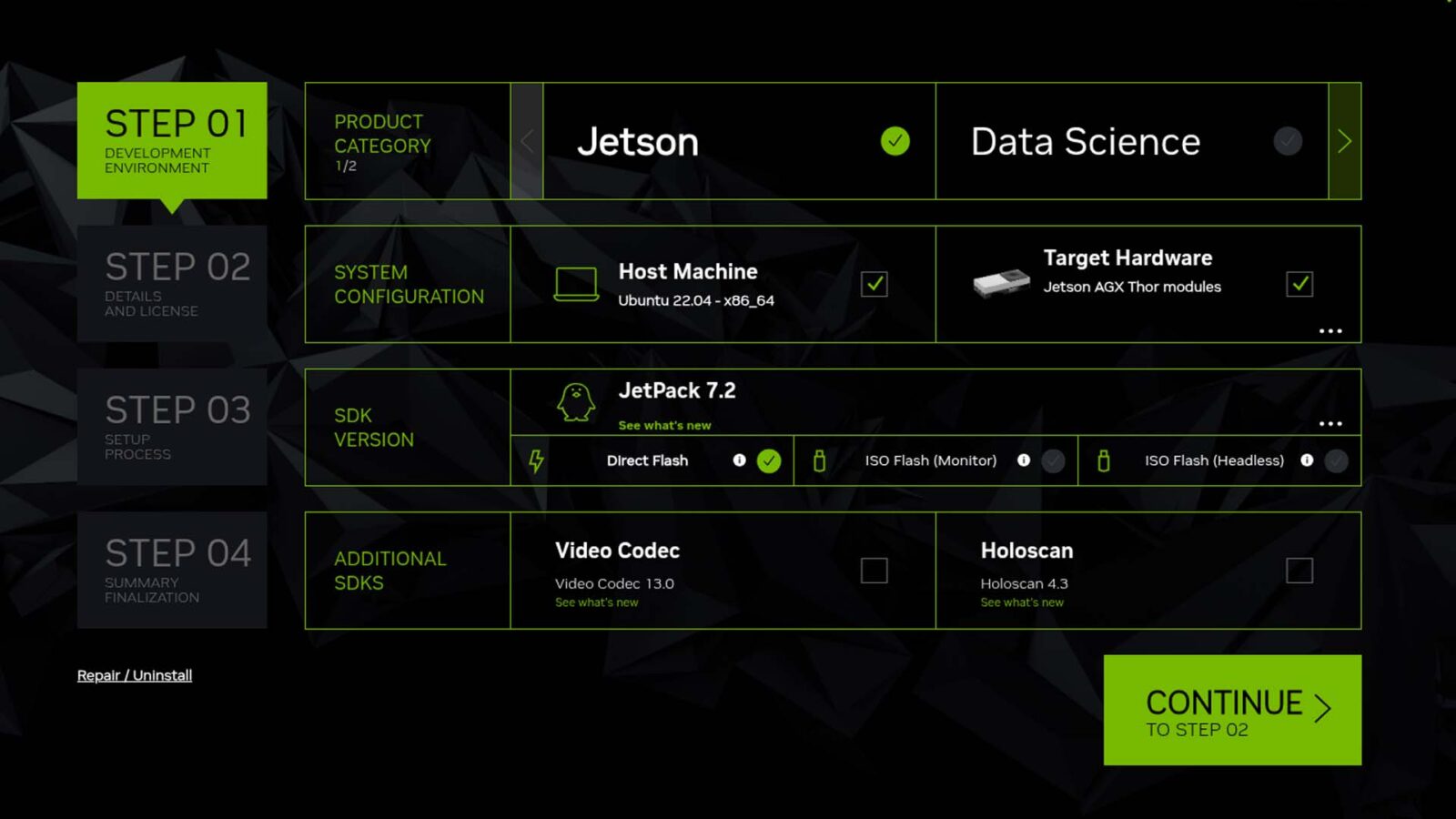
JetPack 7.2 and Yocto on Jetson
JetPack 7.2 brings Jetson AGX Orin and Orin NX onto the same software generation as Jetson Thor, and makes Yocto a supported OS path. A practical look at what it changes for deployed programs.
Why this release matters more than the version number suggests
There was no shortage of AI infrastructure news at GTC Taipei, but one update is worth slowing down for if you build or deploy edge AI: NVIDIA JetPack 7.2 brings full JetPack 7 support to Jetson AGX Orin and Jetson Orin NX.
When JetPack 7 first launched, it was built around the newest Jetson system-on-module, Jetson Thor. The Orin modules stayed on JetPack 6, which is a capable platform but built on Ubuntu 22.04, an OS base now approaching end of life. For programs planning five or more years in the field, that timeline matters.
JetPack 7.2 closes the gap. It brings Jetson AGX Orin, Orin NX, and Orin Nano onto Ubuntu 24.04 with Linux kernel 6.8 and CUDA 13, the same software generation as Jetson Thor. Strip away the version number and what is left is a longer supported life for hardware that is already deployed, and a cleaner story for anything you are about to design. Three changes are worth weighing against your roadmap.
What JetPack 7.2 changes
Whether you are shipping today or designing the next revision, these are the shifts that affect a real program.
-
01
A longer software runway
Moving off Ubuntu 22.04 onto 24.04 buys years of supported life. You no longer have to choose between staying on an ageing OS base or swapping hardware to keep current.
-
02
A unified toolchain
Board Support Packages, workflows, and tooling can align across Orin NX, AGX Orin, and Thor rather than being maintained as separate tracks. For mixed fleets, that consolidation is the practical win.
-
03
A real upgrade path
If you are still evaluating a move off JetPack 5, JetPack 7.2 on Orin is now a credible destination rather than a Thor-only story.
Investment protection, not just a point release
Jetson AGX Orin and Orin NX sit at the centre of a large and growing installed base across robotics, industrial automation, intelligent transportation, and precision agriculture. This is not a minor bump. For programs already shipping, or close to it, JetPack 7.2 is best read as investment protection for the hardware you have already specified.
There is also a performance story on one module. The Jetson AGX Orin 32GB now reaches up to 241 TOPS of AI compute in its Super Mode, around a 20% lift over its original 200 TOPS specification, with a higher GPU clock and power envelope. For vision and multi-model workloads that were previously memory or compute bound, that headroom can be the difference between consolidating onto one box and needing a second.
This is the kind of update we field questions about, because it changes what a deployed system can do without changing the bill of materials. If you are weighing it against your own roadmap, the Jetson Orin range below is where we start most of those conversations.
Yocto Project gets a formal seat at the table
Alongside JetPack 7.2, NVIDIA has given the Yocto Project formal, supported status as an OS strategy for Jetson deployments, with validated recipes and images contributed through the OpenEmbedded for Tegra (OE4T) community. For anyone watching the embedded Linux space, that is a notable signal.
The trade-off between Ubuntu-based JetPack and Yocto has always been real. Ubuntu is the fast on-ramp: CUDA, TensorRT, DeepStream, and Isaac come pre-integrated and ready to go. But Ubuntu images are mutable. Packages drift over time. When you are managing a fleet of 50 or 500 devices in the field, that variability becomes a genuine operational risk.
Yocto answers that with deterministic, image-based builds. Every device in the fleet runs the exact same validated image. The cost has traditionally been the effort to get there: custom BSP work, meta-layer maintenance, and a team with embedded Linux depth to hold it together. For many organizations, that has been a high bar.
NVIDIA formalising Yocto support in the JetPack 7 era is an acknowledgment that production edge AI needs a more controlled software foundation than a general-purpose Linux distribution can provide.
Who is already building this way
The direction of travel is clear from who is adopting it. Names across robotics and field deployment are building custom operating systems on Yocto to get reproducibility, a smaller memory footprint, and tighter control over what ships on each device. Memory efficiency is a recurring theme in this release: several deployments report cutting memory use enough to move to smaller, cheaper modules without losing capability.
That is the practical case for Yocto in one line. It is not about ideological purity over Ubuntu. It is about knowing, with certainty, what is running on every device in a fleet you may not be able to physically reach.
Where the hardware layer fits
A Jetson module handles demanding compute at the edge. A carrier board takes that compute and meets the physical demands of the environment it actually gets deployed into: wide operating temperatures, shock and vibration ratings, sealed enclosures, multi-camera capture over GMSL or FPD-Link, and expansion over M.2, PCIe, and NVMe.
But hardware alone is not enough. A software release only reaches a deployed system through a Board Support Package built for that specific board. The BSP is what makes JetPack 7.2 run correctly, including the camera sensors and imaging pipelines your application depends on. It closes the gap between a supported module and a system that works in the real world.
This is the work we do as your integrator. We are not tied to one carrier-board maker, so we select across the manufacturers serving this market and take on the BSP enablement, validation, and lifecycle support for the build you settle on. The upgrade does not change your hardware, and getting it onto JetPack 7.2 is not something you have to project-manage across a vendor on your own.
How we de-risk the move
A supported module is only the start. These are the points we work through with you so JetPack 7.2 lands as a planned update, not a scramble.
-
01
BSP enablement for 7.2
We confirm a 7.2 BSP for your exact board and its release timing, then handle the enablement so the update reaches your system cleanly rather than stalling on a missing board package.
-
02
Camera and sensor validation
Capture support is the most common thing to slip in a JetPack jump. We validate that your camera sensors and imaging pipelines carry forward intact before anything is committed to a fleet.
-
03
Yocto layer integration
If you are heading toward a Yocto image, we take on the meta-layer integration for the board rather than leaving that work to land on your team.
What this means for your existing program
The reassuring part of JetPack 7.2 is that it does not ask you to change your hardware. The same module, the same carrier board, and the same enclosure can carry an updated software stack and a validated BSP. The work sits in the software layer, not the bill of materials.
In practice, the right first move depends less on the headline features and more on where you sit in the program. It looks quite different for an OEM starting a new design than it does for a team maintaining a fleet already in the field. If the update is also prompting a hardware review, how to size a Jetson module from Nano to Thor walks the current range.
The right move by role
Three common positions, and what each should weigh first.
-
01
OEMs and machine builders
Designing a new product now? JetPack 7.2 on Orin is the sensible target rather than starting on JetPack 6. The longer OS runway and the Yocto option are both easier to design in from the start than to retrofit later.
-
02
Teams with a deployed fleet
The trigger is usually OS support timelines and security maintenance, not the new features. We confirm BSP availability for 7.2 and plan the move as a validated update rather than a rush.
-
03
Weighing Ubuntu against Yocto
Ubuntu remains the fastest route to a working system. Yocto earns its keep at fleet scale where reproducibility, memory footprint, and long-term control justify the up-front engineering. The two are not mutually exclusive across a product line.
The bigger picture
JetPack 7.2, the formal Yocto endorsement, and the growing set of fleet-management and image-build tooling around Jetson all point the same way. The edge AI deployment landscape has matured well beyond prototype configurations. The questions on the table now are about lifecycle, reproducibility, and support over years, which are exactly the questions we spend our time on.
Our priority in this is straightforward. The hardware layer should never be the thing holding a program back. Whichever Jetson module and carrier board you standardize on, we take on the BSP enablement and validation that carries the update, and keep the system supported through its full life.
Planning a JetPack 7.2 or Yocto move?
Whether you are mapping an upgrade path for a deployed Orin fleet or scoping a new build around a Yocto image, our engineers can help you weigh the trade-offs against your hardware, lifecycle, and support requirements.