
 US
US 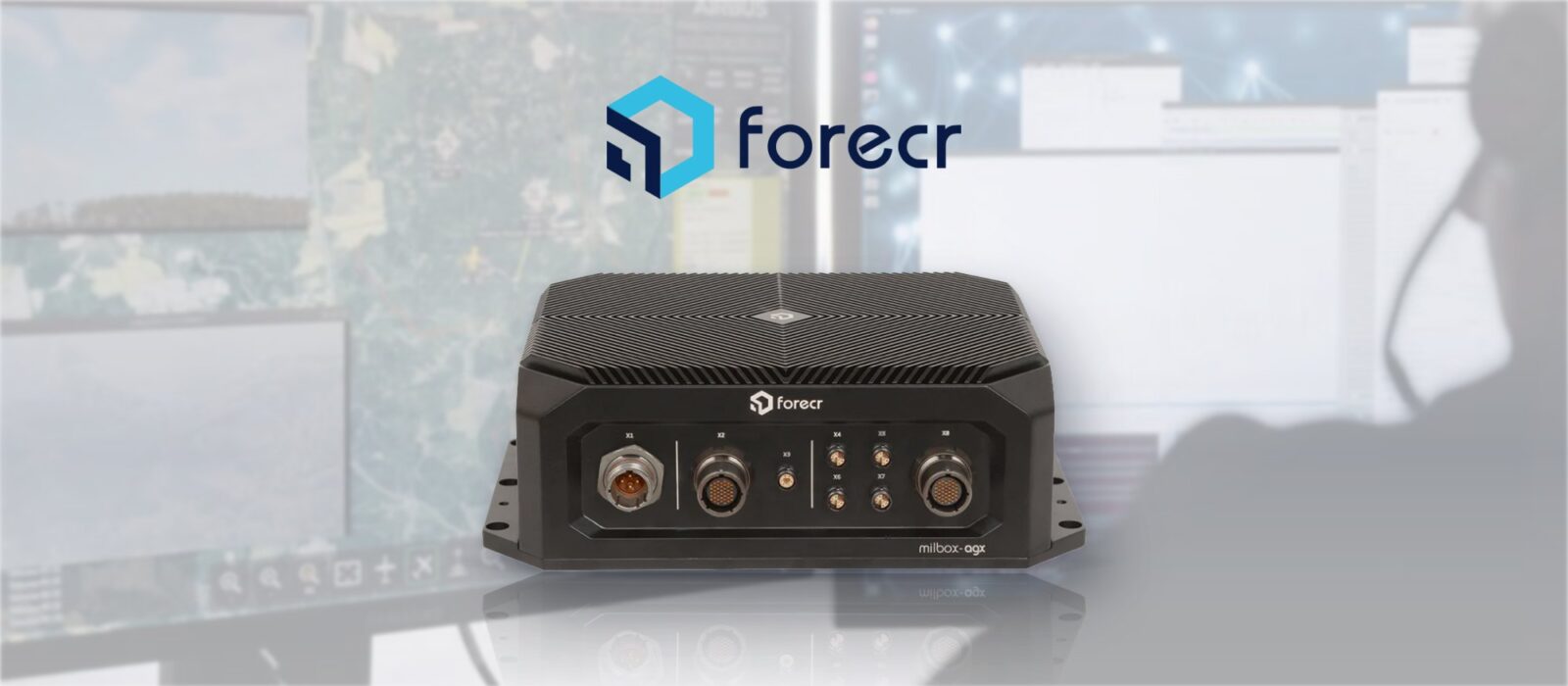
How Airbus Defense and Space runs ISR drone video analytics on a rugged Jetson AGX Orin computer
Airbus Defense and Space needed real-time object detection on live video from fixed-wing ISR drones, in an airframe full of vibration. Forecr supplied its MILBOX‑AGX, a sealed military-grade Jetson AGX Orin computer.
The challenge
Airbus Defense and Space, the defense and space division of Airbus, flies fixed-wing unmanned aerial vehicles on intelligence, surveillance and reconnaissance (ISR) missions. Each sortie streams Full-HD and 4K video, and the value in that feed is what it contains: vehicles, people and objects that need to be found and recognized while the aircraft is still overhead.
Doing that analysis on the ground adds latency and depends on a data link that may be congested, contested or simply out of range. The team wanted detection and recognition on board, so the drone companion computer had to run deep neural networks on live video in real time, inside an airframe that vibrates hard for the whole flight.
Key takeaways
-
Takeaway 01
AI on the aircraft
Running detection and recognition on board removes the ground-station round trip and keeps working when the data link is degraded.
-
Takeaway 02
Ruggedness is a specification
Airborne vibration, temperature and power transients are covered by named standards; check the datasheet quotes MIL-STD-810, 461 and 704.
-
Takeaway 03
Reuse the software stack
Teams already on NVIDIA Jetson move models and DeepStream pipelines across unchanged, cutting development time.
-
Takeaway 04
Size the module to the models
Hardware video engines handle several 4K streams; the AI models usually set the limit, so choose memory and TOPS for the networks.
What decided the build
Two requirements pulled against each other. Real-time detection and recognition on 4K video needs GPU-class AI performance of the kind usually found in a server rack. A fixed-wing ISR drone offers the opposite: constant vibration, wide swings in ambient temperature, a limited power budget and no room for fans or filters. Every gram and every watt in the payload bay is traded against endurance.
That rules out general-purpose industrial hardware. The computer had to be sealed, fanless and designed to military standards for shock, vibration, electromagnetic compatibility and aircraft power, while still delivering enough AI throughput to keep latency low enough for on-the-spot decision support. Our guide to choosing an NVIDIA Jetson companion computer for drones covers the same size, weight and power (SWaP) trade-off for smaller airframes.
Inside an onboard ISR video pipeline
Most onboard ISR video systems follow the same chain, and each stage maps to a dedicated part of the Jetson module, which is why a single computer can keep up with several high-resolution feeds.
-
Capture
SDI · GMSLCameras connect over Ethernet (GigE Vision or RTSP), SDI or GMSL. SDI and GMSL suit long cable runs and low-latency gimbals; our guides to SDI capture for edge AI and GMSL camera links explain the differences.
-
Decode
NVDECCompressed streams are decoded by the hardware NVDEC engine, leaving the GPU free for inference.
-
Inference
GPU · TensorRTDetection and classification networks run on the GPU and deep learning accelerators, optimized with TensorRT.
-
Tracking and metadata
Objects are tracked frame to frame, and their positions and classes become compact metadata that is far cheaper to transmit than raw video.
-
Encode and downlink
NVENCAnnotated video or selected clips are re-encoded by the NVENC engine for the data link, while the metadata goes to the operator’s display straight away.
Video capacity of the AGX Orin
NVIDIA DeepStream ties these stages into one pipeline, which is how Airbus Defense and Space built its video analytics. The hardware video engines set how many streams one Jetson AGX Orin 64GB module can handle.
H.265 streams per module
| H.265 video | Decode · NVDEC | Encode · NVENC |
|---|---|---|
| 8K at 30 fps | 1 | — |
| 4K at 60 fps | 3 | 2 |
| 4K at 30 fps | 7 | 4 |
| Full-HD at 60 fps | 11 | 8 |
| Full-HD at 30 fps | 22 | 16 |
Source: NVIDIA Jetson AGX Orin technical brief. H.264, VP9 and AV1 decode and H.264 and AV1 encode are also supported. — = not supported.
Selecting the platform
Airbus Defense and Space already had extensive experience with NVIDIA Jetson from earlier projects, with development kits across Xavier, Xavier NX, Orin NX and Orin, and its software was built on NVIDIA’s stack. That made a Jetson AGX Orin system the natural choice: existing models and pipelines carry straight across, using DeepStream, TensorRT, CUDA and cuDNN.
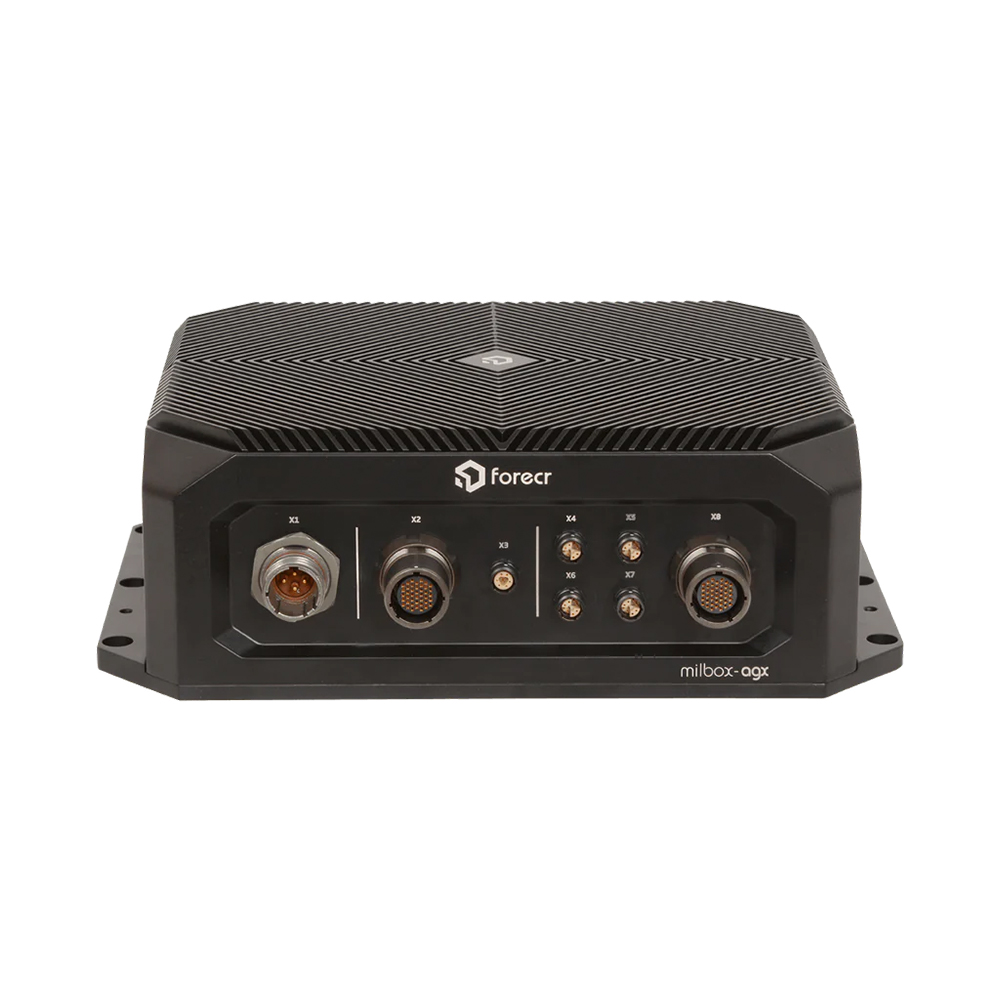
Forecr supplied the MILBOX‑AGX, a rugged Jetson computer built around the AGX Orin module with up to 275 TOPS of AI performance. It is sealed to IP67 with circular military connectors and is designed to the requirements of MIL-STD-810, MIL-STD-461, MIL-STD-1275 and MIL-STD-704. According to Forecr, its ability to deliver against the project’s deadlines was also part of the reason it was selected.
Things Embedded supplies and integrates Forecr’s MILBOX range in the USA, including the MILBOX‑AGX 32GB and MILBOX‑AGX 64GB used in programs like this one.
Why this platform fit
-

Built for airborne vibration
A sealed, fanless chassis designed to MIL-STD-810 keeps the computer stable through the shock and vibration of a fixed-wing ISR drone.
MIL-STD-810 -
GPU-class AI on board
The Jetson AGX Orin module delivers up to 275 TOPS, enough to run detection and recognition on Full-HD and 4K streams in real time.
275 TOPS -
The same NVIDIA stack
DeepStream, TensorRT, CUDA and cuDNN carried straight over from the team’s Jetson development work, which cut development effort.
TensorRT · CUDA -
Power and EMC for aircraft
Designed to the requirements of MIL-STD-704 aircraft power and MIL-STD-461 EMC, so it sits alongside other avionics without interference.
MIL-STD-704 · MIL-STD-461



The military standards that matter
“Military-grade” means little on its own. What matters is which standards a design meets and how each one applies to the platform. For an airborne payload, four carry most of the weight:
| Standard | What it covers | Why it matters on an ISR drone |
|---|---|---|
| MIL-STD-810 | Environmental tests: vibration, shock, temperature, humidity, altitude | Proves the computer holds performance through take-off, flight vibration and landing loads |
| MIL-STD-461 | Electromagnetic emissions and susceptibility | Keeps the computer from interfering with radios and avionics, and from being upset by them |
| MIL-STD-704 | Aircraft electrical power characteristics | Lets it run directly from the aircraft’s DC supply through normal transients |
| MIL-STD-1275 | Military vehicle 28 V DC power | Covers ground vehicles and launch or recovery systems that share the same payload |
Sealing matters too. IP67 keeps out dust and survives temporary immersion, which protects the electronics from rain, condensation and washing between sorties. Our MIL-STD-810G vs 810H comparison explains which revision a datasheet should quote.
What the MILBOX‑AGX brings
The MILBOX‑AGX pairs the AGX Orin module with the I/O a mission system usually needs, so cameras, radios, navigation and legacy equipment connect without adapters.
- Module
- NVIDIA Jetson AGX Orin 32GB or 64GB, up to 275 TOPS
- Memory and storage
- Up to 64GB LPDDR5, 64 GB eMMC, M.2 Key-M NVMe, SD card slot
- Networking
- 4× Gigabit Ethernet
- Field I/O
- 2× CAN bus, 4× RS-232, 4× RS-422
- USB and display
- 1× USB 3.1, 2× USB 2.0, USB serial console, 1× HDMI
- Power
- 12–36 VDC, 28 VDC nominal, MIL-DTL-38999 connector
- Environment
- −25 °C to +70 °C, IP67, fanless
- Standards
- Designed to MIL-STD-810, 461, 1275 and 704
- Software
- Ubuntu with NVIDIA JetPack
Choosing a rugged Jetson computer
Forecr builds the MILBOX family on several Jetson modules, so the same sealed, MIL-STD design approach scales from small drones to large mission systems. The right choice depends on the payload’s power and weight budget, the cameras and the size of the AI models:
| System | Module and AI performance | Video inputs | Power input | Best suited to |
|---|---|---|---|---|
 MILBOX‑ORNX MILBOX‑ORNX |
Jetson Orin NX 16GB, up to 157 TOPS | Optional 4× GMSL2 | 9–40 VDC | Smaller drones and UAVs where weight and power are tight |
 MILBOX‑AGX MILBOX‑AGX |
Jetson AGX Orin 64GB, up to 275 TOPS | Ethernet cameras | 12–36 VDC | Fixed-wing ISR and vehicles running several models per stream |
 MILBOX‑AGX‑SDI MILBOX‑AGX‑SDI |
Jetson AGX Orin 64GB, up to 275 TOPS | 4× SDI (GMSL2 and analog options) | 12–36 VDC | Gimbal and EO/IR cameras with SDI outputs |
 MILBOX‑THR MILBOX‑THR |
Jetson AGX Thor T5000, 128GB | 2× 3G-SDI in (up to 8× GMSL2) | 11–60 VDC | Large models, sensor fusion and 10GbE sensor networks |
For the trade-off between the two Orin modules, see Jetson Orin NX vs AGX Orin, and for the step up to Thor, our Jetson Thor vs AGX Orin white paper.
Specifying an ISR drone computer
-
01
Cameras and interfaces
List every sensor and its output: Ethernet, SDI, GMSL or analog. This decides the variant before anything else.
-
02
Streams and models
Count streams at their resolution and frame rate, then the networks per stream. Memory and TOPS follow from the models, not the cameras.
-
03
Power and weight budget
Confirm the supply voltage and the watts and grams the airframe can spare, including transients covered by MIL-STD-704.
-
04
Environment and standards
Set the temperature range, sealing and the MIL-STD revisions the program requires, and ask for the test evidence.
-
05
Data link and storage
Decide what goes down the link (metadata, clips or full video) and how much must be recorded on board in NVMe.
-
06
Lifecycle and software
Check module availability, the JetPack version your models need, and how images and updates will be managed across the fleet.
The result
-
Outcome 01
Intelligence from live video
Operators receive object detection and recognition results from the drone’s live feed in real time, with the accuracy ISR work demands.
-
Outcome 02
Lower latency
Processing on board removes the round trip to a ground station, giving on-the-spot decision support during the mission.
-
Outcome 03
Stable in a harsh airframe
The MILBOX‑AGX held performance through the vibration and temperature swings of airborne operation.
-
Outcome 04
Delivered on schedule
Forecr met the project’s delivery deadlines, keeping the program on track.
Frequently asked questions
-
What Does ISR Mean in the Military?
In the military, ISR stands for intelligence, surveillance and reconnaissance: the collection, processing and analysis of information about an area or target to support decisions. It is carried out by satellites, aircraft, drones, ships and ground sensors.
-
What Is SWaP-C?
SWaP-C stands for size, weight, power and cost. It is the design trade-off used in defense and aerospace to judge equipment for platforms with tight limits, such as drones and vehicles, where every gram, watt and pound spent reduces endurance, payload or budget.
-
What Is MIL-DTL-38999?
MIL-DTL-38999 is the US military specification for high-density, environmentally sealed circular connectors. It defines four series of connector, with bayonet, threaded and breech-lock coupling, used for power, signal and data on aircraft, military vehicles and rugged computers.
-
What Is an EO/IR Camera?
An EO/IR camera combines electro-optical (visible light) and infrared (thermal) imaging in one stabilized payload, so an operator can see by day and at night. EO/IR gimbals are standard on ISR drones, patrol aircraft, border security and maritime systems.
-
What Is a Drone Companion Computer?
A drone companion computer is a small AI computer that runs alongside the flight controller on a UAV. The flight controller flies the aircraft; the companion computer does the thinking — running computer vision and AI to give the drone autonomy such as obstacle avoidance, navigation, and object detection. NVIDIA Jetson is the common choice because it delivers high AI performance at a weight light enough to fly.
-
MIL-STD-810G vs MIL-STD-810H: What Is the Difference?
MIL-STD-810G (2008) and MIL-STD-810H (2019) are successive revisions of the US military environmental test standard. 810H is the current version; it refined and reorganised test methods and tightened guidance, but both define test methods rather than a pass or fail certificate.
Planning an airborne AI payload?
Tell us the sensors, the video resolution and the platform, and we’ll recommend a rugged Jetson computer that fits the payload, power and certification you need.