
 US
US 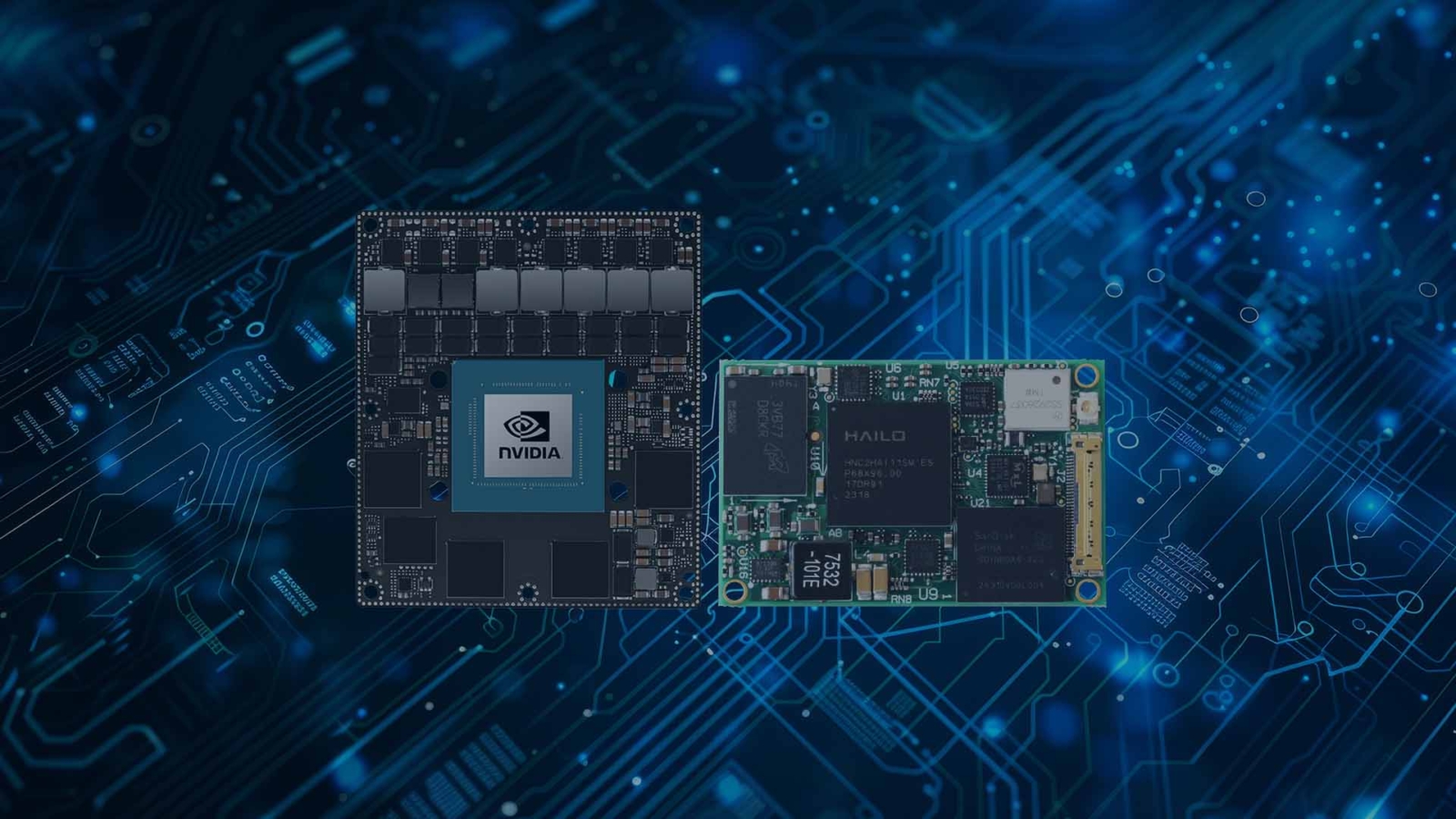
What Is a System-on-Module (SoM)?
A system-on-module puts the processor, memory and storage on one small board that plugs into a carrier. Here is what that buys you, how a SoM differs from a single board computer, and which module standards are worth knowing before you commit a design.
The Short Answer
A system-on-module (SoM) is a complete computing core, with the processor, memory, storage and power management built onto one small board, that plugs into a second board called a carrier. The carrier supplies the connectors, expansion slots, sensor interfaces and mechanical fit that the product needs; the module supplies the compute. Separating the two lets a product keep its carrier design while the module underneath is upgraded, replaced or scaled.
The same idea goes by several names. PICMG calls it a computer-on-module (CoM), which is where the COM Express and COM-HPC standards get their names. NVIDIA calls its Jetson products modules, and the boards they plug into Jetson carrier boards. Raspberry Pi calls its version a compute module. In every case the principle is identical: the hard, high-speed, short-lifecycle engineering lives on the module, and the application-specific engineering lives on the carrier.
Key Takeaways
- 01A SoM is the compute, a carrier is the product
- The module carries CPU, memory, storage and power sequencing. The carrier carries everything the application can see: Ethernet, USB, cameras, CAN, display, expansion and the connector types the enclosure needs.
- 02Standards decide what you can swap
- COM Express, COM-HPC, SMARC, Qseven and OSM each define a connector, a footprint and a pinout, so a module from one vendor can drop onto a carrier designed to the same standard. NVIDIA Jetson is a proprietary SoM with its own connector per generation.
- 03Lifecycle is the main reason to choose one
- When a processor reaches end of life, a module-based design swaps the module and keeps the carrier. That is how industrial products stay in production for a decade or more without a board respin.
- 04A single board computer is the alternative
- An SBC has the processor fitted to the same board as the I/O. It is simpler and often cheaper for one fixed configuration; it costs a redesign when the processor changes.
- 05You still need a working system
- A module and a carrier are parts. Someone has to select them, fit them, image the operating system, validate thermals and I/O, and support the result. That is the work Things Embedded does as standard.
What Is on the Module and What Is on the Carrier
The split is consistent across every standard. The module carries the parts that are hardest to lay out and that change most often: the processor or system-on-chip, DRAM (usually soldered), boot storage such as eMMC or NVMe, the power sequencing the processor demands, and often the Wi-Fi or trusted platform module. High-speed signals such as PCIe, USB 3, display and Ethernet are routed to the module connector but not to any physical port.
The carrier board turns those signals into a product. It decides which of the available PCIe lanes become an M.2 slot, a MiniCard socket or a 10 GbE controller; which USB lines reach a locking connector on the front panel; whether the display output is HDMI, DisplayPort or an embedded panel; and what the board looks like mechanically. It also carries the parts the module does not: the DC input stage and any wide-range or isolated power, serial ports, CAN bus, digital and analog I/O, camera connectors, ignition control and the mounting holes that match the enclosure.
That is why two products on the same module can look nothing alike. A Jetson Orin NX on a 3.5-inch industrial carrier with dual Gigabit Ethernet and CAN is a machine controller; the same module on a carrier with four GMSL camera inputs is a perception computer. The compute is identical, the carrier is the difference.
SoM, CoM and SBC: What the Terms Mean
The vocabulary overlaps, so it helps to pin it down. System-on-module and computer-on-module mean the same thing; SoM is the generic term and CoM is the PICMG term used by the COM Express and COM-HPC standards. A system-on-chip (SoC) is the silicon itself, the single package that holds the CPU cores, graphics and I/O controllers, and is what sits at the centre of the module. A single board computer (SBC) is a complete computer on one board, with the processor, memory and all the I/O connectors together, and no module to remove.
| Term | What it is | What you buy | Typical use |
|---|---|---|---|
| SoC | The processor package: CPU, GPU, I/O controllers on one die or substrate | A chip, by a board designer | Inside every module and SBC |
| SoM / CoM | SoC plus memory, storage and power on a small board with a defined connector | A module, to fit a carrier | Products that need a custom I/O set or a long life |
| Carrier board | The application board the module plugs into; supplies I/O, power input and mechanics | Off-the-shelf, adapted or custom | Paired with a module |
| SBC | Processor and I/O on one board, no module | A finished board | Fixed configurations, standard form factors |
There is a grey area worth knowing. Several rugged board makers sell a carrier with the module already fitted and call the result a COM-based SBC. Functionally it is used like an SBC, but because the module can be changed it keeps the lifecycle advantage of a modular design. Our COM Express carrier boards are sold both ways: bare, for customers fitting their own module, and preassembled with the Intel module, heat spreader and storage in place.
For more on the chip at the centre of every module, how a system-on-chip combines CPU, graphics and I/O on one die explains the trade-offs against a discrete design.
Module Standards at a Glance
- 01COM Express (PICMG)
- The most widely used x86 standard. Basic (125 × 95 mm), Compact (95 × 95 mm) and Mini (84 × 55 mm) sizes; pinout Types define the I/O mix. Type 6 is the general-purpose choice with PCIe, USB 3 and digital display; Type 10 is the single-connector Mini variant for low-power Atom-class parts; Type 7 drops graphics for 10 GbE in headless server designs.
- 02COM-HPC (PICMG)
- The newer, higher-bandwidth sibling of COM Express, with up to 800 pins across two connectors, PCIe Gen 4 and 5, and 25 GbE and above. Client sizes suit demanding embedded workstations; Server sizes take high core-count processors and large memory. Not a replacement for COM Express, which continues alongside it.
- 03SMARC (SGET)
- A 314-pin edge-connector standard at 82 × 50 mm or 82 × 80 mm, aimed at low-power Arm and x86 processors. Common in HMI, medical and portable equipment where power and size matter more than PCIe lane count.
- 04Qseven (SGET)
- A 230-pin edge connector at 70 × 70 mm, one of the earliest small-module standards. Still in service for long-life products, though newer designs tend to start on SMARC or OSM.
- 05OSM (SGET)
- Open Standard Module: solder-down LGA modules from 30 × 15 mm to 45 × 45 mm with no connector at all, for high-volume, cost-sensitive products where the module is placed like a component.
- 06NVIDIA Jetson
- A proprietary SoM family for edge AI. Orin Nano and Orin NX use a 260-pin SO-DIMM-style edge connector; AGX Orin and AGX Thor use a board-to-board connector and a higher power budget. Each generation defines its own carrier, so a Thor design needs a Thor carrier board rather than an Orin one.
Why Design Around a Module
The strongest reason is lifecycle. Embedded processors are typically available for seven to fifteen years, but the products built on them often have to be supported for longer, and the requirement to add performance usually arrives well before the end of that window. With a module-based design the carrier, the enclosure, the cabling and the certification evidence stay as they are; the module is swapped for a newer one on the same connector and the software is revalidated. Rugged board makers have kept products in production for well over a decade this way.
The second reason is scalability. Most standards allow a range of modules on one carrier, from a low-power part to a high-performance one, so a single product design can be offered at several price and performance points. A Type 6 carrier might ship with an Intel Atom module for a basic configuration and a Core or Xeon module for the high-end one; a Jetson carrier designed for Orin NX also takes Orin Nano.
The third is time and risk. Laying out DDR5 memory and PCIe Gen 4 to a modern processor is exacting, multilayer work with a long validation cycle. Buying that as a finished, tested module lets the product team spend its engineering time on the carrier, which is comparatively simple, and lets a custom carrier be turned around in months rather than the year a full board design can take.
Finally there is the supply argument. Because the module is a standard part with several sources, a carrier designed to COM Express or SMARC is not tied to one vendor’s roadmap. Jetson is the exception here: it is single-source, and buyers accept that for the AI performance and software stack it brings.
When a Single Board Computer Is the Better Choice
A module is not automatically the right answer. If the product has one fixed configuration, a standard form factor such as Mini-ITX or 3.5-inch already fits the enclosure, and the lifecycle requirement is covered by the board maker’s own long-life program, then a single board computer is simpler to buy, simpler to cool and usually cheaper at the volumes most industrial products run at. There is no connector between the processor and the I/O, which also removes one source of vibration-related faults.
The trade-off is what happens when the processor changes or the I/O has to. On an SBC that is a new board. Teams that expect either to happen inside the product’s life, or that need an I/O set no standard board offers, are the ones a module-based design pays back.
How to Choose: Four Questions
Environment. Where does it run and how is it powered? Wide-temperature operation, conformal coating, shock and vibration, and a vehicle or MIL-STD power input all belong on the carrier and the module has to be rated to match. Latching connectors and a heat spreader that mates to the enclosure matter more in a vehicle than in a cabinet.
Performance. Is the workload general-purpose x86, or AI inference? An Intel Core or Xeon module on a Type 6 carrier suits control, data acquisition and machine vision with conventional software; a Jetson carrier board and module suits neural-network inference on camera and sensor data. Memory, storage and the number of PCIe lanes available to the carrier follow from that choice.
Expansion. Which interfaces does the product need on day one, and which might it need later? PC/104 and PCIe/104 stacking, MiniCard and M.2 sockets, camera inputs and isolated I/O are carrier decisions. A carrier with a spare expansion socket is often what turns a two-year product into a ten-year one.
Lifecycle. How long must it be supportable, and who supports it? Ask for the module and carrier availability commitments in writing, confirm that a newer module on the same standard is on the roadmap, and plan the software so a module swap is a revalidation rather than a rewrite.
From Module to Deployed System
A module and a carrier are parts, and a parts list is not a product. Things Embedded supplies Jetson and COM Express carrier boards as working platforms: we recommend the module and carrier to start from, fit and image them, validate thermals and I/O in the target enclosure, and support the result through its life. Where no standard carrier fits the requirement, we design a custom one; a fanless GPU computer built on a custom Jetson carrier board is a recent example.
If you are weighing up the two x86 standards, our comparison of COM-HPC and COM Express sets out where each one fits. If the workload is edge AI, start with our guide to choosing a Jetson carrier board, and note that Jetson Thor needs its own Thor carrier board rather than an Orin one.
Frequently Asked Questions
-
Does Jetson Thor Need a New Carrier Board?
Yes. Jetson Thor uses a different connector, higher power (up to 130 W), and new I/O compared with AGX Orin, so it needs a carrier board designed for Thor rather than an Orin board. Moving from AGX Orin to Thor is a platform change, not a drop-in module swap.
Designing Around a Module?
Tell us the application, the environment it runs in and how long it has to stay in production. As your system integrator we will recommend the module and carrier board to start from, or design a custom carrier, and deliver it as a validated system.